Celebrating 50 years of the Friendship Centre

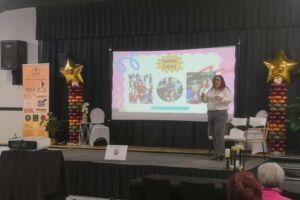
Community members, organizers, and guests gather for the 50th anniversary of the Native Friendship Centre of Montreal showcasing traditional dancing, cultural celebration and community. Courtesy Raven Katsit’siio Edwards Brown
Fifty years ago, the Native Friendship Centre of Montreal (NFCM) opened its doors as a safe haven for Indigenous people living in the city, a space to gather, share stories, access essential services, and stay connected to culture.
Half a century later, the centre remains a gathering space of urban Indigenous life in Montreal. To mark this historic milestone, the NFCM unveiled a powerful new art installation: a glass wampum belt spanning its front windows welcoming visitors as they enter the building.
Designed and created by the community, for the community, this wampum is a vibrant symbol of unity, resilience, and cultural continuity, a glowing testament to the relationships and responsibilities that have shaped the Centre’s journey since 1974.
“Wampum represents agreement, responsibility, and long-term relationship,” said Ashanti Rosado, director of Programs and Services at NFCM. “That aligns with what the centre has always stood for over these 50 years, a place of belonging and accountability to the community.”
The new installation was conceptualized and led by artistic director and project management support Carling Sioui, who worked closely with community members, staff, MAC museum partners along with Danielle Hum from Studio du Verre in Montreal to bring the piece to life.
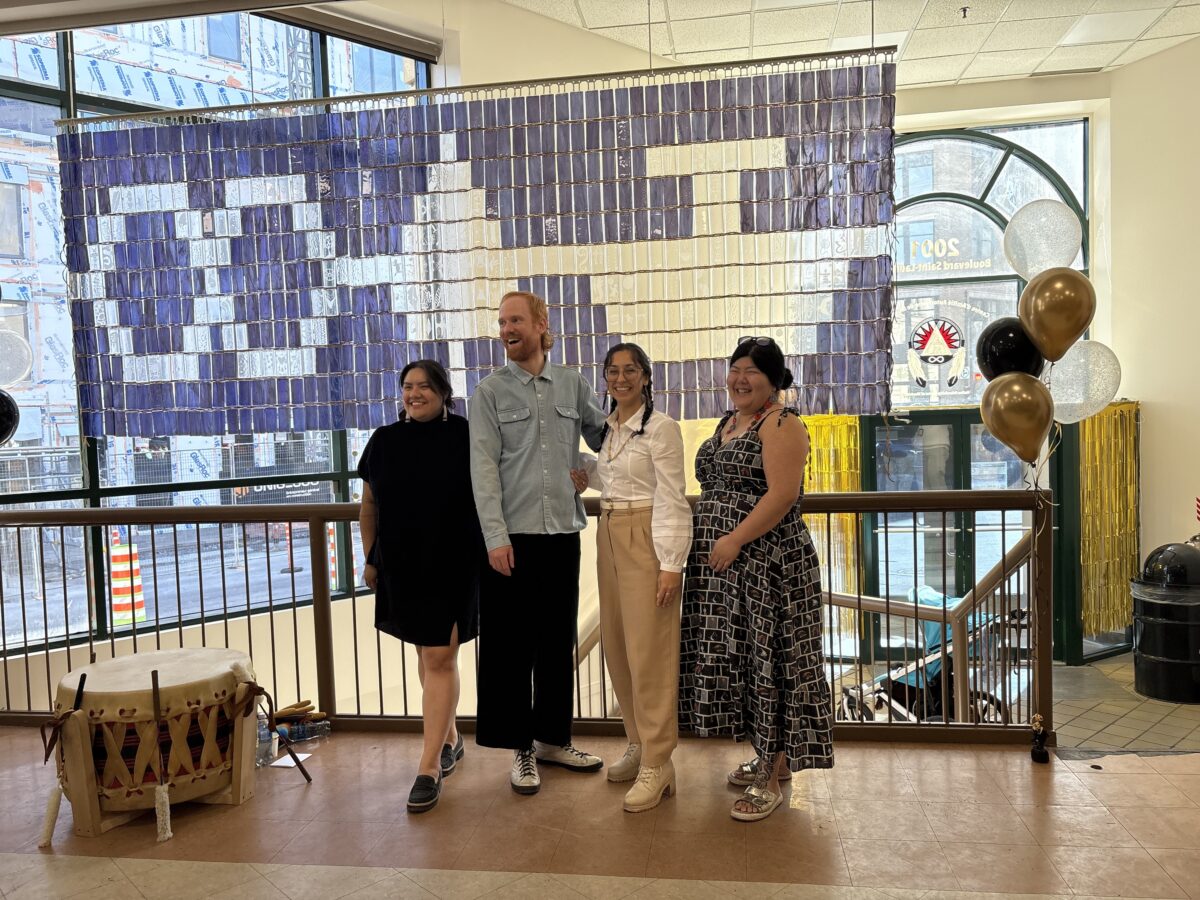
Group photo of organizers, from left to right, director of development of the Native Friendship Centre, MAC museum representative Vincent Briere, Carling Sioui artistic director, and Danielle Hum the creator of the glass wampum pieces from Studio Du Verre in Montreal. Courtesy Raven Katsit’siio Edwards Brown
Drawing from the traditional symbolism of wampum belts, which have long been used by Indigenous nations and traditionally created by women as treaty records and shared values, the glass version reimagines the form for today.
“A wampum in and of itself is a contract of friendship, especially this one, it’s the Friendship Wampum,” said Sioui. “So, having people participate in this including the workers, the members, the allies, it really gave us an even stronger sense of community. I think it gave everyone a stronger sense of belonging, because they were part of something huge for the centre. Physically huge, but also spiritually.”

Each “bead” in the installation began as a hand-drawn image submitted by a community member. These drawings were then digitized and transformed into colourful panels of glass.
“Our community did not just witness the creation, they helped build it,” said Rosado. “Each image reflects a voice, a story, a presence.”
Sioui described the wampum as both a spiritual and artistic journey.
“You don’t have to be an expert to create a wampum, it’s a spiritual practice,” she said. “As long as you understand the intention, you can create one. I’m so grateful because it rooted me in my own ancestry, and the ancestors protected and guided us the whole time.”
Materials were sourced with care and connection. When it came time to find deer hide to complete the piece, Sioui turned to Wolf’s Den, a trusted supplier and community partner in Kahnawake.
“When it came to hide, Wolf’s Den is my go-to for everything. They are good community members, and they were also very open to our project. So, we came to them, we showed them the project, and they’re the ones who brought us the hide,” Carling said.
“They didn’t just provide the materials; they even showed us how to weave it. Their participation helped deepen that connection to Kahnawake.”
The anniversary was more than a celebration, it was a reunion, a reflection, and a reminder of the centre’s deep impact. For many, like workshop facilitator Ashley Foster, participating in the project was deeply personal.

“It felt really special, especially being a part of the wampum belt and seeing my little drawing up there. I made a dreamcatcher, and it was placed right beside my partner’s drawing,” she shared. “That makes it even more meaningful, your kind of etched in this forever.”
Foster also led a dreamcatcher workshop as part of the 50th anniversary events, creating space for hands-on cultural sharing.
“We used the metal rings; we did small dreamcatchers and then we used sinew and just different feathers. There were all different kinds of feathers,” she said. “It was nice to have that one-on-one time with community members while they were making something meaningful,” she said. “Everything just flowed, it was busy, but the Centre looked absolutely gorgeous.”
Delores LaPratt, Cultural Programming coordinator, reflected on the collaborative nature of the project and the emotion it stirred.
“It’s beautiful. Even my daughter participated, and I made two: one that looks like a Red River cartwheel, and a floral design for the Metis infinity symbol,” she said. “That’s what the Friendship Centre is, a meeting place.”
The unveiling ceremony was attended by Elders, artists, families, youth, and longtime friends of the centre. Kahienes Sky, an elder and women councillor at NFCM, shared a reflection that brought many to tears.
“This wampum is a true testament to change not just here at the Native Friendship Centre, but across all our lands,” she said. “This place is a home away from home. A place to feel love and acceptance. This place exists for you, so you can come here and feel safe. It’s a place to come, to share food, to talk with people, and to feel heard.”
Sioui added “Some people told me that when they walked in, they felt good energy and good medicine, and that’s exactly what I want.”
Sign up for email updates from The Eastern Door
Sky emphasized how rare and necessary it is to feel spiritually held in an urban space.
“That centre tree, it really is that white pine, the Tree of Peace,” she said. “And that Tree of Peace is the central fire. The central fire is right here.”
For a centre that began in 1974 with a mission to provide culturally appropriate services to Indigenous people living in Montreal, this moment was about more than longevity. It was a chance to affirm with art, presence, and love that Indigenous cultures thrive here.
“Celebrating the 50th anniversary and witnessing this installation come to life reinforced the importance of holding that responsibility with care,” said Rosado. “I’ve seen the centre evolve, and this moment felt like a strong step forward.”
The Friendship Wampum now hangs in full view of the street, right at the entrance, a visual invitation to all who pass by.
“What stood out to me most was the happiness in the building. Seeing longtime service users standing alongside new community members and youth all in one space was very meaningful,” she said. “I want people to see themselves reflected in the space, and to feel that their presence matters.”