Border advice issued

Indigenous leadership is cautioning community members to be well prepared when travelling to the US following increased activity by Immigration and Customs Enforcement (ICE) agents, who, like Customs and Border Protection (CBP), work under the umbrella of the Department of Homeland Security. File Photo
The Mohawk Council of Kahnawake (MCK) is urging Kahnawa’kehró:non to be as prepared as possible when crossing the United States border, in light of growing tensions related to the actions of US Immigration and Customs Enforcement (ICE) agents.
At least one First Nations man is said to have been detained and had his Certificate of Indian Status seized in the area of Rainy River (Treaty 3 territory), where the Canada-US border separates northern Minnesota and Ontario.
Last month, ICE agents also fatally shot two American citizens during encounters in Minnesota: Renee Good, who had reportedly been acting as a legal observer of ICE activity at the time, and Alex Pretti, an intensive care unit (ICU) nurse, who had also been protesting against ICE actions.
This week, the MCK put out a press release to inform community members about how to prepare for crossing the border, should they be intending to travel to the United States, stating that “recent rising issues south of the medicine line have highlighted the importance of understanding your rights as Onkwehón:we.”

The advice mirrors that of the Jay Treaty Border Alliance, which is co-chaired by MCK grand chief Diabo.
Community members born in Canada are classified as Jay Treaty entrants, and have lawful status to live and work in the United States under Section 289 of the Immigration and Nationality Act.
The press release advises these individuals to bring a letter from the MCK confirming at least 50 percent blood quantum - this letter can be ordered by calling Client Based Services (CBS) at 450-638-0500 and picked up at the CBS offices located in the Kahnawake Services Complex.
Individuals should also bring their Secure Certificate of Indian Status card or the older Indian and Northern Affairs Canada card with a red stripe. They should also bring a copy of their birth certificate and any government-issued photo ID, such as a driver’s licence.

For those born in the United States, proof of citizenship should be brought to the border, including a valid tribal ID, a state-issued ID or driver’s license, and a United States passport.
MCK chief Iohahi:io Delisle, who is a portfolio chief on the lands and territories file, emphasized that carrying the necessary documentation is important to ensure that community members can exercise their right to safely cross the border.
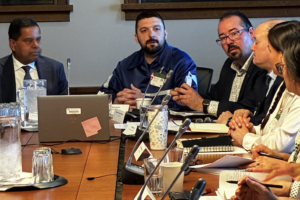
He said that MCK grand chief Cody Diabo is working to set up meetings with stakeholders to discuss the community’s concerns about safe border crossings during the political unrest in the United States.
“Unfortunately, what they don’t really realize is that the Kanien’kehá:ka, the Iroquois Confederacy, have always occupied these territorial lands, and there’s no border for us, there never was, and we continue to maintain that perceptual knowledge and outlook,” he said.
Sign up for email updates from The Eastern Door
“We’re not going to give that up, that’s non-negotiable, so we’re definitely going to fight and assert ourselves when it comes to any mechanisms or governments that attempt to undermine our inherent rights to travel across our ancestral lands.”