‘The Knowing’ directors recognized

When Tanya Talaga and Courtney Montour learned that Playback, a Canadian television industry magazine, would be recognizing them as TV directors of the year for their docuseries The Knowing, based on Talaga’s book, they were both surprised and honoured.
“It was incredible to receive that news, especially from Playback, which is a really important industry resource,” said Montour. “To know that the industry is taking notice in the work that we’re putting out there like The Knowing, which is such an important and personal project, such a personal project for Tanya on residential school and her own family’s experience, that really stood out.”
Talaga, for her part, said that as someone who has not done much directing, it gave her confidence she was on the right path.
“I was totally stunned. It was so nice to see an industry magazine recognize both Courtney and me for the work we did on The Knowing,” said Talaga, who is a member of Fort William First Nation.
“Courtney is a well-known director. She’s super intelligent and has been working in the field for several years. I’m a journalist and a writer; I’ve never been to school for directing. I’m a storyteller. I own a media company, and we produce films, but directing is a whole other ball game, and I feel like I’ve been learning as I go. So, it feels great to be recognized.”

The pair were featured in Playback in the Winter 2024 issue, where editor Kelly Townsend spoke to the two about the process of getting Talaga’s book to the screen.
“I think we felt strongly that it was such a culturally important piece out of Canada this year,” said Townsend on the decision to recognize the docuseries.
Each year in its Winter issue, Townsend explained, Playback recognizes people, shows, production companies, and others in the industry that they feel deserve to be recognized. While not awards with fixed categories per se, Townsend said that the magazine tends to usually focus on the business part of the industry.
“We tend to focus on the business aspect of things, how well things sold, did they make a profit, their ratings, things like that. However, in the case of The Knowing, this was a situation where we felt culturally, the documentary was an important piece,” said Townsend.
“I will say this is not me speaking as the editor of Playback, but more as a citizen of Canada: I really feel like The Knowing is such an essential read for Canadians to really get the context as to how residential schools happened and the bureaucratic processes behind them,” Townsend said.


“Some of the numbers of our residential schools are just so massive. And I think Tanya’s ability to put a face to some of those numbers, I think that really puts it into a different context and perspective for Canadians. So, it feels like a very important read for me.”
Montour said that the recognition by Playback is part of a greater recognition of the docuseries across Canada, in the months following its release by CBC.
“I think it’s really important that the work is resonating across Canada, and not only with our own communities. Our communities are who we made the series for, and we collaborated with our communities while we’re doing the work. But it is really important that Canada is able to take in these stories and sit with them,” said Montour.
Talaga reinforced the idea of community collaboration and made sure to return to the communities featured in the docuseries to present it to them.
“It’s been amazing, because we sit down with survivors, we show them The Knowing and, put together, it’s four hours of television. We usually just watched the first two episodes, but in some instances, the survivors said, ‘no, we want to keep going.’ So, our events turned into these four or five-hour gatherings,” said Talaga.
Sign up for email updates from The Eastern Door
“It’s really a community endeavour. I never want to be a story taker. Some people use that phrase to describe journalism in Indigenous communities, when people go in and out. But that’s not our way. We form relationships with people and then once you get to know people, we don’t just run away with their story and say thank you very much. We have that commitment of going back to community and giving back, and that’s part of how we do that.”
Other ways Talaga’s production company Makwa has given back is the Spirit to Soar Fund, set up in Thunder Bay to help provide Indigenous youth in the region with the resources they need to stay safe during their transition to the urban centre.
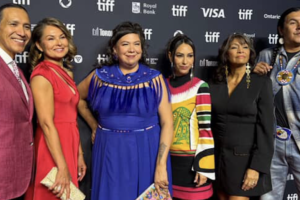
When the docuseries was presented at the Toronto Internation Film Festival in September, many of the people featured in the film went to see the presentation.
“It turned out to be a giant celebration. And that’s what filmmaking, to me, is about. It’s about our communities and sharing our stories in a good and responsible way. The work that I do at Makwa Creative, my production company, and through my books and my writing, I try and do that every single time,” said Talaga.