Support and hurdles for Jordan’s Principle

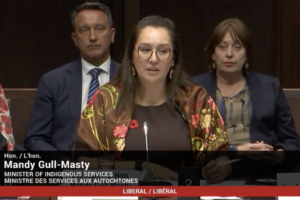
Indigenous Services Canada (ISC) Mandy Gull-Masty announces the renewal of funding to Jordan’s Principle on February 26, 2026. Courtesy Indigenous Services Canada
Ottawa has said its commitment of $1.55 billion to extend Jordan’s Principle will bring stability to families, but according to a Kanesatake Health Centre (KHC) coordinator, more needs to be done to improve the program and keep claims from being backlogged.
“It’s good that it’s been renewed,” said Katsitsaronkwas Jacobs, Jordan’s Principle coordinator at the Kanesatake Health Center (KHC).
However, Jacobs, who helps many Kanehsata’kehró:non families apply for Jordan’s Principle funding, said she has noticed a recent uptick in files being flagged for more investigation and delayed for approval.
“Going to these Jordan’s Principle meetings, they always say it depends on who grabs your file. It’s how they assess it. So I feel like that’s where the issue lies. How do you assess it? What is your process?” said Jacobs, who is also a social work technician.
“They don’t let you know what their process is. They say they ask themselves various questions. And, so, it’s very inconsistent, or biased.”
At the end of February, minister of Indigenous Services Canada (ISC) Mandy Gull-Masty announced the renewal of funding to Jordan’s Principle until March 31, 2027.
Overall, Jordan’s Principle works well to meet the needs of the community, said Jacobs.

Most funding goes toward occupational, speech, and language therapy, as well as neurological and psychological assessments for children, with the majority of evaluations being for autism or attention deficit hyperactivity disorder (ADHD).
Kanehsata’kehró:non Kyle Atkwiroton Canatonquin said his first time applying for Jordan’s Principle funding went smoothly. The coverage was for his nine-year-old son’s dental braces.
“We got approval almost within the next week or so,” said Canatonquin.
In Kanesatake, applications for funding under $25,000 are processed at the provincial level, said Jacobs. Most are approved and have a response time of two days to one week.
However, applications for funding totaling more than $25,000 are processed at the federal level, said Jacobs. Those take six months to a couple of years to process, with some being rejected.
A few Kanehsata’kehró:non families are among the backlogged applications, said Jacobs.
“I try as much as possible to keep it under $25,000 even if we have to break it up within like three to six months instead of the full year,” said Jacobs.


In January, the acting assistant deputy minister for Jordan’s Principle confirmed that the backlog is still at 130,000 requests nationally during a cross-examination at the Canadian Human Rights Tribunal. This number represents a decrease of only 5,000 requests compared to the number of backlogs reported by ISC in March 2025.
In some cases, applications for funding which Jacobs considered routine are being escalated for further review.
For example, a family with three kids quickly received Jordan’s Principle funding to cover the costs associated to getting a driver’s license for their first two kids, said Jacobs.
However, their application for their third child for the same coverage was escalated to the federal level, and the family experienced a delay.
“There’s been inconsistencies,” said Jacobs, who is serving 500 clients for Jordan’s Principle funding.
Jordan’s Principle is named after Jordan River Anderson of the Norway House Cree Nation, who died in 2005 after living in a hospital for two years while provincial and federal governments disputed who should pay for his at-home care.
He never lived in a family home.
Sign up for email updates from The Eastern Door
In a statement to The Eastern Door in early March for a previous article, Gull-Masty said that the investment provides stability for families and efforts to reform the program and partnership with Indigenous partners will continue.
“When initiatives are shaped by First Nations, they are more grounded, more effective, and more successful,” Gull-Masty said. “My commitment is to continue this work side by side with First Nations, so that every First Nations child grows up safe and supported.”
The purpose of Jordan’s Principle is to ensure Indigenous children receive coverage of a wide range of health, social, and educational needs and to ensure First Nations children have no delays in accessing government services.
Hadassah Alencar, Local Journalism Initiative Reporter