Skating in style

Courtesy Molly Huntington
This year’s Kanien’kehá:ka Onkwawén:na Raotitióhkwa Language and Cultural Center (KOR) Skateboard Project art design competition, in its fourth year of existence, may have been smaller in scale than years past, but that doesn’t make the winning works any less visually impressive.
Last year, artists from many different Haudenosaunee communities outside of Kahnawake – Wahta, Kanesatake, Akwesasne, Six Nations, and Tyendinaga – were chosen to have their work produced onto skateboard decks and sold at the KOR to raise funds for the annual Go Skate Day event.
While any Indigenous artist can still apply to have their design considered online for next year’s lineup, Scott Berwick, manager of The Arts and Archives Department at the KOR, said that the project was different this year because of a poor sales year of boards.
“I believe skateboarding in general had a poor year,” said Berwick.
This year, two designs were produced, created by artists Molly Huntington and Jordan Montour from Kahnawake.
Huntington’s skateboard design, five dancing figures in purple traditional attire on an orange and magenta background, was inspired by seeing the work of Arikara, Hidatsa, Blackfeet, and Plains Cree artist Lauren Good Day last summer at the National Museum of the American Indian in Washington D.C.
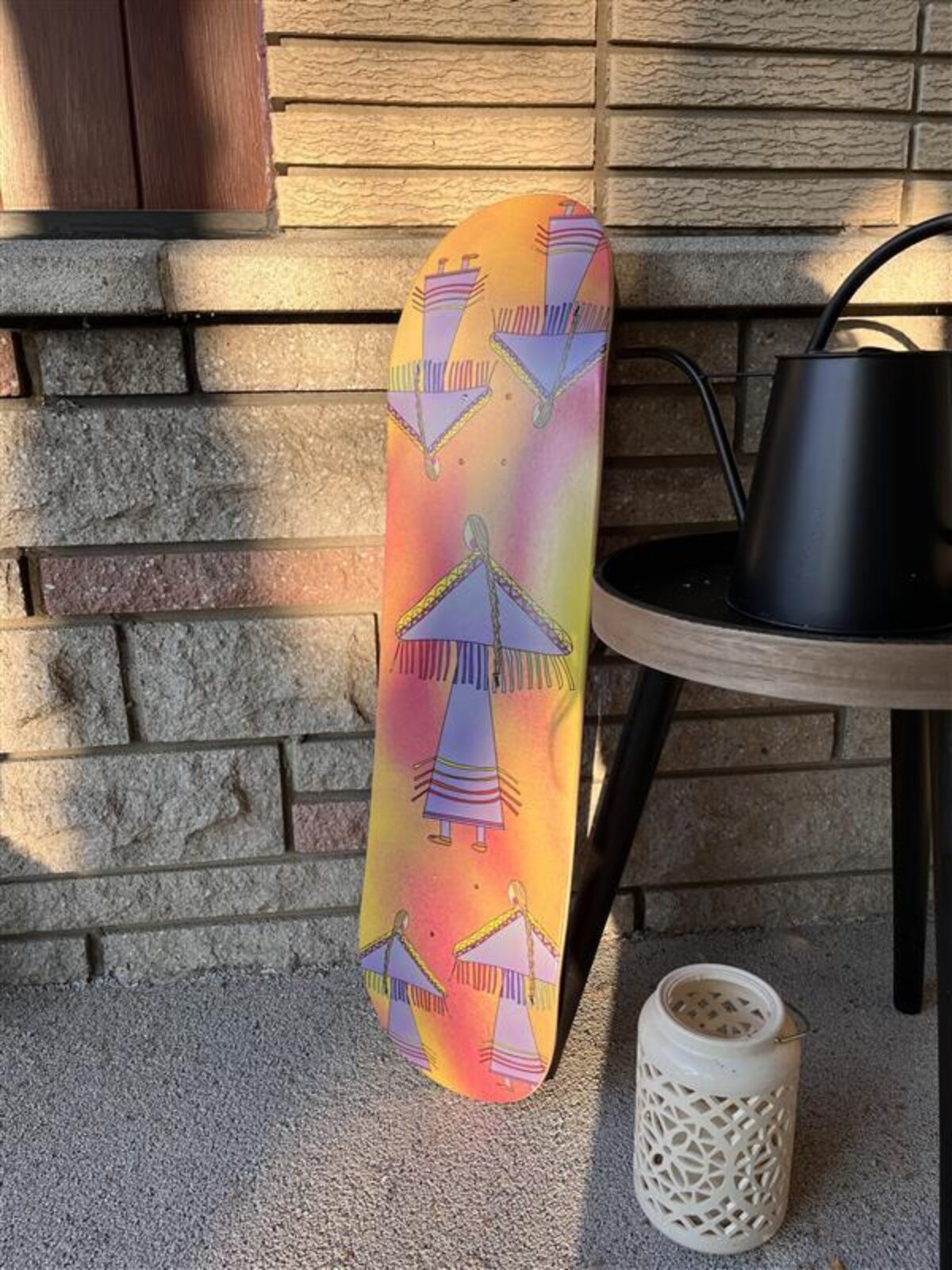
Molly Huntington’s deck features art inspired by the work of Indigenous artist Lauren Good Day, with Huntington’s design striving to represent Indigenous women who are fair-skinned and have lighter-coloured hair, as she is herself. Courtesy Molly Huntington
“Her beautiful ledger art spoke to me in a way I can’t fully explain, especially when I saw her work in person,” said Huntington.

She said she designed the dancers have lighter skin and blonde hair, to represent herself and other Indigenous women with those same features in her work.
“So often we see beautiful Indigenous artwork, but there’s still a lack of representation for the many different ways we look,” said Huntington.
“I wanted to create art that reflected that art that shows our blonde First Nations women and girls, too. We belong in the story, in the beauty, in the tradition exactly as we are.”
Huntington created the design digitally on the Procreate app on the car ride back from Washing DC.
She said that seeing the design on a real-life board was a powerful experience.
“It made me feel like I was really doing something with my art,” said Huntington.
“I hope that when little First Nations girls see these boards, they feel proud of who they are whether they’re blond, brunette, ginger, or anything in between. We are all proud to be First Nations, and our diversity deserves to be seen and celebrated.”
Montour, for his part, used elements of the Kanien’kehá:ka Creation Story in his design: the heron, the turtle, the otter, and the Tree of Life.

“I was just trying to put something together that was cool looking, but also had some kind of symbolic meaning to it,” said Montour.
Joining those symbols are the five arrows symbolizing the five original members of the Confederacy, bundled together to show unity. Montour said he first saw this element of the design on a US commemorative dollar coin.
“I was like, wow, that is a cool, powerful symbol that’s a little different from just kind of the Hiawatha Belt that you traditionally see,” said Montour.
He said he has been aware of the Skateboard Project’s contest for a while now, and seeing his own design join the ranks of past winners feels special to him.
“Some of the previous year’s designs were just amazing, so creative in the design and conceptualization, but then also in how they were executed and the artistic talent of putting them together,” said Montour.
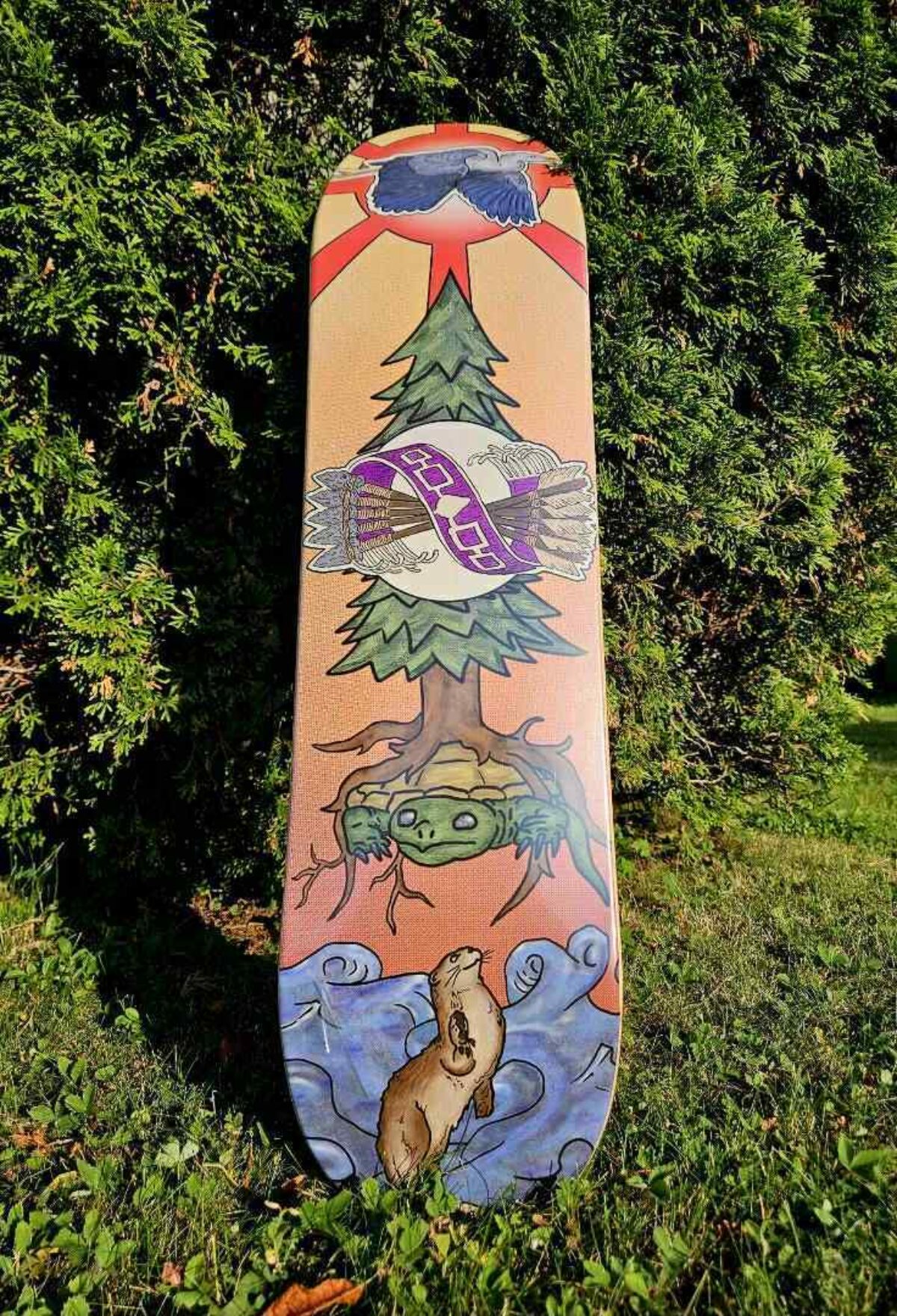
Jordan Montour’s deck design showcases elements from the Creation Story, with the goal of creating something both visually striking and deeply symbolic. Courtesy Jordan Montour
Seeing it in person - and potentially in action on someone’s board - is a great feeling, too.
“Just having a useful piece of art that can either go on the wall or be used for something cool, like teaching young Kahnawa’kehró:non how to skateboard, and seeing that design out there in the real world, that is so cool to me. I can’t pretend to be a good skateboarder, but I think it’s a really cool sport and would love to see more young kids taking it up,” said Montour.
Sign up for email updates from The Eastern Door
Along with being sold at the KOR, this year’s winning board will also be sold in Six Nations in gift shops, which Berwick said helps a lot to get the boards out into the world.
The new Kahnawake Cultural Arts Center, slated to be occupied in April 2026, will also help their numbers.
“We foresee skateboard sales being a bit higher with the new foot traffic,” said Berwick.
He hopes the KOR will be able to include Kahnawake’s sister communities in the project again soon.
Indigenous artists who want to submit designs for next year’s contest can do so already at www.korkahnawake.org/goskate, until October 31. Only designs that follow the contest’s guidelines will be considered.
With files from Eve Cable