Reconciliation walk builds connection

Marcus Bankuti The Eastern Door
The voices of Kanesatake youth studying at Ratihén:te High School, where they practice the Ohén:ton Karihwatéhkwen on Mondays and Fridays, resonated over a sea of orange outside Ecole des Pins this week.
“It was a step closer to reconnecting with my roots, and that’s very important to me,” said grade nine student Skanaie:’a Serena Ionescu, part of the group who recited the Ohén:ton Karihwatéhkwen for students from seven schools on Wednesday.
“I think it was really cool that there were so many of us that stepped up,” said Ionescu, who noted that everyone who spoke from the stage of the gazebo volunteered. “It was really good. Everyone hyped each other up, too.”

Marcus Bankuti The Eastern Door
The occasion was the second annual Inter-School Walk for Truth and Reconciliation, held October 1, the day after Orange Shirt Day, which saw as many as 400 students from Ratihén:te, Rotiwennakéhte Elementary School, Ecole des Pins, Ecole secondaire d’Oka, Mountainview Elementary, St. Jude Elementary, and Lake of Two Mountains High School gather for a walk to the Lacrosse Box.
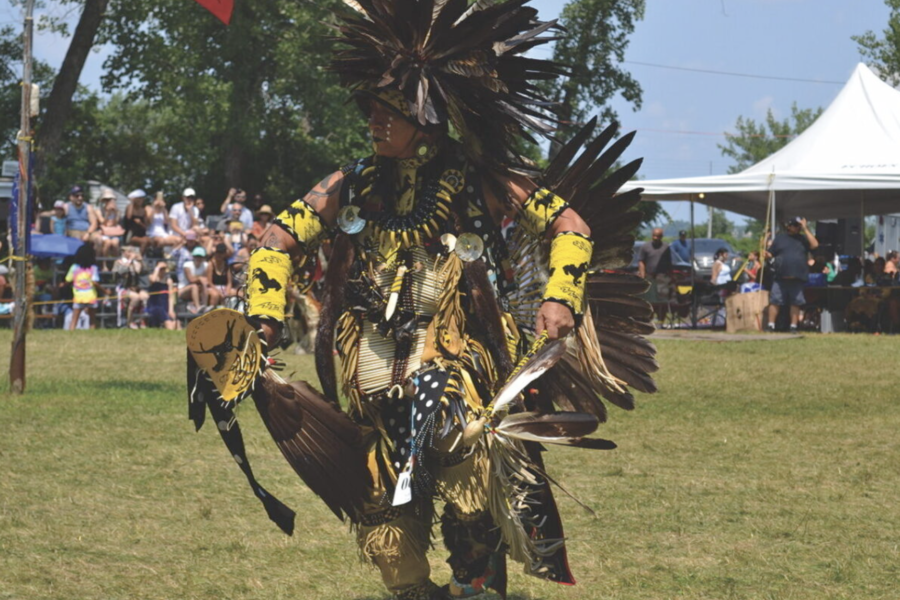
There, they took part in a social, participating in cultural activities like the alligator dance and round dance, complementing the teaching that took place on truth and reconciliation in the preceding days.
Grade 10 Ratihén:te student Maya Murray observed the significance of the event.
“It’s important to remember the things that happened, so people can learn the history so it doesn’t happen again - so they can prevent it from happening,” Murray said.
This year, the outside schools received visits from Kanesatake educators in the days ahead of the walk, so they would know what to expect and to boost their understanding of Orange Shirt Day, complementing the lessons coming from the teachers at those schools.


The residential school system is an injustice that only a generation ago many students grew up hearing not a word about, but efforts like the reconciliation walk seek to continue driving change.
“Overall, it was absolutely amazing. It was so great to see so many new faces and just so many people as well,” said Kanesatake Education Center (KEC) education director Watsenniostha Nelson, adding that lessons learned last time out helped this year’s event go more smoothly.
The event is important not only as an educational tool for external students, Nelson noted, but it also has a positive impact on students at local schools.
“I think it shows them that non-Indigenous people and outside communities are open to learning about our community,” said Nelson. “Their participation today and showing interest in our social songs and our dances just shows you that there is a key interest in learning about who we are as Indigenous people across Canada.”
Ratihén:te principal Kimberly Simon echoed this sentiment.
“It’s very powerful to see other students come here for this cause because we’ve been talking about reconciliation, what it is, but to see it in action is another thing, and to see other people appreciating your culture, participating, I think it’s really meaningful,” said Simon, adding that this kind of event can furnish young people with compassion for what others may be going through, including the trauma that has been wrought on Indigenous communities by colonization and residential schools.
“I think having these students here at a young age to gain that understanding, they’ll be more open and accepting of Indigenous people and people of other cultures too,” she said.
Not all of Kanesatake’s youth attend local schools, of course, and there are also non-Kanien’kehá:ka Indigenous students who go to school in the area who brought their own perspective to the walk.
“To take part in the walk today meant a lot to me, because I grew up with mom and my grandmother, and knowing my cousins and learning a lot about my background as being Inuk and Indigenous, so to me, it was very important to me to go on this walk today,” said Lake of Two Mountains High School grade nine student Hunter Pursch.
The walk felt good, he said. “I feel like you remember all the people and all the things that happened, and it helps revive those thoughts of your people and what happened back then. I feel it was very important,” Pursch said.




All were welcome to join the walk, and Lise David, who has lived in Kanesatake for four decades as the wife of a Kanehsata’kehró:non, embarked upon it alongside Oka resident Mimi Depelteau.
“We have to take care of the children,” said David. “I think what happened to the Native kids cannot be forgotten. What better way to tell it to the kids in school? They need to learn about that. We didn’t when we were young, so I think it’s important for them to learn.”
“It’s a very important day for the children, but I think reconciliation must be for the old people, too,” said Depelteau, adding that the world needs to learn from Onkwehón:we traditions, such as living in harmony with the planet.
Cedric Jean, the principal of Ecole des Pins, said the students at his school benefited from the presentation by the KEC.
“Normally they’re more energetic than that, but they’re all calm because they know the significance of all this,” he said.
The walk can help prepare the children from Oka to embrace reconciliation, he said, not to mention that his school has around 20 students from Kanesatake.
“I think it’s important for us because the students have to learn from the error of the government before, and now take action for the future,” he said.
“It’s a good way, to start with the children, to grow up in a positive way to see the community and build something strong together.”
Alexandra Seguin, a teacher at the school, said teaching students about Indigenous issues is a priority at Ecole des Pins.
“Each teacher is very sensitive, more I would say than the other schools in Quebec, because we have the community of Kanesatake not far from us,” she said. For the same reason, she feels the school’s students are more attuned to the importance of reconciliation.
Sign up for email updates from The Eastern Door
“We’re doing this to repair what happened before. It’s important to me,” said Léa-Rose, who is in grade six at Ecole des Pins.
Leilou, also in sixth grade at the school, agreed.
“I love it a lot here. It’s a culture that I love,” Leilou said, standing on the field near the lacrosse box. She wanted to come to Kanesatake to discover more about it, she said, and she is hopeful that reconciliation and spending time with one another as youth will help contribute to a harmonious relationship between the communities of Oka and Kanesatake.
“I think it was very heartwarming,” said Ionescu of the event. “It brought a lot of joy see that there are so many kids who care enough to show up and make these signs and put effort in. I think that’s really important, and I’m really glad that it happened.”
Marcus Bankuti, Local Journalism Initiative Reporter