New language cohort opening
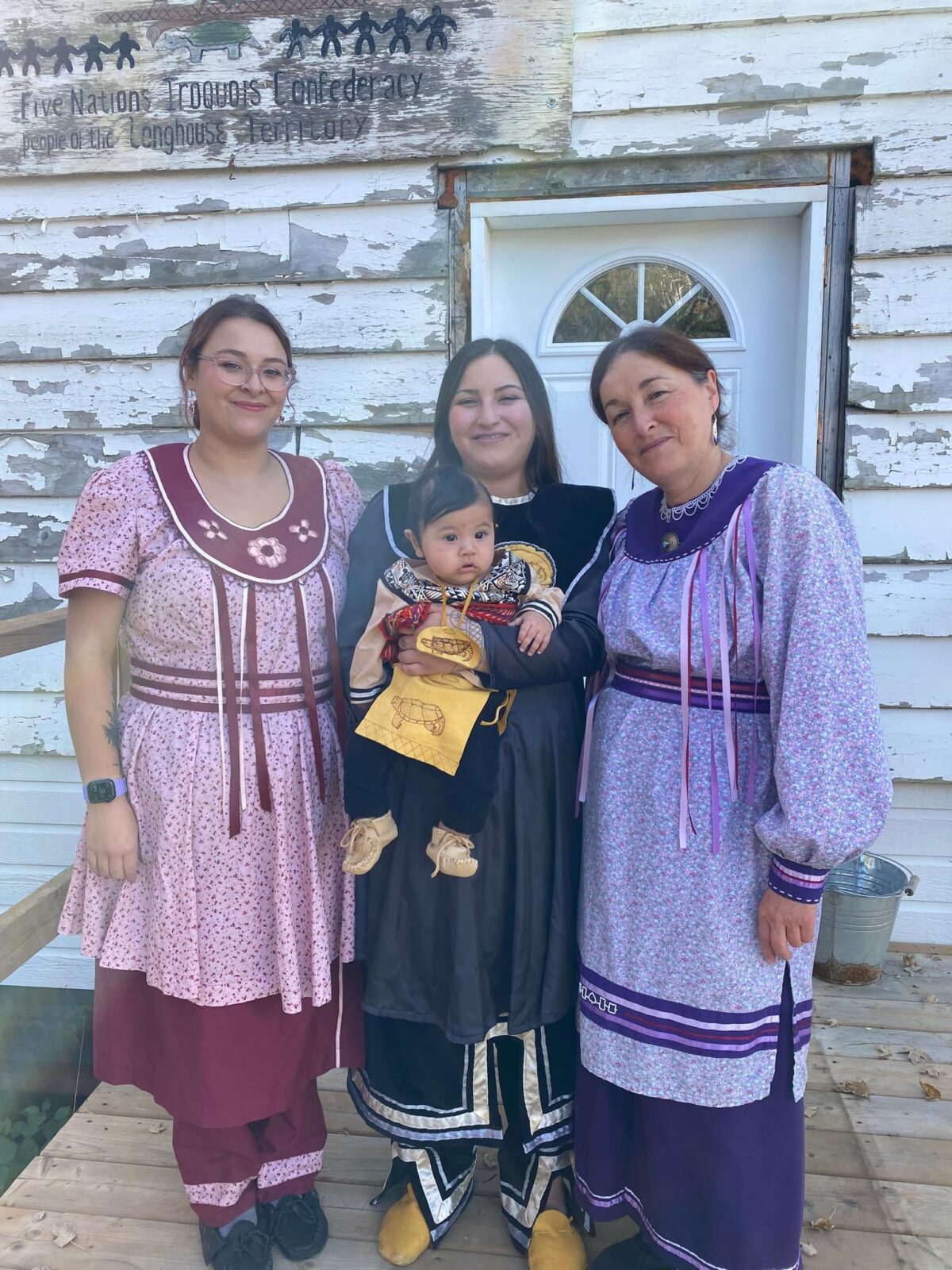
Otsitsaónwe Gaspe, right, is finishing up the Ratiwennenhá:wi Kanien’kéha immersion program. Now her daughters Kahentanoron Beaver, left, and Karihohetstha Cupples, middle, intend to follow in her footsteps. Cupples holds her young son, Ro’nikonhratshà:ni, whom she hopes to raise in the language. Courtesy Karihohetstha Cupples
Learning the language full time is a big commitment, but Karihohetstha Cupples knows that already: her mother, Otsitsaónwe Gaspe, is in her final year of the Ratiwennenhá:wi Kanien’kéha immersion program at the Tsi Ronterihwanónhnha ne Kanien’kéha Language and Cultural Center.
Now a mother herself, Cupples yearns to raise her baby boy, Ro’nikonhratshà:ni, as a speaker. But that means she has to become one first.
So now she is planning to follow in her own mother’s footsteps when the application to join the newly announced cohort opens next week. Her sister, Kahentanoron Beaver, is also planning to apply, a testament to the power of a mother’s influence.
“She works very hard studying and always makes an effort to speak to us in Kanien’kéha,” said Cupples. “Even though she has struggled with her courses, she is always trying. I want to make her proud, and I want to be a part of her language journey by learning to be fluent myself.”
Cupples did Kanien’kéha immersion in elementary school and hopes to see this program revived in local schools. In the meantime, she’s focused on doing what she can to help strengthen the language in Kanesatake.
“Overall, I have so much to say about how important to me this program is, but to nail down what is the most important part, it is becoming a fluent family,” she said.
Commitment to the language is exactly what the program is looking for, according to Hilda Nicholas, director of the language and cultural centre.
“If you’re committed and you want to learn, you will be successful,” Nicholas said, noting that the program is looking for people who will put in the effort to work hard, be on time, and be consistent.

There is a lot of interest in the upcoming cohort, noted Nicholas. She sees the popularity of the program as emblematic of a shift in the community.
“It’s in big demand at this time,” she said. “A huge change has happened. Sometimes I worry that we don’t have the space to take everybody in. I see the young people coming forward and they want to learn, and they see the success that’s coming from the program.”
It’s no wonder the program is gaining so much interest, if the current cohort’s experience is any indication. These students are set to graduate in June.
“Almost every day, from where I sit, I hear the laughter in the classroom. I hear the conversations in the Kanien’kéha language. I hear the conversation in the hallways,” said Nicholas. “These are memories that won’t go away, and how some of the students express themselves, and how I see them, how hard they’re working - these are all wonderful memories.”
Some local services are even looking to sponsor their employees to take the program.
“It’s great. I haven’t seen this before,” she said.
One of the students who most recently graduated, Kawisaiénhne Albany, now teaches part time and helps out in other ways at the cultural centre, like doing beadwork or a display for the museum.


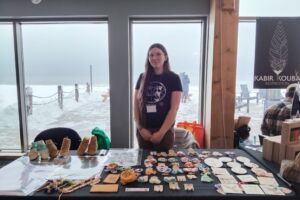
While she occasionally gets stumped by questions from students, she loves the way her role keeps her connected with the language. The learning never ends, after all.
“It’s nice. I like seeing the students come,” said Albany. “It’s funny to see because I’ve been in the same situation where they’re starting to understand the language and then they ask something, and it completely doesn’t follow the pattern anymore, and they’re like ‘oh crap, I got stumped again,’ and they’re confused again. It’s the same thing through the whole language.”
For her, choosing to attend the program was immensely rewarding.
“I think it just connects you back to your roots, your ancestors. For everybody it could be different. I wanted to learn because I grew up around it,” said Albany, referring to her grandparents.
“It makes me very proud. We don’t have many people in Kanesatake that speak, and we’re losing a lot of first-language speakers. Sometimes I even surprise myself when I talk, I didn’t realize I knew that or how to say it.”
There are 15 spots open in the upcoming cohort, and students who gain entry to the three-year program will receive a stipend to study full time - and hopefully go on to play an important role in the resurgence of the language in the community.
“I know that if I get accepted, I will pass everything I learn to my son,” said Cupples.
Sign up for email updates from The Eastern Door
Applications can be picked up from the language and cultural centre from March 27 to April 24, with a deadline of May 5 at 3 p.m. to submit.
Marcus Bankuti, Local Journalism Initiative Reporter