New cohort of paramedics

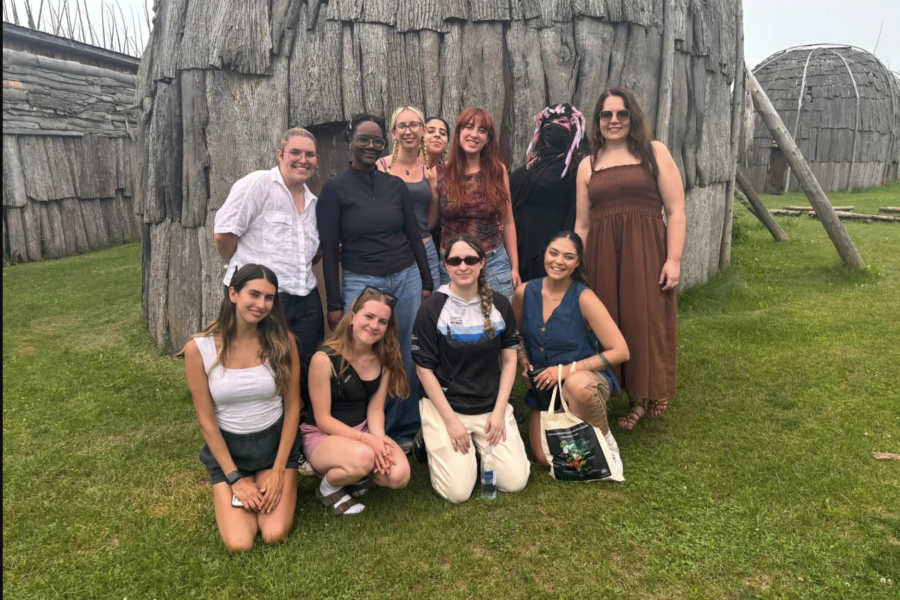
Back row: Brad Kouri, Shakowennenháwi Deer, Rotshennonni Two-Axe. Front row: Tanner Phillips, Kaycee Diabo, Konwatharani Jacobs, Konwashennonni Beauvais, Kwaronienhawi Jacobs, Reaghan Tarbell, and medical director Dr. Aurel Bruemmer. Courtesy Kahnawake Fire Brigade
For Tanner Phillips, the stakes couldn’t be higher when it comes to training the next generation of local paramedics. After all, his students could be called upon to treat members of his own family.
“That sets us apart from many other departments, and I think it really pushes everyone to be the best they can be for themselves, but ultimately for their community, to be called upon to treat their family and their friends and their neighbours,” said Phillips, paramedic supervisor at the Kahnawake Fire Brigade (KFB),
“That’s what keeps me motivated, and I don’t want to speak for everyone, but that’s the reality that we live in.”
It was the second cohort since the KFB launched its own 20-month paramedic training program over five years ago, an alternative to the three-year CEGEP course that exists outside Kahnawake and concludes with an exam in French.
“We know that it’s important to have our own people serving our own people,” said Phillips, who conducted the training alongside colleague Brad Kouri.
“We live in a very unique community, and just having someone who grew up here who understands not just the culture but the culture of the community, understanding those types of things, it really provides so much more comfort to the people that are calling in their need.”
Phillips added that it’s not realistic for many people to go to school full-time for three years to come back home and, in at least some cases, work part time at the KFB; but beyond that, the program is a way for Kahnawake to exercise its right to train its own people, with the goal of paramedics serving their own community.
That’s not to say the 20-month training was a walk in the park.

“You are covering a lot of material, and it has both the theory and the hands-on experience that you have to get as well,” said Rotshennón:ni Two-Axe, who balanced his paramedic studies with his first year of studies on his way to becoming a doctor.
“That was definitely a rewarding part of the program too was actually getting to be out in the community and practicing all the skills we were learning.”
He hopes to serve as a paramedic throughout his time in school and beyond, filling in when possible to help his community. That element was another aspect he appreciated about the training.
“It was really nice that we were able to learn from a paramedic that’s been working in the community and understands the unique challenges that come with being a Kahnawake paramedic and taking care of your own community, your own family sometimes. We were lucky to have that teaching and that experience,” Two-Axe said.
For twin sisters Kwaronienhawi Jacobs and Konwatharani Jacobs, the time was right to take the plunge and study together to become qualified to serve as paramedics in Kahnawake.
“I’ve always wanted to do it since I can remember,” said Kwaronienhawi, who took part in the junior Kahnawake Fire Brigade program as a kid along with Konwatharani.
“I think life just threw different curveballs, and I never had the time or the opportunity to do it.”
That changed when she saw a Facebook post announcing the opening of the latest cohort and signed up. It wasn’t easy, but she balanced evenings and weekends of training with being a full-time manager with the Mohawk Council of Kahnawake (MCK) Sports and Recreation Unit.


Now she’s found community with others who are involved with the KFB.
“There’s that sense of connection, and it’s really cool,” Kwaronienhawi said.
“I think it’s even more special my twin sister and I did it together.”
Konwatharani is already working at the Fire Brigade as a firefighter, and now that she’s wrapped up the program, she’s hoping to contribute to emergency medical services at KFB as well.
“It was a big commitment, especially for both of us being single moms and watching each other’s kids when we had to do stage hours,” Konwatharani said. “Our parents helped when we needed. But we also overlapped our firefighter course for almost six months while we did the paramedics course together.
“The entirety of the program was tough with having to deal with personal struggles with divorce, custody and getting justice. I realized that I can do more for others with my story and helping my community.”
Commitment to the field and to the wellbeing of Kahnawake was something all the cohort brought with them to the training, according to their instructor.
“I don’t think they realized how intensive it was going to be, but I think it shows their dedication not just to the profession of being a paramedic, but they want to give back to their community. That’s what drove them to the finish line, so to speak,” said Phillips.
Sign up for email updates from The Eastern Door
“As their instructor, I think it’s something I will look back on as one of the highlights of my career.”
Besides Two-Axe, Konwatharani, and Kwaronienhawi, Shakowennenháwi Deer, Kaycee Diabo, Konwashennonni Beauvais, and Reaghan Tarbell took part in the latest cohort to become qualified as Kahnawake paramedics.
Marcus Bankuti, Local Journalism Initiative Reporter