Lawmaking ratification vote announced

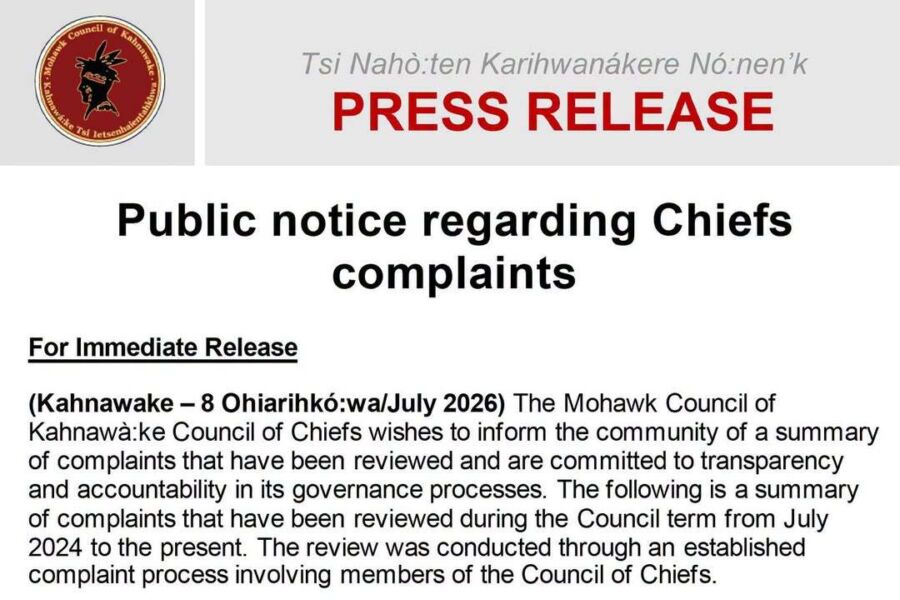
Mohawk Council of Kanesatake. File Photo
Kanesatake currently has one law on the books: the law to make laws.
Now the Mohawk Council of Kanesatake (MCK) is following through on its vow to put a slate of Kanesatake laws to a ratification vote before the end of the term, even if the timing of the vote - just two weeks before the general election - is sure to raise some eyebrows.
“Personally, my belief is that this will lead to a better outcome for the community than whoever gets elected,” said MCK chief Brant Etienne, who has argued that the suite of legislation - a trespass law, a land protection law, a code of ethics, and an emergency law - is needed to equip Council to confront the serious problems plaguing the community.
“We’ve had band councils come and go, and things aren’t as safe and as good as things could be in the community,” he said, presenting the legislation as a structural step forward in the quest for law and order amid rampant environmental abuses and other security concerns.
For instance, under the draft Mohawks of Kanesatake Land Protection Law, people could be charged for environmental offences on the territory, such as illegal dumping, that could be tried in the Court of Quebec, with penalties that could include a fine up to $5,000 or two years less a day imprisonment.
Each of the four laws will be voted upon separately. Voting day for the ratification is set for July 19 from 8 a.m. to 8 p.m. in the Ratihén:te High School gym.
Kanehsata’kehró:non will also have the opportunity to vote online using OneFeather. Electronic voting on the platform opens 8 a.m. on July 5 and runs until 8 p.m. on July 19. More information on how to vote is available on the MCK website.

Whereas the Custom Electoral Code that governs Kanesatake elections makes no mention of electronic voting or forms of voting not outlined in the code, the Kanesatake Law-Making Process (KLMP) dictates that when laws are put to a community vote - which is not strictly necessary under the law - voters can cast their ballot in person and “through any other platform deemed appropriate by the MCK.”
The lawmaking law was ushered in this February. According to the KLMP, at least 20 percent of eligible voters must cast a ballot for the result to be considered valid, with 50 percent plus one being sufficient to signal approval of a law.
According to Etienne, there are probably more than 2,500 eligible voters, suggesting at least 500 people or more need to vote on the laws for the ratifications to carry.
“It’s simply part of the consultation process. Technically speaking, we’ve already reached the minimum threshold for passing the law for Council passing it, but with this being the first set of actual laws, Council thought it was best to have a community referendum on it,” said Etienne. “Hopefully, it shows that the community is in favour of this.”
However, with Council’s four-year mandate coming to an end at the end of the same month, the timing is not accepted in all corners, with presumptive candidate for MCK chief Amanda Simon already making it an election issue.
“The lawmaking process being pursued by the current quorum of five, in the final stretch of their mandate, is not only questionable - it is irresponsible and dangerous,” said Simon.
While she has also professed a belief in the need for Kanesatake to have its own laws, she has objected to the process pursued by the current Council.






“For over three decades, Kanesatake has needed foundational laws - laws grounded in community consultation, traditional governance, and legal clarity. And yet now, as we approach the 35th anniversary of the 1990 Oka Crisis, this outgoing Council has chosen to introduce sweeping laws at the sunset of their term, propped up by lawyers, consultants, and political mouthpieces, while ousting the grand chief and silencing dissent,” said Simon, referring to the independent Ethics Commission ruling that Victor Bonspille had vacated his position as grand chief in response to an appeal he launched against the Council majority’s sanctions against him.
“This is not lawmaking - it is damage control disguised as governance. You do not resolve 35 years of legislative neglect in less than a year,” Simon said.
She criticized the consultations that have been held to date as inadequate and questioned why more information from the sessions, such as who participated and what they said, have not been published.
“It is chaos wrapped in chaos - and it betrays both the spirit and the process of good governance. Kanesatake deserves better,” she said. “We deserve laws - but not like this.”
Etienne defended the timing, noting that the proposed laws and lawmaking process itself have been in the works for quite a while. The first consultation on the lawmaking process was held nearly a year ago.
“Council has the mandate and the ability to govern in the best interests of the community,” said Etienne when asked why Council did not instead campaign on the laws for passage in the next term. “It would be a dereliction of duty to just put it off for convenience’s sake and hoping to use it as a bonus in an election campaign.”
The draft laws were worked on by First Peoples Law, which drafted the process as well, leading community workshops on the topic.
Sign up for email updates from The Eastern Door
Etienne acknowledged practical difficulties in the vote being so close to the election, noting the need to ensure people don’t get the two votes confused.
The MCK general election is being held August 2. Today (Friday) is the last day of the nomination period for the election, and a provisional candidate list is expected on Sunday.
Marcus Bankuti, Local Journalism Initiative Reporter