Labour legislation progresses at last
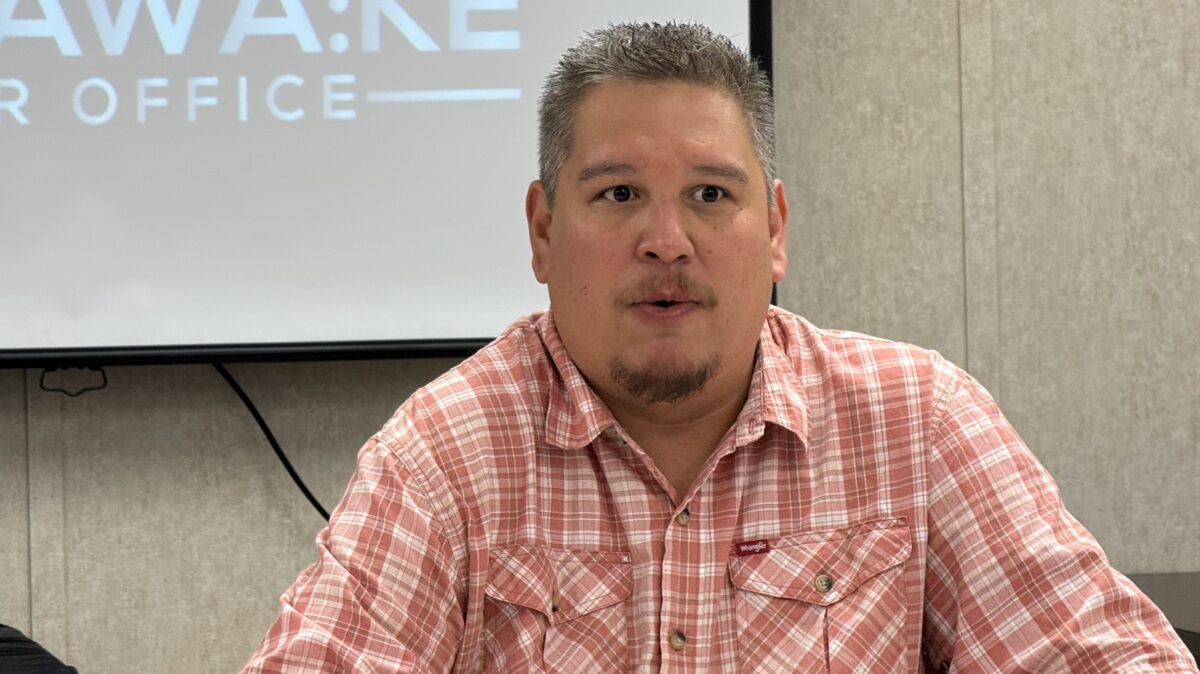
Kahnawake Labor Office director Jeff Morris at a press conference this week. Marcus Bankuti The Eastern Door
Nearly 15 years after it was initially proposed, the Kahnawake Labor Code is finally making headway.
The Kahnawake Labor Office (KLO) this week announced that the code will progress through the Community Decision Making and Review Process (CDMRP), after having first been proposed in 2011.
“This is something that’s been in the works and that we’ve been talking about since long before my tenure here,” said KLO director Jeff Morris at a press conference announcing the news this week.
“We’re officially now at this point where we’re kind of putting the last puzzle piece in place.”
Morris said the KLO will be kicking off an educational campaign in September involving consultations with stakeholders internally and externally, including with business owners and community engagement.
“We’re going to be consulting the community every step of the way on this general level. Information sessions will be ongoing, kiosks, more focus groups, surveys,” Morris said.

“We want the community’s input going forward so that we can tailor this law in ways that are going to benefit the community but also fit the needs of the community.”
The Labor Code itself will regulate health and safety in the workplace, including addressing workplace accidents and occupational diseases, occupational health and safety, and labour standards.
When the code was first proposed in 2011, it was specifically with regards to the construction industry, and has since evolved to include the general industry, meaning it will cover all businesses and workplaces in Kahnawake.
It will specifically pertain to working practices and standards, especially relating to safety, rather than regulatory aspects like food codes or building codes.
AJ Rice, executive operations officer at MCK, said the education and consultation period will be key to the code’s success.
“The implementation steps may take a little bit of additional time, but we want to make sure that the community is aware this is going on and has their opportunity to be engaged on this, whether they’re employees or employers,” Rice said.


Morris said that the legislation would be a positive thing for workers and for employers, with research conducted by the KLO showing social and economic benefits in correlation with occupational health and safety for workers.
“Research has been around for years saying that if you’re safer at work, the better quality of life you’re going to have, and by extension, you’re improving the quality of Kahnawake’s community,” he said.
MCK chief David Diabo also attended the press conference this week and said that he’s happy to see the progression of the code as a former construction worker.
“Having worked most of my construction life here in one way or another, I was able to see the things that happened due to a lack of formal standardization for health and safety,” he said, pointing to workplace injuries and a lack of a compensation regime as an example.
“I know a lot of older guys, some are passed on now, but who’ve gotten hurt one way or another and a regime like this could have really helped them,” he said.
Morris said the team at the KLO is determined to get the code implemented after such a long road to where it is today.
Sign up for email updates from The Eastern Door
“I believe it’s long overdue, I believe it’s a priority for Kahnawake to have some of this legislation in place to really protect workers,” Morris said.