Kanesatake walks for Orange Shirt Day
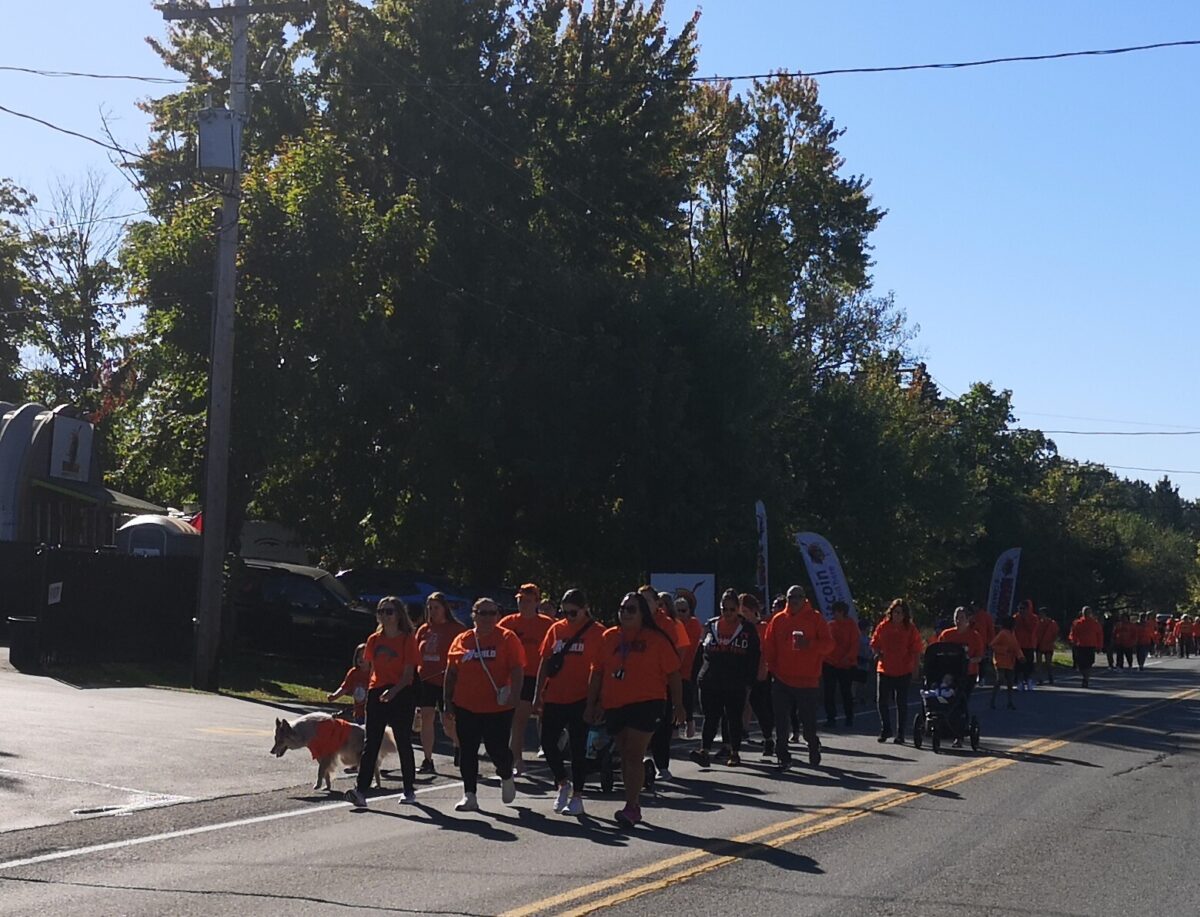
For this year’s Orange Shirt Day, the Kontinónhstats ne Kanien’kéha Language and Culture Center (KKLC) and the Kanesatake Health Center (KHC) came together to organize a six-kilometre walk in Kanesatake, to bring together the community to remember the victims of the residential school system.
“We’re all affected. All of our families are affected. We all know someone who’s gone through the residential school system,” said the KKLC’s Kevin Nelson.
Nelson said the KKLC was approached by the KHC to collaborate on the event. He said there was no hesitation to accept from the KKLC.
“We want to honour all the ones that have gone through the residential schools, and we want to be able to come together as a community and show our support and do everything we can to return back to our ways of learning, our language and culture,” said Nelson.
He said that along with the KKLC/KHC partnership, the help of Kanesatake Perimeter Security (KPS), First Nations Paramedics (FNP), and Onen’tó:kon Healing Lodge was crucial in the walk’s success.
A FNP emergency vehicle lead the dozens of walkers along the route, with assistance from KPS to block traffic.
The walk started and ended at Ratihén:te High School, and was open to all ages and abilities, with cars driven by volunteers patrolling the route to make sure everyone was okay, and to drive anyone who needed to take a break back to Ratihén:te.

At around the halfway point of the walk, fruit and water were offered to the walkers, a welcome break after the early, mostly uphill portion of the walk.
One walker, Anne Trentin, thought of stopping at the halfway point, but completed the walk with the encouragement of her daughter.
“It’s not an easy walk, but I’m doing it for my kids and their great-grandmother, because she was in residential school,” said Trentin. Although she herself is not Indigenous, her husband, Patrick Hannaburg, is.
To Trentin, Orange Shirt Day should not be the only day that people remember what happened to those that went to residential schools.
“People shouldn’t forget what happened to these little children that were taken from their homes and dragged out. People forget about them, and they shouldn’t.” said Trentin. “It should be all the time that it’s remembered, not just one day.”
A tobacco burning was held in the early morning before the walk, to honour those that had passed away, and a round dance was done after everyone arrived back at Ratihén:te.
Kane Montour, coordinator for the KPS, was not supposed to work on Orange Shirt Day, but he wanted to make sure the six-kilometre walk went as smoothly as possible.




“I’m really glad I did,” said Montour.
He said he saw a few drivers rev their engines and honk their horns when their path was blocked by the walkers.
One in particular marked Montour: the driver was wearing an orange shirt and had a “Every Child Matters” bumper sticker.
“Some people wear the orange hat, they wear the orange shirt, they put on the bumper sticker. But I don’t think they really know what it means,” said Montour.
Montour said the driver was swearing in French, and loudly wondered what the holdup was. Montour decided to ask him what his orange shirt meant to him. After the driver was unable to explain, Montour told him the blockage was for the Orange Shirt Day walk, the very cause he was wearing today. The driver “looked ashamed,” said Montour, apologized, turned around and left.
Other drivers were very supportive, including a trio of non-local drivers stopped in front of Ratihén:te who explained to the long line behind them what the walk was, and made sure everyone had returned safely to the school grounds before allowing the line to move.
One emotional moment stood out for Montour: discovering that his neighbour was a residential school survivor.
Sign up for email updates from The Eastern Door
He had approached his neighbour, who was in a car waiting for walkers to pass, to explain the reason for the hold-up, and his neighbour told him there was no need to apologize.
“He said, ‘it’s perfectly fine. They’re walking for me today, and it makes me feel so good,’” said Montour.
Montour was shocked that, after years of living near each other, he had never known prior to Monday that his neighbour was a residential school survivor.
“He told me what school he was at, who was there from the community, where most of the kids were from that were at that school, and, he got really emotional, but in a good way,” said Montour.
To him, getting to see the vastly different perspectives - ignorant non-locals, supportive non-locals, the support from the community, and a survivor - made the day worth it, and really put into perspective what Orange Shirt Day is about.
“It was almost like all these people were there that day for a reason, almost like fate,” said Montour.