Kahnawake schools receive fresh vegetables
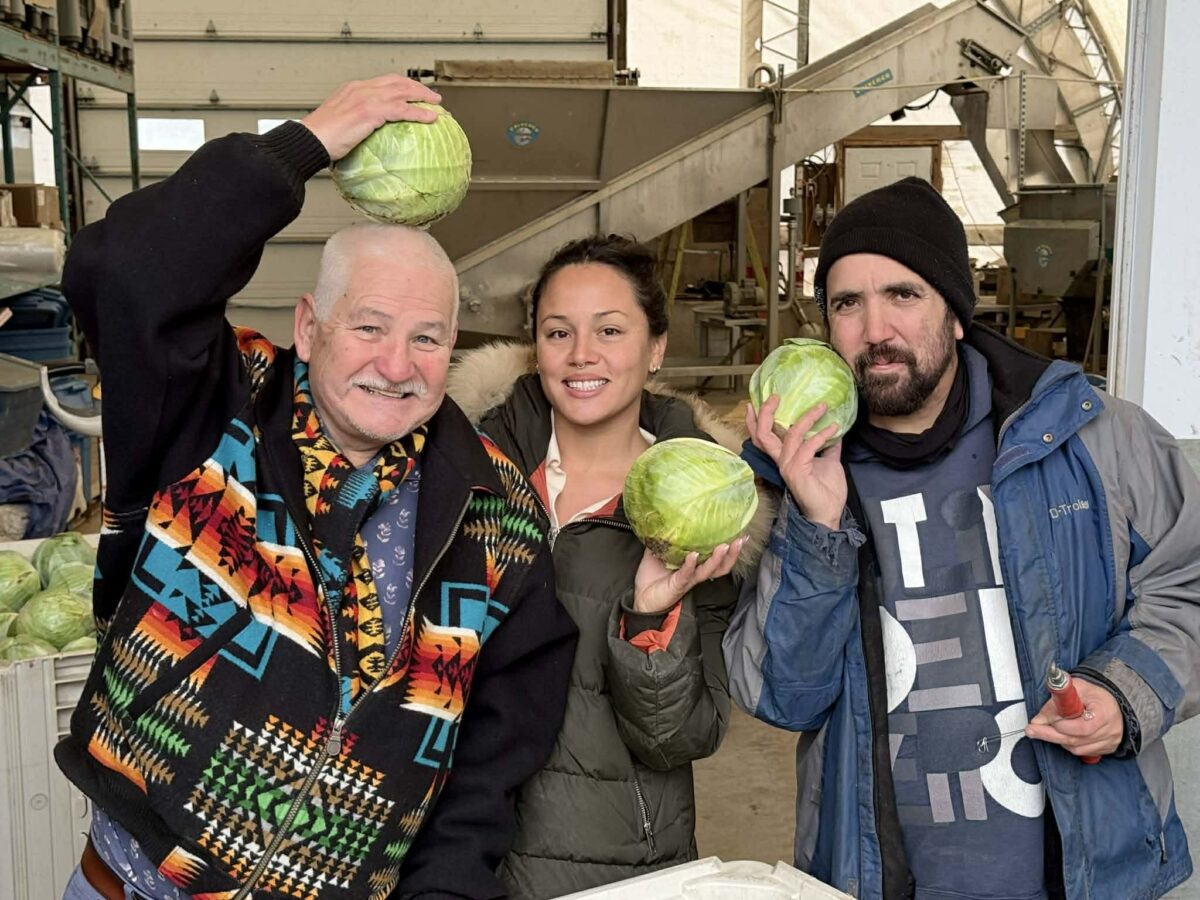
MCK chief Stephen McComber, Brooke Rice owner of Tkà:nios and Alex Godly of Regroupment Portage distributing the vegetables to the schools. Courtesy Brooke Rice
Kahnawake students benefitted from a spontaneous community effort to distribute fresh, organic vegetables including carrots, potatoes, beets, and cabbage to local schools to bring fresh, organic vegetables into classrooms, highlighting the importance of community collaboration and food sovereignty.
Originally, the vegetables were intended for the Kateri Food Basket. However, logistical challenges and space limitations meant that not all produce could be accommodated. “Usually they deliver here to the community, but the truck that they had was no longer available, the food basket wasn’t able, at this moment, to take on all that as well as the delivery,” said Mohawk Council of Kahnawake (MCK) chief Stephen McComber, who has been organizing food distribution through the Three Sisters Garden project and Regroupement Partage for four years.

Carrots and potatoes ready to be distributed into the schools. Courtesy Brooke Rice
That’s where Brooke Rice and Tkà:nios stepped in. Rice, the organization’s founder, emphasized that the initiative was not planned but emerged from an immediate need.
“It was a time-sensitive situation where we thought on the fly, who could benefit from organic winter crops,” she said.

With Tkà:nios’ vehicle available, Rice and her team offered to transport the vegetables directly to schools, providing students access to fresh, nutritious produce.
“I would describe it as an innovative opportunity to get organic food for the children in our schools. It wasn’t planned, but it was a solution to a real need, and it could grow into future partnerships,” she said.
The distribution reached multiple schools, including Kahnawake Survival School, the Iakwahwatsiratátie Language Nest, Step By Step, and Karihwanó:ron, supporting classroom programs that emphasize hands-on learning and cooking.
“I was thinking that our kids could eat organic winter crops, instead of missing out on the delivery. They have cooking classes, hands-on learning, and it goes right into the school’s food program,” Rice said.

Courtesy Brooke Rice




While the effort was spontaneous, McComber emphasized the importance of long-standing community partnerships.
“We hope the collaboration with Regroupement Partage continues,” he said, mentioning others as well. “We’ve been with them for a number of years, and it’s a good thing, anything that has to do with food and helping communities. That’s the important part, for sure.
“A lot of people volunteer, and they know they can give to us. These people are my personal friends. That connection helps. Their farm produces food that the city of Montreal distributes across the Montreal area, and that’s why they’re able to bring some food here,” said McComber.
Both McComber and Rice stressed that such projects ensure that communities have control over what food they grow and eat.
“Real food sovereignty is about how food is being grown, what’s being served, what’s being eaten, and how it’s being distributed. We as a community get to guide it and cultivate the food we want to eat,” Rice said. “A lot of our projects are geared by seasons, harvesting medicine, corn, maple, sorting beans and corn, food preservation, and storytelling.
Sign up for email updates from The Eastern Door
“Food is a complex weaving that connects our health, our identity, our culture, and our stories, even our governance,” Rice said. “It’s how we govern and self-determine who we are and what we eat and how we grow food. That’s what real food sovereignty is.”