Gabor Maté draws hundreds
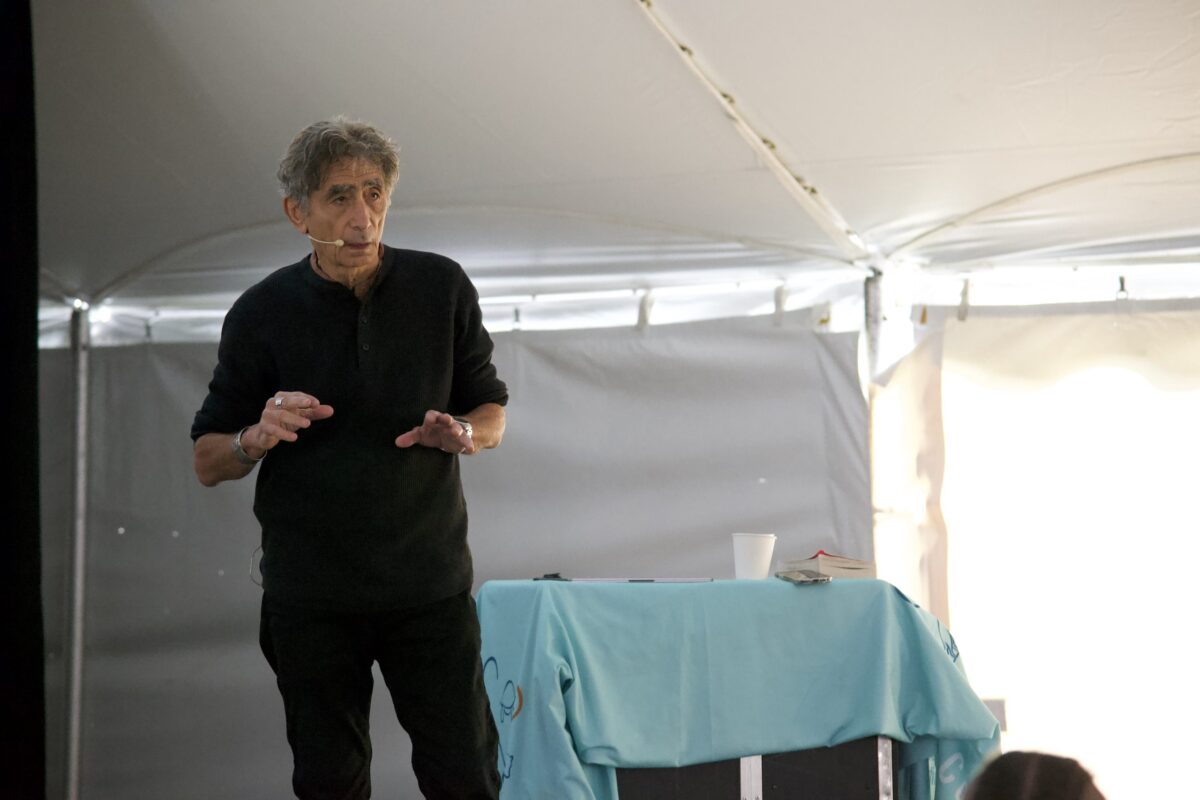
Thursday was a day full of reflection for many in Kahnawake, as over 400 descended on the Sports Complex field to listen to acclaimed author Dr. Gabor Maté, known for his expertise on intergenerational trauma.
Maté opened with the story of a woman he met in Haïda Gwaïi, British Columbia, who approached him about the shame she felt in having lost her language. She stopped while at residential school after being beaten there for speaking it.
This adaptation of hers came to harm her later on, and that’s the case for nearly everyone that’s still reeling from having lived through a traumatic childhood, he said.
“Her forgetting her language was actually the only way she could protect herself, and she didn't do it deliberately,” he told the crowd gathered under a massive tent at the sports field.
“We adapt to traumatic situations when we're kids, and then those adaptations become a problem later on, but at the time they were necessary.”
Maté’s talk centred on the relationship between trauma and colonization – a worldview that promotes individualism and domination over collaboration and cohesion – and how that culture produces multigenerational illnesses.

“That way of looking at the world translates into all kinds of pathologies,” he said. “In almost all cases, illness is a result of trauma. I'm talking about both mental illness and physical illness.”
Everything Maté touched upon Thursday has been explored in depth in his most recent book, The Myth of Normal: Trauma, Illness, and Healing in a Toxic Culture, a 2022 release he co-wrote with his son Daniel Maté.
The former family doctor spent years working out of harm reduction clinics in Vancouver’s downtown eastside, experiences that later went on to inform his 2008 release In the Realm of Hungry Ghosts: Close Encounters with Addiction, which went on to become a bestseller in Canada.
Throughout the morning Maté spoke at length defining what trauma is, explaining that it's not the traumatic event that happened, but rather what happens inside in response that creates a lifelong wound. While it’s not possible to undo the past, it is possible to heal those wounds, he told the crowd.
“If trauma is a wound that's inside of us that hasn’t healed, then healing is possible,” he said. “Nobody is damaged goods. It's never over. As long as there’s consciousness, as long as there is support.”
Time was also set aside throughout the afternoon for community members to come to the mic and ask questions. One woman asked how to approach healing while still living in community with an abuser. To that he suggested returning to tradition and an approach of restorative justice.



“Until communities take responsibility for their collective healing and their collective justice, there's going be no solution to eviction. There's going to be no solution to aggression,” he said as he touched on the manifestations of intergenerational trauma.
Maté also got into a lengthy discussion on parenting during the question-and-answer period, touching on how it can be used to break intergenerational wounds. Skin-to-skin contact right after birth, refusing to ignore infants’ cries, and giving children the freedom to feel and express their emotions without shame are all key, he said.
The talk was hosted by Kahnawake Shakotiia'takehnhas Community Services (KSCS), which pitched a massive tent at the sports field to welcome the crowd. It was filled to the brim by 9 a.m., equipped with seating, heating, and plenty of food from local caterers.
Stephanie Horne said she was touched to have had the opportunity to see Maté speak. She works with elders, some who are residential school survivors, through her work for KSCS at the Turtle Bay Elders Lodge, where she gets to promote healing and resiliency.
“A lot of times we hear we're traumatized, we have injuries, we have intergenerational trauma, that colonization has caused us trauma. But I think I have hope for today, because I hear we can heal,” she said while in line for lunch. “I like the idea of collective healing, but I think it needs to start with the individual, and then from there bring it to your children.”
KSCS executive director Derek Montour said he was impressed to see the connection Maté made between trauma and colonization.
Sign up for email updates from The Eastern Door
“We've had 400 years of colonization here in Kahnawake. It's going to take time for all of us to get to a place of renewal. And I think we have to be gentle with ourselves,” he said. “There's a lot of individualism, a lot of capitalism, violence, whether it be childhood violence or childhood abuse. So I think we still have ways to go, but we're certainly further along than our parents' generation.”
Karahkwinetha Sage Goodleaf said the talk made her reflect on the ways colonial thinking hasn’t altered social norms down to parenting especially.
“You have to do a lot of internal self-reflection. And I think he’s really igniting that right now, almost in a visual way,” she told The Eastern Door.
Free copies of Maté's most popular titles were handed out at the event, which also had time set aside for a book signing. The author also later joined a panel talk alongside community members Suzy Goodleaf, Linda Delormier, and Steve Sawyer.