Empty chair transferred to Tk’emlúps
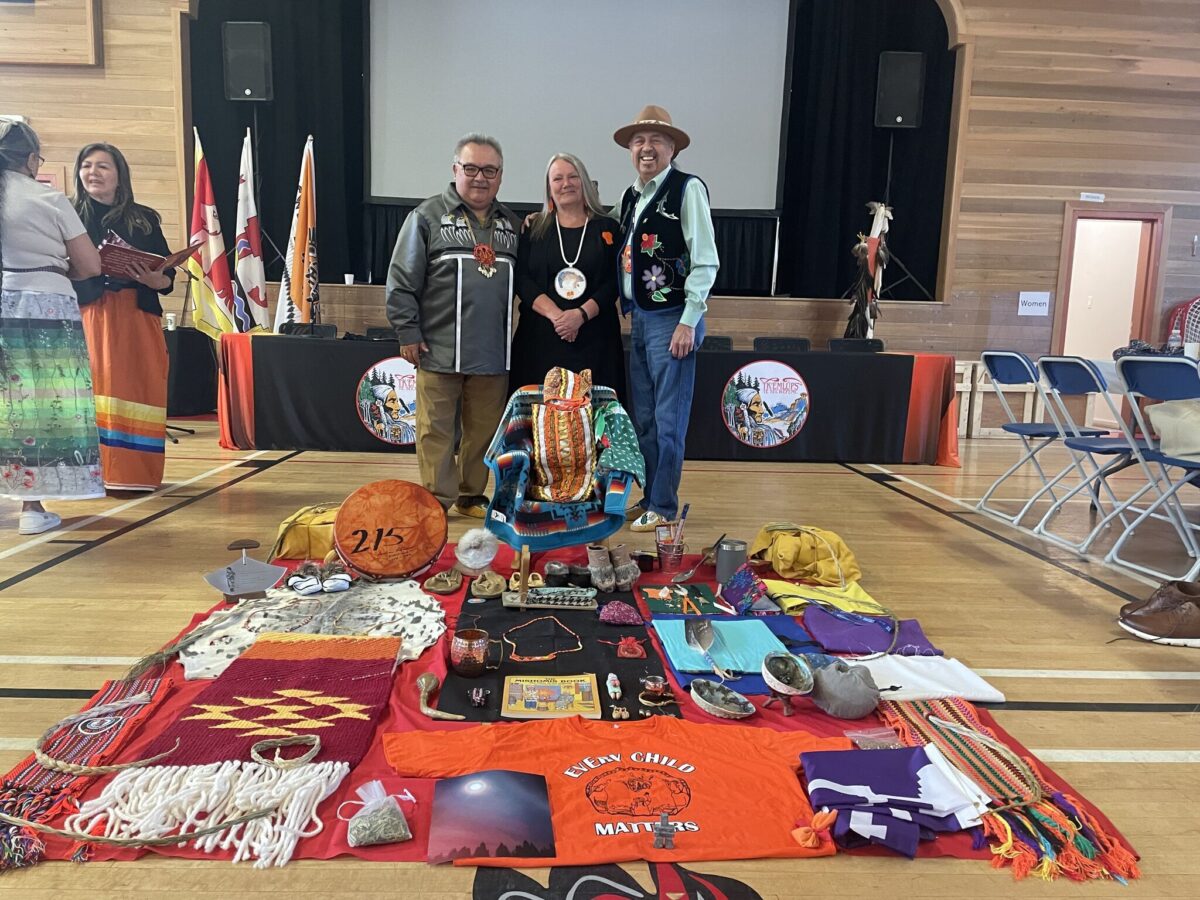
Laver Simard (left), Kimberly Murray (centre), and Darrell Boissoneau (right) at a ceremony transferring the empty chair and its sacred items last month. courtesy Kimberly Murray
Back in 2022, an empty chair was placed at the front of a conference room in a convention centre Edmonton, Alberta.
It was the inaugural National Gathering on Unmarked Burials, the first of many hosted by the office of Kimberly Murray, who at the time was serving as the independent special interlocutor for missing children and unmarked graves and burial sites associated with Indian residential schools.
As she walked around the humongous space, she felt the weight of its emptiness, and thought back to national events at the Truth and Reconciliation Commission, where commissioner Wilton Littlechild had placed an empty chair on stage, recognizing the children that never made it home from residential schools.
As the Edmonton gathering progressed, individuals from communities across Turtle Island solemnly placed offerings upon it: a blanket, eagle feathers, offerings of tobacco.
At the final national gathering in Gatineau, where Murray presented her final report with 42 obligations for the federal government to commit to in order to find a path forwards for reconciliation, the chair sat upon an illuminated stage, so laden in sacred objects that many had to be gently placed next to it.
A drum bearing the number “215,” referencing the discovery of the remains of 215 children at the site of the former Kamloops Indian Residential School back in 2021, a small inukshuk, an ulu knife, cradle boards, cradleboards, children’s moccasins - all precious items gifted to the chair from participants of national gatherings held over two and a half years.

At the end of last month, one final item was placed upon the chair, hung from one of its arms: a small medicine pouch handmade by Murray many years ago.
“I’ve been wearing that medicine pouch to every community I went to, every cemetery I walked in, and I just felt compelled to give it to the chair,” Murray said.
Within the pouch was tobacco, and a special rock, hand-painted like a turtle.
“I felt like I had to give this to the spirits of the children, because I think that I really started to carry those spirits in that bundle with me.”
The pouch was placed as part of a final ceremony, when the chair, and the sacred bundle of items given to it, were transferred to the leadership of Tk’emlúps te Secwépemc.
The chair will now be kept in their community, and Murray said that their leadership has committed to bringing the chair to other communities, a request that often came to Murray’s office during her time as special interlocutor.


She was specifically interested in giving the chair to Tk’emlúps, in part because of the discovery of the 215 in their territory.
“People continue to come to Tk’emlúps, international visitors, people from all across Canada, community members, non-Indigenous people, they continue to come to Tk’emlúps to hear from the community about the search they’ve done and are continuing to do,” Murray said.
Before Murray’s mandate ended, she wrote to the Canadian government asking them to fund Tk’emlúps to take care of the chair, ultimately obtaining money for specialized boxes made of mahogany wood to be used as carrying cases.
“That’s something I wanted to continue, I wanted it to continue to be brought into communities for survivors and others, to respect those children that are disappeared and missing, because it’s very healing as well,” Murray said.
At the ceremony, Murray was joined by elder Darrell Boissoneau, who is Anishinaabe, and Laver Simard, who is from Treaty 5 territory and worked closely with Murray when she was special interlocutor. They presented the chair to Rosanne Casimir, who is the kúkpi7 (chief) of Tk’emlúps te Secwépemc.
“It was very emotional for us, because we’ve cared for the chair, we’ve brought it around,” Murray said. “When the transfer of the chair ceremony happened, I turned to kúkpi7 Casimir, and I said ‘I know I made the right decision to give the chair to Tk’emlúps because I know they’re going to care for it, and they’re not going to stick it in a box in a closet or have it buried away in a university where no-one can see it.”
Sign up for email updates from The Eastern Door
An archivist that Murray previously worked with created a thorough inventory of the items associated with the chair, logging every piece and writing a description of what each item is for historical purposes.
“I have no doubt that the bundle will continue to grow,” Murray said. “It’s a commemoration piece, it memorializes what happens, what used to be happening, and the fact that we have missing and disappeared children in the country. When you’re with the items and the chair, it’s a moment of reflection. It makes you reflect and think about the history.”