Emergency preparedness top of mind

Council chief David Diabo has some food for thought after returning from a recent emergency preparedness conference hosted in Ottawa by the Canadian Red Cross.
He was there for its first day, on January 29, which had panel discussions set aside about the challenges First Nations face in particular when it comes to responding to emergencies and natural disasters.
For communities like Kahnawake, that generally comes down to a lack of funding, the lead on emergency management said.
“We are limited in funding and resources, equipment, and training,” said Diabo, who attended the conference alongside Melanie Morrison, who shares the portfolio with him.
That’s why the relationship between Kahnawake’s first responders and public safety authorities, like the one for the St. Lawrence Seaway, is key.

The extent to which Canada’s emergency preparedness ministry has grown in size over the years gives him hope First Nations will be better served in coming years, however.
Asked whether he feels the community is ready for a major catastrophe like a train derailment, Diabo was upfront. No, it’s not.
“Our hazard spaces are really centered around those four modes of transportation,” he said - the railroads, highways, cargo ships, and airplanes that pass through the territory.
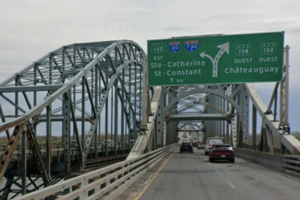
“That’s where all the hazardous materials pass,” Diabo said, mentioning the Mercier bridge and the cargo ships that run through the seaway. “If a ship hits the rocks and it rips a hole in the side, we don’t know what they’re carrying. If it’s nuclear waste, oil, or components of oil that could do a lot of damage to the waterway.”
Just as recently as last summer a cargo ship got lodged in the Seaway for over 24 hours after a system malfunction. Luckily, it wasn’t carrying any hazardous materials or punctured when it ground to a halt. No one was injured either.



Commercial trains that run through the territory carry the same kinds of hazardous materials.
“A chemical spill or an oil spill, with a train derailed and all of the tankers put on the side and ripped open, it would be a catastrophe,” Diabo said.
He also worries about how fast some of the trains are travelling.
“We have that big curve just by the (CP) tunnel, and it’s got a speed limit,” he said. “Some of the trains that go around that fence are well over that speed limit, and there’s houses just below it, so that’s a real risk right there.
Then there’s also the possibility of a plane crashing in the territory, which though unlikely, is possible given Kahnawake’s proximity to the Trudeau airport.
Sign up for email updates from The Eastern Door
Regardless of how well equipped one government is over another, everyone is also struggling with how to best predict and respond to extreme weather events becoming more common because of climate change.
“Climate change is making the summers hotter, and the winters and colder. There are more wildfires, there’s more flooding, there’s more critical infrastructure damage,” Diabo said. “You never know what you’re going to need to be prepared for, or how much you need to be prepared.”