Commemorating 1990 in solidarity
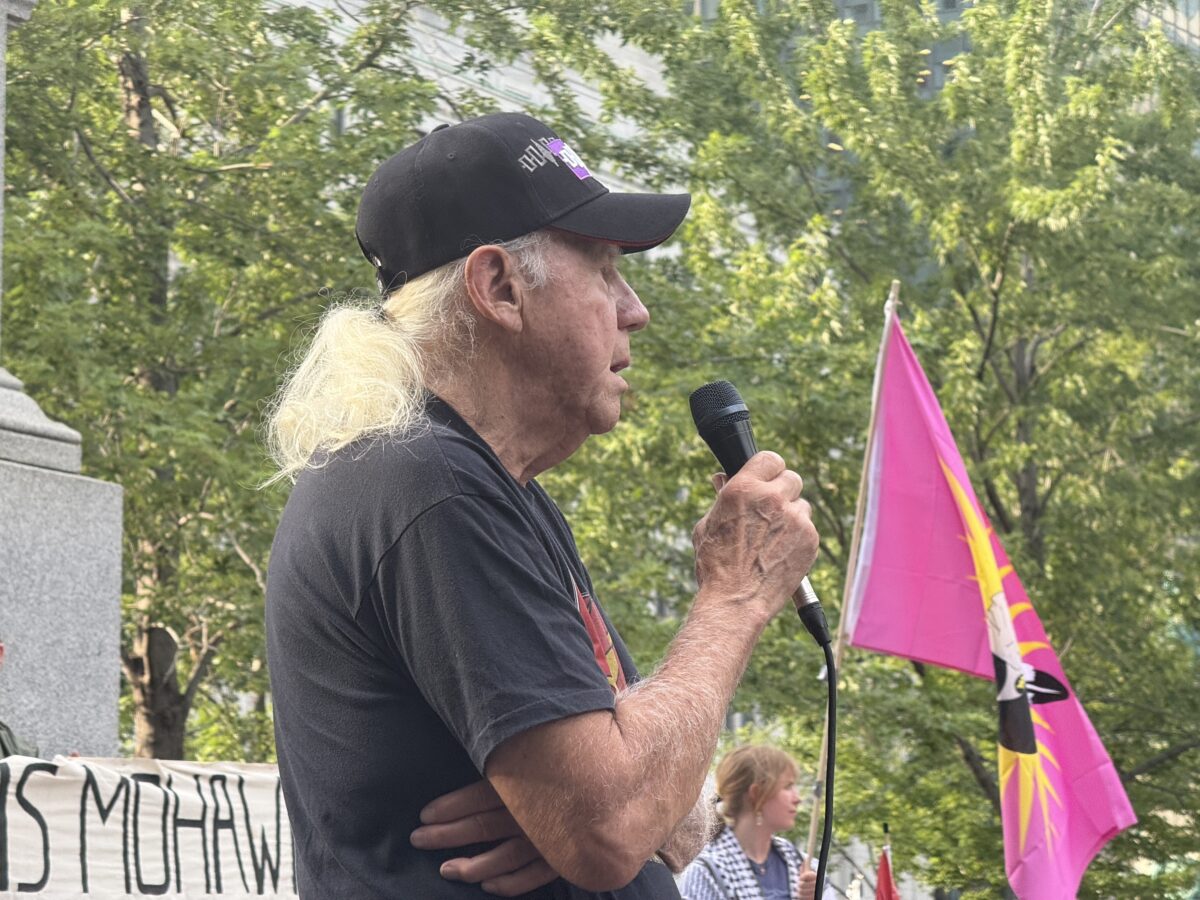
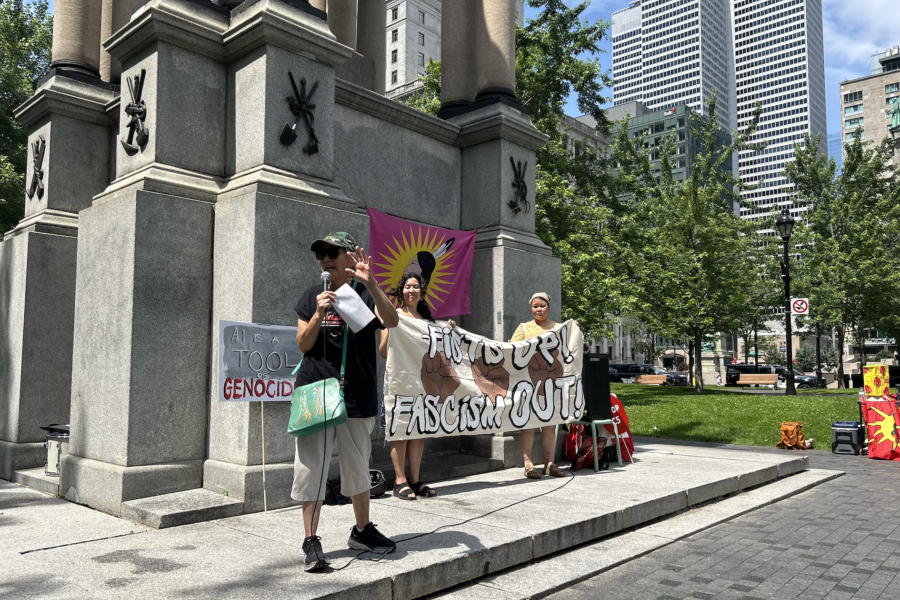
Joe Deom speaks at the Place du Canada event. Marcus Bankuti The Eastern Door
During the Siege of Kanehsatake in 1990, Ellen Katsi’tsakwas Gabriel would speak at night with the men on the front lines after wrapping up the day’s negotiations. One of the men, Richard Two-Axe - “Boltpin” - had a saying. You can break one arrow very easily, but if you take a bunch of arrows, you cannot break them.
“That’s what solidarity is,” said Gabriel, speaking to more than 200 people assembled at Place du Canada in Tiohtià:ke on July 11 to mark the 35th anniversary of the Siege. The commemoration was not merely a remembrance, but a call to action that highlighted the pivotal importance of solidarity.
“I really think that if we understand one another and have a relationship with one another, maybe we’ll stop killing one another, and we can bring children up in a world that is safe for them,” said Gabriel.
As such, the rally featured speeches not only from Kanehsata’kehró:non and Kahnawa’kehró:non, but also the Palestinian Youth Movement and other speakers who are not Indigenous to Turtle Island.
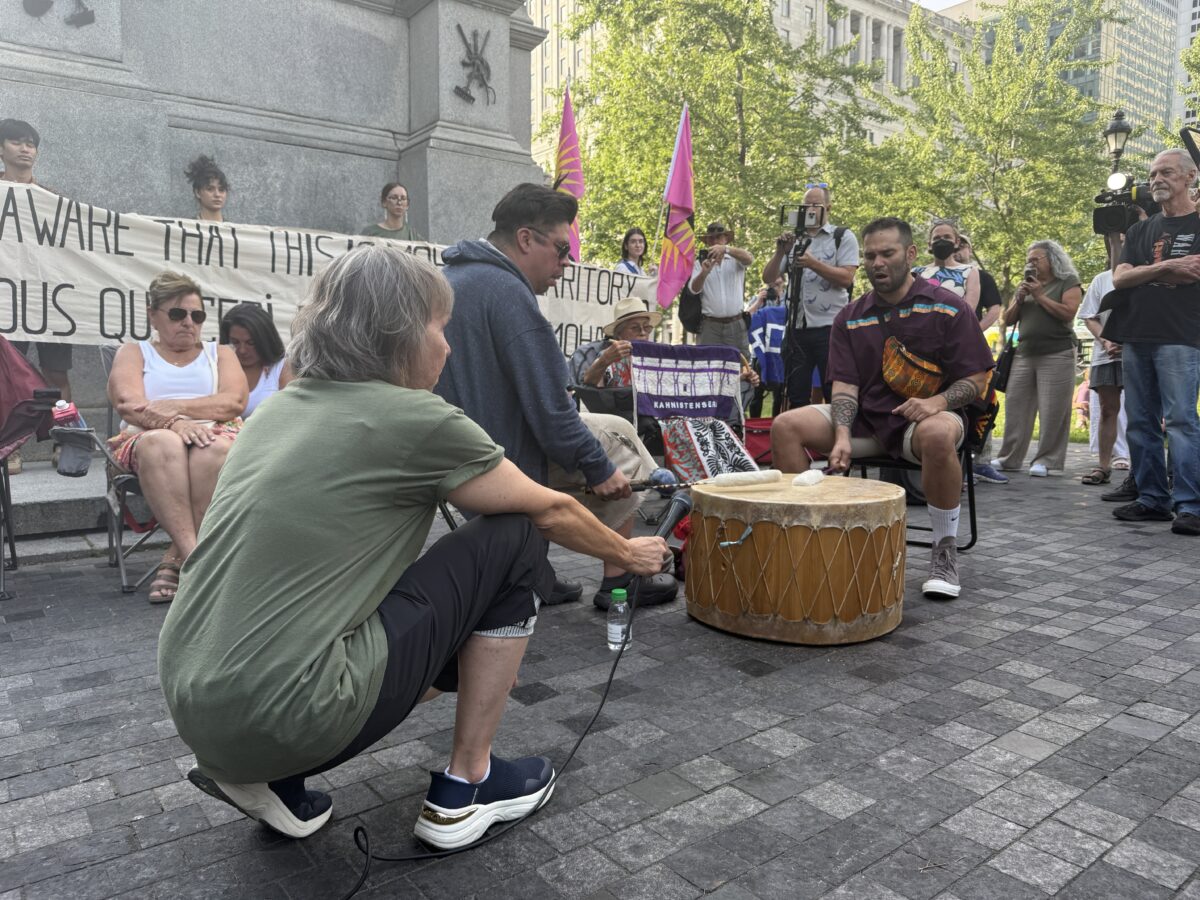
Spirit Wolf performed the American Indian Movement (AIM) song near the beginning of the rally. “It is a unity song and a resistance song for Indigenous people around the world,” said Ellen Katsi’tsakwas Gabriel. Marcus Bankuti The Eastern Door
The speakers, gathering at Place du Canada, also made clear that the fight against the government for the recognition of Kanien’kehá:ka rights and territory is not over.
“As oppressed people, we are stronger than our colonizer because we resist constantly, and it may not be shown evident on a daily basis, but it’s in our hearts and our minds. It’s that courage and strength and the resilience to be able to say ‘throw what you want at me, my ancestors are walking with me. You cannot defeat my ancestors,’” said Gabriel.
Despite the government’s efforts to assimilate Onkwehón:we, Indigenous people are not ashamed of who they are, Gabriel said. “We hold our heads high because we won, in a sense, simply because there was solidarity with all of you, with all of the people that you heard today,” she said.
The rally also sought to highlight 16 calls to action directed at the governments of Canada and Quebec and to Canadian institutions and the public at large.

Wanda Gabriel, one of the organizers of the rally along with Ellen, summarized a few of them to the crowd - for Canada to negotiate in good faith to return stolen homelands, to eliminate policies that violate and exclude rights to self-determination, and for institutions and the public to seek better education on the root causes and history behind the 1990 Kanehsatake and Kahnawake Siege.
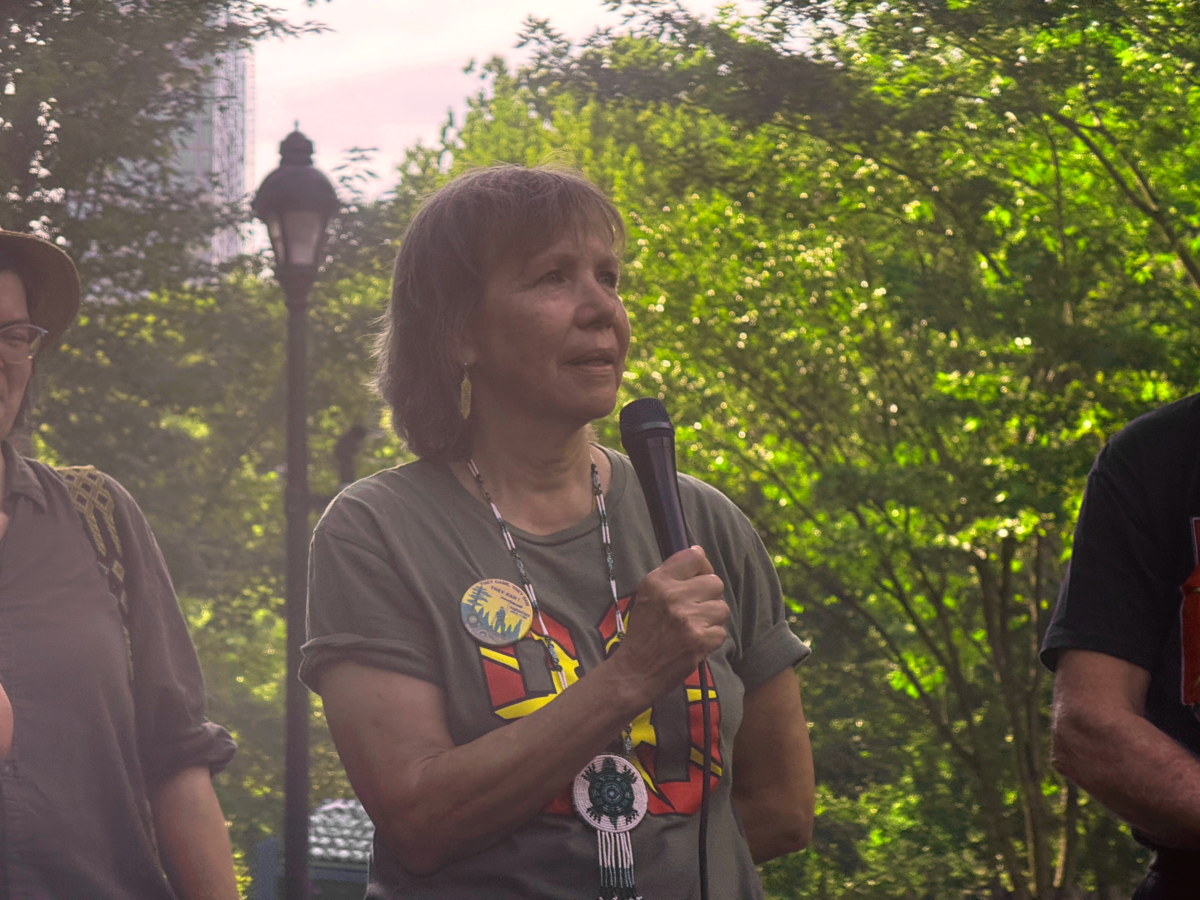
Ellen Katsi’tsakwas Gabriel emphasized solidarity at the July 11 commemoration of the Siege of Kanehsatake. Marcus Bankuti The Eastern Door
“We are awake, but there has been a cost to the awakening. While the world remembers the barricades, we remember what it cost our community: mistrust, divisions, and wounds that have not healed. When the land is insecure, the people are insecure,” said Wanda. “When governments profit from our exploitation, safety is impossible. The Kanehsatake Resistance was not just a standoff; it was a reckoning.”
She went on to describe how Canada has not honoured the findings of commission reports since then that have identified root causes, already known to the Kanien’kehá:ka who had been fighting for their land and sovereignty, before directly addressing the young minds in the crowd.
“I want to say to our young people, you are not here just to listen,” said Wanda. “You are here to pick up the work. You are the next barricade, but this time it won’t be built with logs and tires, but with knowledge, unity, and courage.”
Kahnawa’kehró:non Allison Deer attended the rally with guests of hers from Six Nations of the Grand River who were in town for the powwow.
“I thought the venue location (Canada Place) was appropriate as the challenge is still with the federal government. It was important to let the general population know that the disputed lands are still not in the possession of the people in Kanehsatake, and that more work needs to be done,” she said.
“My key takeaway is that our true strength lies in cultivating a thoughtful and open-minded approach by using a good mind - this is our way. Our resilience is rooted in peace, diplomacy, and unity.”
Joe Deom, spokesperson for the Mohawk Nation at Kahnawake, spoke at the event to recall his experience of 1990.

“We had to deal with the Army and also the politicians from Quebec who were determined to annihilate us in Kahnawake and also in Kanehsatake,” said Deom. “Throughout that whole summer, I tell people that I never had so much fun in my life. There were times when things got really serious, but we prevailed through all that.”
However, he said, while the encroachment of the Oka Golf Club was halted, the larger land issues remain unresolved.
“I was asked several times today, what’s the purpose of this commemoration?” he said.
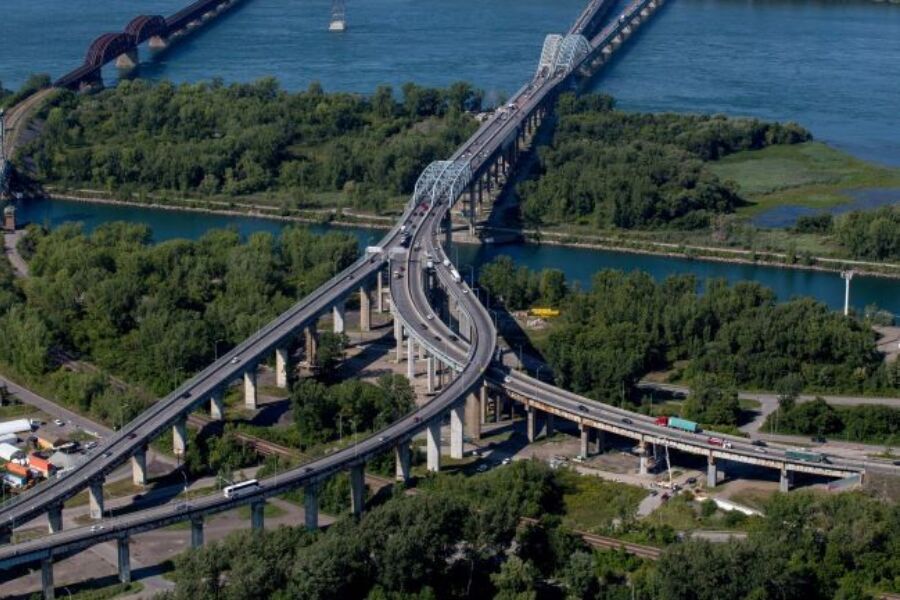
“The men in Kahnawake, we have a small group that raise our flags near the bridge to remind the motorists that we’re still here and we’re still alive and kicking. That’s what this is all about because a lot of you people today were not even born in 1990, or maybe you were very young, so you don’t know the whole story behind what happened in 1990.”
Others also spoke to share their stories. One was Kahentinetha Horn, who recalled how a member of the Canadian military stabbed her 14-year-old daughter, Waneek Horn-Miller, in the chest. She called for an investigation to finally take place.
“They sent in the Canadian Army to deal with us, and they keep saying and telling the world and everybody that we’re citizens of Canada, and yet they sent their soldiers against us,” said Horn, reminding the crowd that this land belongs to its Indigenous peoples.
“We never gave it up,” she said.
Another who spoke was Wendy Mayo, the wife of the late Richard Two-Axe, who died in 2003.
Two-Axe, who grew up in New York, had been one of the Kanien’kehá:ka held captive in the Onen’to:kon Treatment Centre and transported to custody in Farnham. His thick New York accent made him a particular target, Mayo said, because the authorities were demanding on that basis that he confess a connection to the American Indian Movement (AIM).
Sign up for email updates from The Eastern Door
Mayo visited him with their three-year-old daughter every day until his release a month later. “We were treated like we were killers, criminals,” she said. “They escorted us to the bathroom almost with a gun on our back each time that we went there.”
The summer had been a painful episode for the family, with the couple apart and scarcely able to communicate outside of the news media.
Mayo’s 15-year-old son, meanwhile, became a man overnight, she said. She recalled the incident on Tekakwitha Island, when the military landed.
“When the island happened, it happened so quick that my son came running. He said ‘they’re going to tear gas you.’ I was holding (my daughter) in my arms, and when the first thing went off, all of a sudden we’re at the water, and my daughter wasn’t in my arms any longer,” she said. “I swear to god, I thought I dropped her, and all the while it was my son that grabbed her and went running and put her under his hood because the tear gas was all over, and not to mention it was right beside a hospital.”
It was in the final moments of the rally that Ellen recalled Two-Axe’s saying, not long before inviting those assembled to take part in a round dance to the sound of the drum, which she described as the heartbeat of the people, performed by Spirit Wolf.
“That’s what solidarity is,” said Ellen about the bunch of arrows. “That’s what that solidarity is about, and together we cannot be broken.”
Marcus Bankuti, Local Journalism Initiative Reporter