Canada to reimburse tuition costs
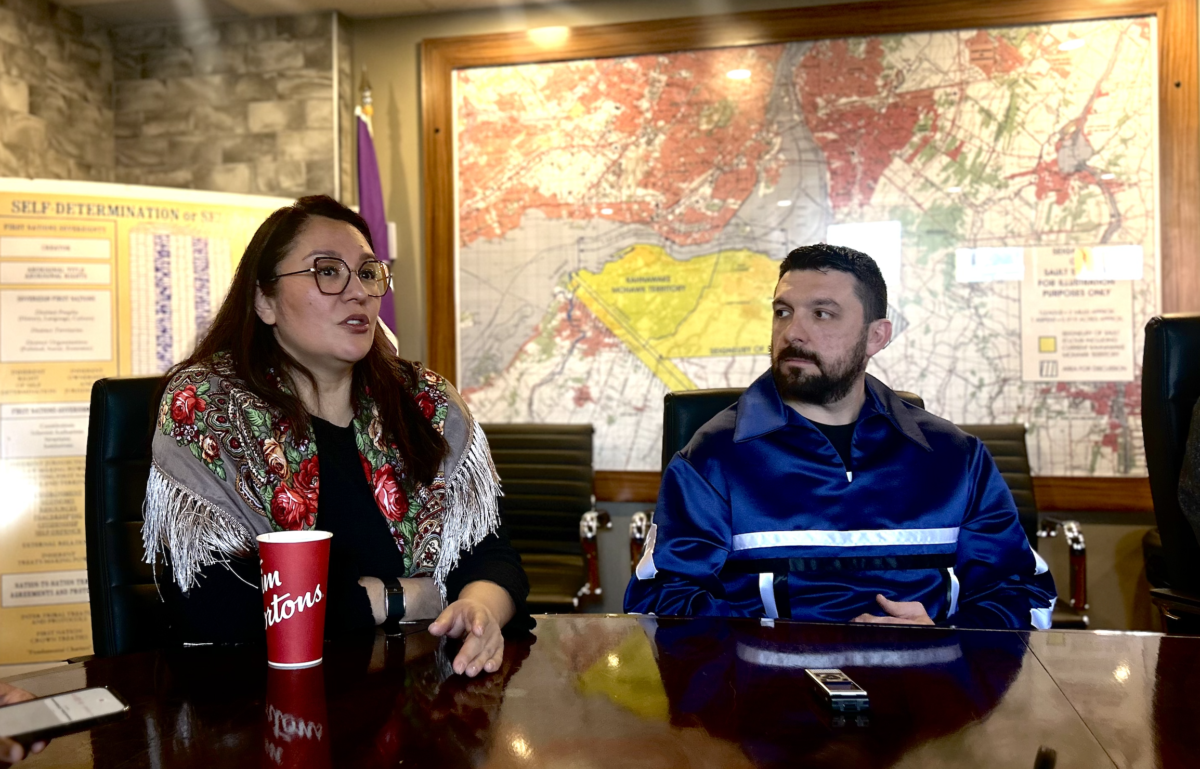
Indigenous Services Canada minister Mandy Gull-Masty (left) met with Mohawk Council of Kahnawake (MCK) chiefs on Thursday morning, ahead of a tour of the community. Eve Cable The Eastern Door
After stepping in to cover private school tuition for students with special needs last year, the Mohawk Council of Kahnawake (MCK) will be reimbursed for the tuition costs by the federal government, Indigenous Services Canada (ISC) minister Mandy Gull-Masty announced at a meeting in Kahnawake yesterday.
The issue had arisen last summer, when ISC announced a Jordan’s Principle operational bulletin that would change the criteria for services covered by the program, including an end to coverage for private school tuition.
The announcement left families in the lurch, including many in the community who have students attending specialized schools such as Centennial Academy, which can provide more support for students with additional support needs associated with learning difficulties like autism, attention deficit hyperactivity disorder (ADHD), and dyslexia.
During the 2024-25 fiscal year, Jordan’s Principle covered around $700,000 in private school tuition for students from Kahnawake, and with the changes to coverage being announced just weeks before the 2025-2026 school year, many families were left scrambling to find a solution to ensure continuity for their children’s education.
The MCK had then stepped in to ensure that students attending private schools for additional support reasons would be covered for the next school year, contributing around $326,000 for 25 students identified as most at risk. All of those students were diagnosed with special learning, developmental, or emotional needs.

While MCK maintained that they fully expected ISC to reimburse that cost, the federal government had until now provided no information about whether they’d eventually pay that bill.
At a press conference yesterday, Gull-Masty said that ISC has determined that the costs will be reimbursed to MCK, noting that 23 of the 25 student files have been approved for processing the reimbursement. She said that she is hopeful that the remaining two cases will also be approved for reimbursement, pending the completion of final paperwork, something that MCK grand chief Cody Diabo said was “very positive news.”
“We’ve been doing a lot of work behind the scenes to look at the files that were submitted to us, and we’ve found that a lot of these cases really meet the criteria,” Gull-Masty said on Thursday morning.
When asked by The Eastern Door if the decision means that those families can expect tuition to be covered by ISC for future years of schooling, Gull-Masty said that her office is working to streamline the reapplication process.
“What I think people need to understand and know is that here at ISC, I want to make changes. There’s additional reforms that are coming to ensure we’re making this process user friendly, that we’re reducing the paperwork for those cases that are complex, when people have applied annually,” Gull-Masty said.



“It’s important that we offer stability and consistency in service, and I’m trying to make sure that I remove barriers so that is offered to people that are using Jordan’s Principle, and this is the work that we have to continue doing together.”
For Kirsten Sheridan, health programs liaison at Onkwata’karitáhtshera, the news is a relief. Onkwata’karitáhtshera manages Jordan’s Principle requests in the community, and ensuring continuity of education for students with additional support needs has been a priority for the office over the past year.
“I think it’s a real positive moving forward for our community kids that do attend certain schools for specific educational needs,” Sheridan said
She said that her office is still coordinating with ISC to approve funding for nine further students who did not have their tuition covered by MCK, but who may qualify for reimbursement.
In the meantime, she said she feels reassured by communications from ISC about the future of funding for special education needs, having been told by their point person at Jordan’s Principle that tuition should be covered if a student has a specific diagnosed educational need.
Sign up for email updates from The Eastern Door
“I don’t think we’re going to see a repeat of what happened last year right before the beginning of the school year,” she said. “As long as there’s that medical, educational need of the child, then it’s going to be considered for approval.”
Sheridan said that more information about applying for tuition in specialized cases can be accessed by contacting Onkwata’karitáhtshera directly, and that families should expect to bring assessments by medical professionals to support their applications.