“Canada is continuing genocide”
Olivier Cadotte The Eastern Door
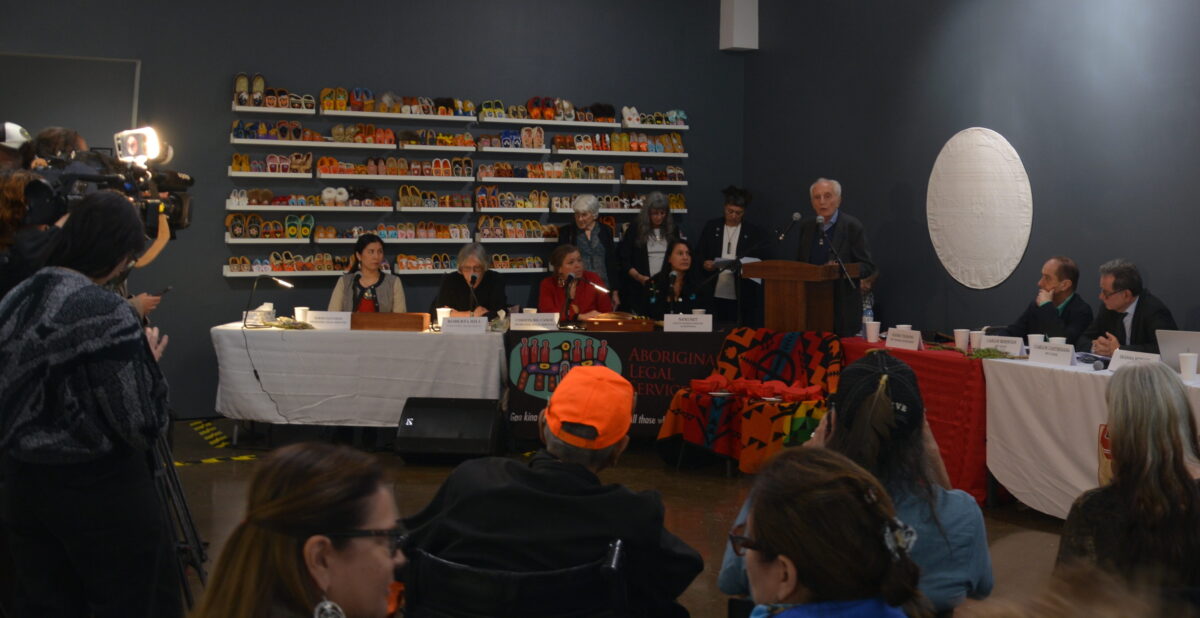
At the daphne art centre in Tiohtià:ke on Friday, those in the room and watching the live stream heard the judges from the Permanent Peoples’ Tribunal read out their verdict: the government of Canada has committed and continues to commit genocide against Indigenous Peoples.
The interim ruling, put together by the Tribunal’s panel of seven judges, found that Canada had not just committed genocide in the past towards Onkwehón:we, but that its current policies mean the genocide is still ongoing.
“They asked us to prove or demonstrate genocide, and that’s what we aimed to do, and that’s what the witness testimony and the survivors, particularly, were able to contribute to their finding,” said Aboriginal Legal Service legal director Christa Big Canoe, the leader of the prosecution.
The Permanent Peoples’ Tribunal is an international organization that was founded in 1979 to investigate crimes related to human rights violations.
During the week-long proceedings, the panel of judges heard stories of abuse and trauma from survivors and witnesses of the residential school system, as well as the long-term, multigenerational impacts of the attempts to eliminate Indigenous culture and separate families.
“Its responsibility towards Indigenous Peoples for genocide and crimes against humanity is not only historic, but also contemporary and continuing,” said Tribunal judge Valmaine Toki.
“We see a continuing denial of Indigenous sovereignty over their data, their land, and their bodies, and other violations of Indigenous People’s rights. This pattern reveals clear implications of a continuing genocide,” said Tribunal judge Seánna Howard.
On Friday, many at the daphne art centre were emotional during the reading of the ruling, after a difficult week that brought up bad memories for many.

“Telling the story is always going to hurt,” said Big Canoe.
“Truth needs to be heard and accepted to be truth. So, it’s not about wanting to retell the story over and over again. It’s about the true sharing process. It’s about acknowledging the harms and figuring out a way to get a path forward.”
But, for many, hearing the ruling given was a meaningful recognition of the pain Indigenous people have gone through - and continue to go through - as a result of the Canadian government’s actions and inactions.
“This is something that gives me hope, and it’s a long journey, but it’s a beginning,” said Roberta Hill, a member of the Survivor’s Secretariat and survivor of the Mohawk Institute Residential School in Brantford, Ontario, which closed in 1970.
“I am thankful for what was brought today, and for the judgment, and we’ll continue on until we get a final resolution with this, and we get answers. It’s all we’ve ever asked for.”
Big Canoe said that the initial statement was everything they had hoped it would be.
“Hearing the decision today, it shows that the judges were listening to all the testimonies before them. The type of testimony that went to them were not all dissertations, they’re not what denialists are claiming about Indian residential schools or the survivors; they were truths. They heard the truth, they made determinations,” said Big Canoe.
Na’kuset, the executive director of the Native Women’s Shelter of Montreal, requested in 2024 that the Tribunal come and hold a session.
She said that she was looking to bring in an organization from outside Canada, because of the government’s inaction regarding the Calls to Action of the Truth and Reconciliation Commission of Canada, among others.
“We need accountability, because it’s not in the history books. When children learn about residential schools, they’re not going to learn about the fact that there are graves behind the residential schools,” she said.
“It’s going to be forgotten. It’s going to be put under the rug, like it is now. I needed to bring this to the world’s attention.”
Na’kuset said that the ruling was not surprising, all things considered, but it was still the result of the work put in by the prosecution team, which included Big Canoe.
“Christa was great at presenting the types of information that the judges needed to hear to give them clarity,” said Na’kuset.
“One of the co-chairs, Frances Webber, said that they want to take this now to the Vatican. We need to continue with this momentum and forge forward, because on September 30, if we bring enough awareness to this, then the outcome could be greater when that announcement comes.”
Crown-Indigenous Relations and Northern Affairs Canada (CIRNAC) spokesperson Maryéva Métellus said that the government is continuing to support Indigenous people, including survivors of the residential school system.
“The government of Canada is working with partners, including survivors, Indigenous leaders, and families and communities to support healing, address historical injustice, and advance reconciliation. This includes ongoing work to respond to the Calls to Action of the Truth and Reconciliation Commission of Canada and to build renewed relationships with Indigenous Peoples based on respect, partnership, and recognition of rights,” said Métellus.
Sign up for email updates from The Eastern Door
“We will continue working with Indigenous partners to support education, commemoration, and community-led healing initiatives for survivors, families, and future generations.”
No representative of the Canadian government was present during the week’s hearings.
“If they show up, how are they going to be defending themselves?” said Na’kuset.
“When the government is in control by financing and overseeing everything, then they’re able to pretend that they’ve accomplished something when really, they haven’t. Then it’s all up to the Indigenous people to show up, testify, to be retraumatized.”
A full ruling is expected to be given on September 30, which is Orange Shirt Day, also known as the National Day for Truth and Reconciliation.