Review: ‘Stone and Bone’ unearths history
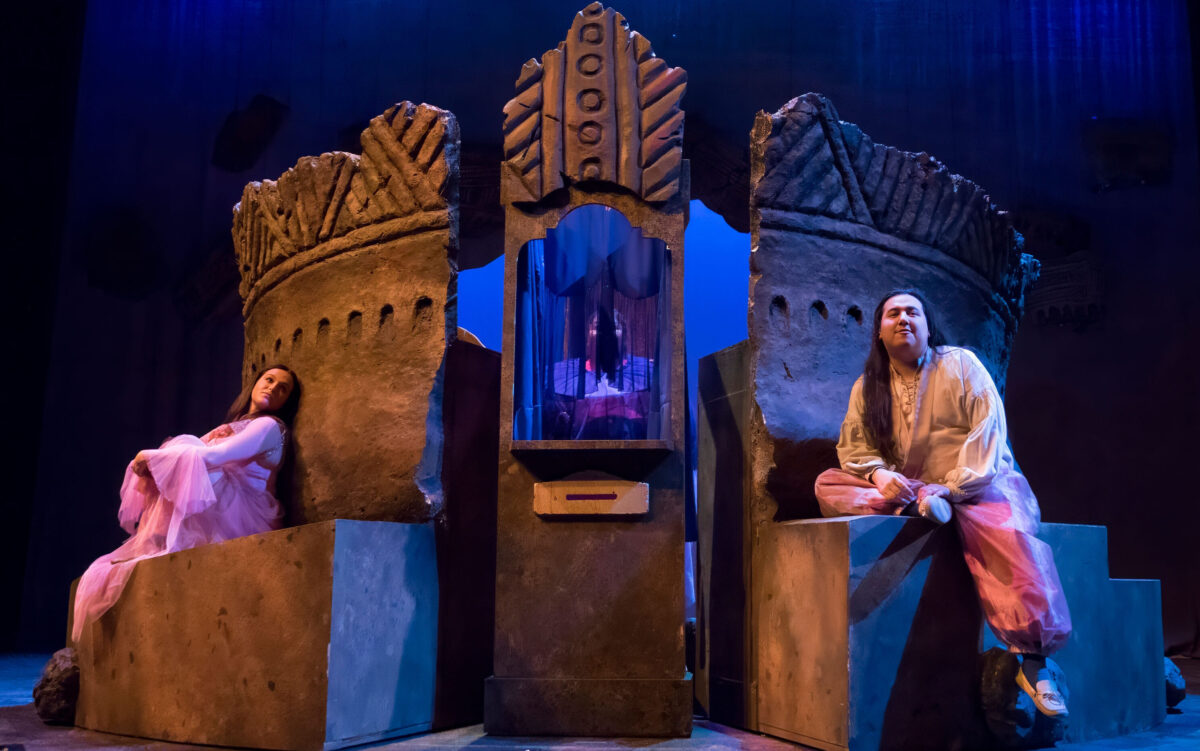
Véronik Picard and Iota’keratenion Thomas-Beaton performing Stone and Bone at the Centaur theatre. Courtesy Selina La Farciola
Stepping into the Centaur Theatre, the audience is greeted by the bold ambition of Stone and Bone Spectacular, a vibrant production that seeks to re-sculpt the narrative of Tiohtià:ke through a Kanien’kehá:ka perspective.
Fusing theatre, dance, and puppetry, it’s a work that feels constantly in motion, as if time itself were shifting under the stage. Written and directed by multidisciplinary artist Ange Loft, in collaboration with Barbara Kaneratonni Diabo and Iehente Foote, this production emerges from Centaur’s inaugural Indigenous Artist Residency.
I didn’t quite know what to expect. What I experienced was less of a traditional play and more of a living excavation, a collage of movement being unearthed before our eyes. It felt like a reclaiming of Montreal’s land, history, memory, and ancestral storytelling with both humour and heartache.
A stone-like structure rearranges itself throughout the performance. At times it resembles Mount Royal, a place of gathering and dialogue, and an archaeological dig site of construction built on unacknowledged remains. The performers dig, dance, and reclaim fragments of the past. The lighting design layers soft blues and golds over the stones, creating a dream-like atmosphere.
What made this play so thrillingly immersive was a monkey twisting and swinging with an unrestrained vitality that feels both childlike and primeval. The aerial choreography is interactive as the monkey dangles above the audience, the boundary between stage and spectator dissolves and gasps turn to laughter.
The moment encapsulates the play’s essence: history not as something distant, but something hanging above our heads, about to drop into our present.
Later, another performer begins lifting heavy stones in a sequence that feels both athletic and ceremonial. The audience claps instinctively, cheering as though at a weightlifting competition. But the stones are symbols of history, grief, and endurance. Each lift feels like an act of resistance, a reclaiming of strength.

The scene captures one of the production’s key achievements: it invites the audience’s participation, then transforms that energy into reflection.
The costumes are flowing, iridescent fabrics and translucent textures, adding to the ethereal and whimsical quality and vulnerability of the play. They shimmer in soft lighting, fluttering with every movement. The whimsy, though, is layered over something much heavier. Beneath the humour, music, and playful choreography lies an unflinching examination of colonial violence and cultural erasure.
This dream-like aesthetic creates a mesmerizing dissonance. The world onstage looks like a fantasy, but the words and gestures carry the gravity of colonial violence, stories buried, and land theft. It’s a haunting juxtaposition: beauty draped over brutality, laughter echoing over loss, giving Stone and Bone its emotional core.
The ensemble, including Barbara Kaneratonni Diabo, Iehente Foote, Wahsontí:io Kirby, Veronik Picard, Iota’keratenion Thomas-Beaton, and Dylan Thomas-Bouchier, move throughout the stage and through the audience in constructive dialogue. Their work is precise but fluid, steeped in ritual and community.
The soundscape, layered with drums, wind, and whispers, turns the theatre into something between a dream and a memory.
For a theatre built within the Old Stock Exchange, a literal monument to colonial commerce, this production feels like a reclamation.
Loft and her collaborators have turned the stage into a space of resurgence, where Indigenous presence isn’t just acknowledged but celebrated.



One of the most striking achievements of Stone and Bone is its willingness to challenge how Montreal’s history is told, especially on land that has long been inhabited by Indigenous Peoples.
The production rejects A conventional linear plot and instead embeds a sense of layering to each scene, no matter how disparate, adding another facet to the excavation like unearthing shards from different eras, each contributing to a fuller mosaic of memory.
There’s a sense of urgency, and unpredictability that keeps the audience alert and unsure of what will emerge next: a dance of beavers, an aerial sequence, a song of loss. That sense of wonder, of constant discovery, is precisely what gives the production its power.
The production’s narrative can feel tangled at times, and its transitions can feel abrupt, but that gives meaning to the show. Few plays dare to be this immersive, this emotionally-layered, visually cinematic scene invites us not just to watch history, but to feel its texture: rough as stone, fragile as bone.
Stone and Bone Spectacular unfolds like oral storytelling - living, breathing, and adapting in the moment. It asks the audience to listen differently, to find meaning in rhythm, and repetition, rather than linear resolution.
That might challenge some viewers, but it also rewards those willing to engage with the piece on its own terms.
This production reminds us that storytelling is survival, and survival can be joyous. As the final lights dim, a hush fell over the audience, that rare kind of silence born from witnessing something ancient made new again.
Sign up for email updates from The Eastern Door
What lingers is not just the shimmering imagery or the echoes of applause, but the sensation of connection to land and history. Stone and Bone Spectacular breathes life into Montreal’s buried histories, turning pain into poetry and reminding us that even the heaviest stones can be lifted when lifted together.
Stone and Bone Spectacular runs at Centaur Theatre until October 26.