Backlogged requests continue countrywide

File photo
Despite Kahnawake’s health authority reporting some progress in turnaround times for approvals of Jordan’s Principle requests, advocates at the First Nations Child and Family Caring Society remain concerned about ongoing backlogs which they say could result in children across Canada receiving delays in care.
“Canada has not yet publicized a plan on how they’re going to address the backlog,” said Brittany Mathews, director of reconciliation and strategic policy at the Caring Society. “First Nations and other experts have certainly provided Canada with options and solutions, but as far as we can tell, Canada’s not taking any of that up.”
Earlier in January, acting assistant deputy minister for Jordan’s Principle Julien Castonguay was cross-examined at the Canadian Human Rights Tribunal (CHRT), as part of a human rights complaint against Canada by the Mississaugas of the Credit First Nation. There, Castonguay confirmed that the Jordan’s Principle backlog is still at 130,000 requests nationally - a decrease of only 5,000 from the reported backlog by Indigenous Services Canada (ISC) in their March 2025 report to the CHRT.
The backlog has swelled since March 2024, when ISC reported that backlogged requests stood at between 40,000 and 82,000, leaving questions about the government’s ability to manage the volume of requests.

An audit of Jordan’s Principle in May of last year found that an increase in requests and limited human and financial resources was making services unsustainable, with recommendations made to change the backlog management process.
“I do think that Canada does have the manpower to do this, I do think they have to install some quality assurance pieces in here,” said Mathews, who said that Canada’s current methods for managing requests slows down the process.
“The fact, for example, that they’re relying on an email intake system is absolutely ridiculous,” she said. “There is no other large-scale government initiative or program that relies on email intake systems such as this, so there’s very simple and quick steps they could do to ensure that at the very least they’re not adding to the backlog.”
Earlier this week, The Caring Society also submitted a response to the CHRT concerning Canada’s request to approve a Final Settlement Agreement regarding long-term reform of the First Nations Child and Family Services program.


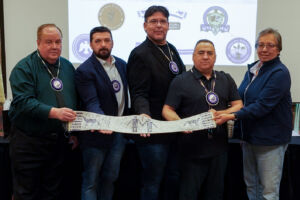


Canada has already negotiated a separate region-specific agreement for long-term reform with the Chiefs of Ontario and the Nishnawbe Aski Nation, and had asked the CHRT to approve that final agreement without condition, ending the CHRT’s supervisory jurisdiction.
The Caring Society, however, has advocated for national minimum standards for Child and Family Services, a different approach to Canada’s proposed national plan that they outlined in submissions to the CHRT at the end of last year.
Mathews said that approving the Ontario plan and ending the Tribunal’s supervisory role could be a blow for First Nations.
“I think it’s important that the Tribunal maintains a supervisory role and maintains jurisdiction in Ontario and nationally. We’ve been able to make great strides forward in addressing Canada’s discrimination and making sure that First Nations kids have a chance at fairness because of the Tribunal’s ongoing supervision of Canada,” Mathews said.
Sign up for email updates from The Eastern Door
“Canada’s conduct when it comes to Jordan’s Principle really shows that they are still choosing to put their own interests ahead of First Nations kids. That is unfair, and that needs to stop.”
ISC did not return The Eastern Door’s request for comment in time for publication.