Assembly votes on settlement agreement

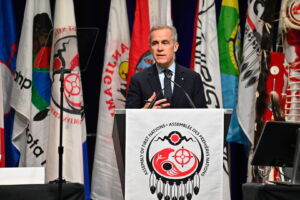
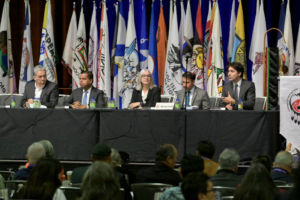
After an arduous Special Chiefs Assembly this week, a proposed $47.8 billion final settlement agreement (FSA) on long-term reform of the First Nations Child and Family Services Program was rejected by the membership of the Assembly of First Nations (AFN).
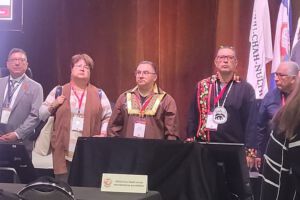
The three-day assembly began on Wednesday in Calgary and is continuing today, Friday. Kahnawake Shakotiia’takehnhas Community Services (KSCS) executive director Derek Montour and Mohawk Council of Kahnawake (MCK) chief Arnold Boyer were in attendance on behalf of the community.
The agreement itself concerns a deal made in July between Canada, the AFN, the Chiefs of Ontario, and the Nishnawbe Aski Nation, after the Canadian Human Rights Tribunal (CHRT) ruled that Canada’s underfunding of on-reserve child welfare services was discriminatory. The CHRT ordered Canada to forge an agreement with communities to reform the system long term and provide compensation to children who had been affected by the system.
While the AFN wants to push ahead with the agreement, it has proved to be controversial. Leading child welfare advocate and executive director of the First Nations Child and Family Caring Society (FNCFCS) Cindy Blackstock believes that it doesn’t go far enough, and argues that the agreement would actually give Canada new powers over First Nations and their child welfare agencies.
In another settlement agreement, Blackstock led the fight for more children and families to be covered by a historic $20 billion compensation package, ultimately securing an extra $3 billion after arguing that some individuals were left behind in the agreement.
At the time, the agreement for long-term reform was also secured in principle for $20 billion, though the final amount agreed upon in July is more than double that.
The Caring Society opposes this agreement on similar terms to Blackstock’s initial opposition to the compensation agreement. She said it doesn’t ensure the urgent long-term reform needed.
Blackstock told The Eastern Door in an interview ahead of the Special Assembly that the agreement will not serve children harmed by the system.
“We’re very concerned about how the agreement takes away decision-making from First Nations,” she said.

The agreement also enmeshes layers of bureaucracy that would ultimately decrease transparency in reform processes, Blackstock said.
“I’m a big believer that when we’re dealing with other people’s children, we have to be open, transparent, evidence-based, and accountable,” she said.
In contrast, the AFN and other parties implored chiefs to vote in favour of the FSA at the Special Assembly. Many put forward the argument that a future Conservative government could be harder to negotiate new terms with.
Lawyer Julian Falconer, who is the legal counsel for the Nishnawbe Aski Nation and who has also worked with the Mohawk Mothers in court, said that Pierre Poilievre would be harder to negotiate with than Justin Trudeau.
“When I’m told that we can go back and we can negotiate A, B, and C, who is that with? It’s not with the Trudeau government. It’s with the Poilievre government, whose mandate when – not if, when – they succeed is to stop giving you money,” he said.
“I cannot make Mr. Poilievre a compassionate person. I can’t do it. And when we understand that our options are very limited, I think that puts this agreement in a different light.”
Blackstock also spoke to attendees and addressed directly the question of how the unapproved FSA would survive if a Conservative government attempted to defund the CHRT.
“If the CHRT was defunded, the orders don’t just disappear. The orders are there until they’re replaced by another legal order,” she said. “I’m older now. I lived through the Harper years, and the CHRT survived through the Harper years.”
Representatives from the FNCFCS who had been through the care system also shared their experiences with attendees. André Bear, who is Nêhîyaw, emphasized the importance of ensuring that the agreement does the absolute most it can for those affected by the system.

“I’m a former child of care. I remember the day when I was four years old and I was ripped out of my mother’s arms by a social worker and I was placed with a white family. We have an unprecedented opportunity,” he said. “We crushed Canada at the CHRT, and this moment is critical, because for the first time we truly have the ability to hold Canada accountable to the atrocities that they have committed against our kids.”
He asked chiefs to focus on ensuring the best possible deal in the FSA, and not to settle for less.
“This is bigger than the AFN. This is bigger than their legal team. This is bigger than Canada,” he said. “The decision we will make here will have a lasting impact on our children suffering in the child welfare system today, and those who are going into the same harmful system tomorrow.”
Falconer spoke after Bear and had said that what Bear expressed about negotiation prospects at the CHRT may not work under a Conservative government.
“That’s the Tribunal in the current conditions, and not what I as a negotiator fear is going to happen,” he said. “And it’s not rocket science. That’s how it works.”
Angela Levasseur, a chief from the Nisichawayasihk Cree Nation, said that she found Falconer’s comments inappropriate.
“I want to say that I felt that Julian, you were a little disrespectful and condescending towards Mr. André Bear, and I did not appreciate it,” she said.
Levasseur told the Assembly that her first grandson had been born at 8:30 a.m. that morning, but she had made the decision to miss his birth due to the gravity of the discussions taking place at the AFN. She encouraged everyone to acknowledge the depth of what was being decided on.
“This FSA arose with the ultimate purpose of addressing and eliminating, or at least alleviating, racism and discrimination in the provision of child and family services to First Nations,” she said.
Sign up for email updates from The Eastern Door
“Canada has created and perpetuated the poverty that has caused many of our children to be in care. True prevention would be giving us our land and our resources back, and there would be no need for prevention dollars.”
She emphasized the importance of heeding the FNCFCS’ warnings to ensure that long-term change comes to the child welfare system.
“Money alone will not address issues related to racism and discrimination, policies must change,” she said.
AFN national chief Cindy Woodhouse acknowledged the differing opinions on the agreement and asked chiefs to work together towards an agreement.
“I’m not trying to hurt anybody. I just want to help First Nations,” she said. “This is your agreement to consider, and I will take whatever direction you give me, but I do say let’s try and come together and find a common way through this, because it’s too much money to just wipe off the table and leave to the courts.”
A total of eight draft resolutions, including the FSA, were scheduled to be voted on before 5:30 p.m. Calgary time on Thursday, though no decisions were made before The Eastern Door’s publishing time.
Note: This article was updated to reflect the result of the AFN vote, which was not available by press-time.