Appeal fails at Supreme Court
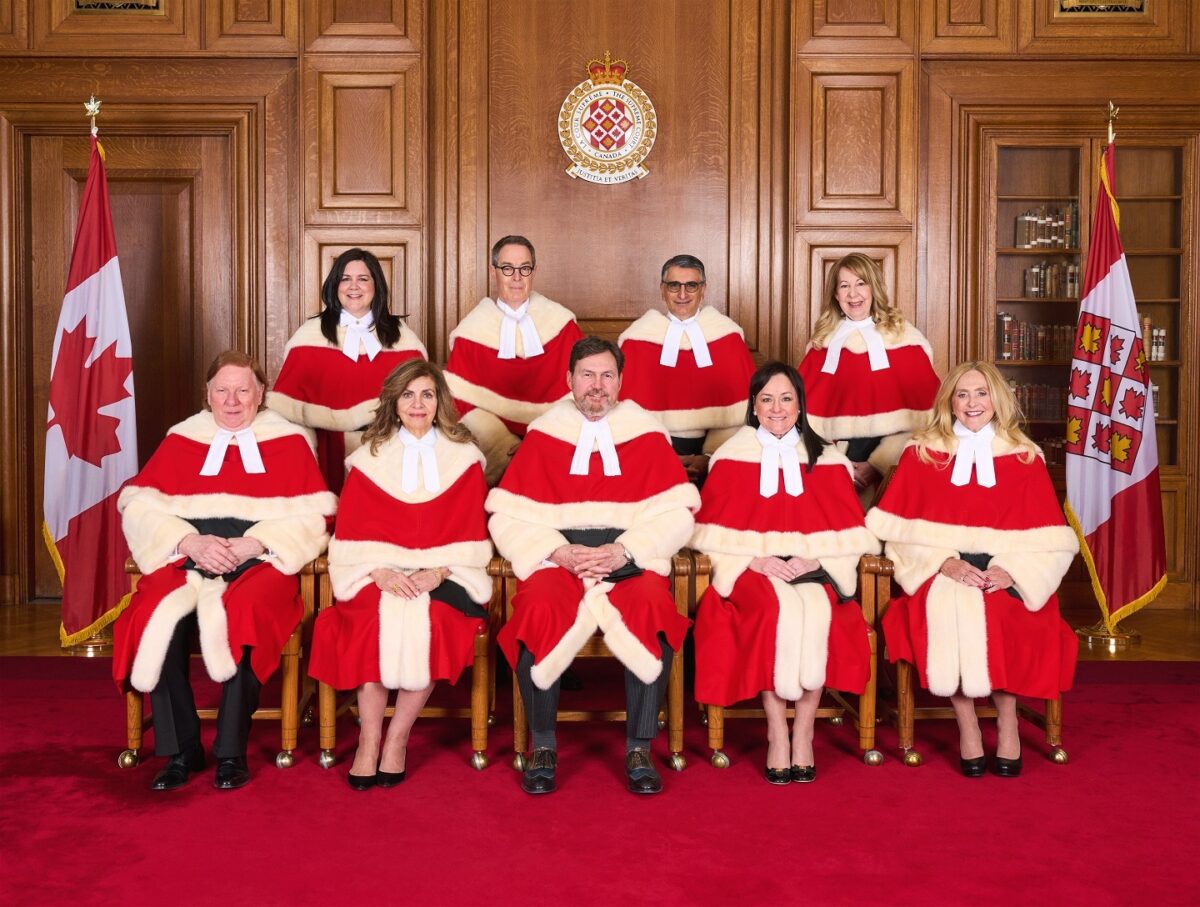
Judges on the Supreme Court of Canada.
While Kahnawake’s legal counsel believes the worst outcome was averted for First Nations across the country, the Supreme Court of Canada’s ruling against the Mohawk Council of Kanesatake has nevertheless left that community, already strapped for cash, forced to consider its options for a debt of $2 million and counting.
While it was Kanesatake’s appeal, the Mohawk Council of Kahnawake was the sole intervenor in the case, motivated by the potential for the ruling’s broader ramifications for First Nations.
At issue was whether a creditor’s attempt in 2016 to seize property that is unseizable - property on reserve is protected from seizure by non-Natives by Section 89 of the Indian Act - was enough to reset a 10-year limitation on the collection of a debt owed by Kanesatake Council. This process is known as interrupting prescription.
The debt goes back more than 20 years, when a 2004 judgment ordered Kanesatake to pay $700,000 to Louis-Victor Sylvestre and other professionals who had done work to assist Council in confronting a Niobium mine that had been planned for Oka. At the time of the 2004 judgment, Kanesatake was under third-party financial management.
“I think Kanesatake was outright robbed,” said incumbent Council chief Serge Otsi Simon, who was Kanesatake grand chief in 2016 when Sylvestre attempted to seize band property, adding that it shouldn’t have been Kanesatake’s responsibility to foot the bill for that fight in the first place. “Yes, he did go ahead and fight the Niobium mine, did all the studies, but I’m not entirely sure that’s what led to the project being dropped.”
The debt has been accruing interest ever since.
Nicholas Dodd of Dionne Schulze, who represented Kanesatake’s Council at the Supreme Court, pointed out that band councils, unlike corporations and individuals, cannot declare bankruptcy, meaning that if creditors are allowed to reset the window for collecting a debt indefinitely, it could become insurmountable.
“That’s why it’s very frustrating and, I feel, very unjust,” Dodd said.
He was disappointed with the judgement, which he feels could put other debtors, including Indian Act bands, at further disadvantage. One issue in the case was the fact that a bailiff, having concluded that the property was exempt from seizure, failed to serve his minutes of suspended execution to Kanesatake Council and did not prepare minutes nulla bona attesting he had found no property to seize.

“It means that bailiffs aren’t required to document an unsuccessful seizure, which, as it did in this case, can create real confusion around what’s actually happened and what people’s rights are,” Dodd said.
He said this is why arguments on behalf of the Mohawk Council of Kanesatake focused on the need for formalism in debt collection.
“Other than throwing people in jail, one of the worst things the state can do is use its power to take people’s property and money, and that’s what a seizure is, using state power to take people’s property,” said Dodd.
“In that circumstance, you want formalism because formalism ensures that no abuses are committed and that everything is done with the utmost respect for debtors’ rights. That’s what I think is lost by the Supreme Court in its judgment.”
The Supreme Court, which issued a unanimous ruling against the appeal, determined that the bailiff suspending the seizure didn’t matter, nor did the bailiff neglecting to notify the debtor that the seizure had been suspended. “With this decision, the Court gave clarity and certainty to both creditors and debtors about how judgement debts can be enforced and what types of events can interrupt prescription,” the Court wrote in a brief summary of the judgement.
Meanwhile, a separate case involving a lien on 104 square acres adjacent to Tioweró:ton, held in trust by Kahnawake and Kanesatake, will now be able to proceed after the Supreme Court determined that the window for collecting the debt was reset by Sylvestre’s attempt to seize unseizable property.
Eric Doucet, a lawyer for Kahnawake’s Council, said he could not comment on the Tioweró:ton action because it is before the courts. However, he said he was not surprised by the Supreme Court’s judgement, which reflected the questions the justices chose to ask.
“Clearly it’s not the ruling that Kanesatake wanted because now the clock has restarted for them, at least with the facts that involve them in this case,” Doucet said.
Yet, while the Supreme Court had requested submissions based on Section 89, the court chose not to address this directly in its decision relating to the interruption of prescription.



“I’m happy that there’s no legal precedent with respect to Section 89 of the Indian Act. That’s a good thing,” Doucet said.
He noted the recourse suggested by the Supreme Court of pursuing an abuse of procedure application to dismiss an unfounded notice of execution to collect on a debt. Had the Court decided there was no remedy at all, band property off reserve could have been seized based on astronomical debts as they compounded, Doucet said, even if on-reserve assets are protected.
“A First Nation isn’t necessarily restricted to the resources that they have within the reserve. They’ve got their broader traditional territories, and it’s in keeping with economic reconciliation to have First Nations be able to participate in economic development projects that are outside of the reserve,” he said. “So as soon as you make any investment off reserve, that would have been easily seizable.”
Kahnawake has several such investments.
However, Dodd was not satisfied by the court’s reflections on the possibility of a debtor attacking a notice of execution as an abuse of procedure.
“The court does say maybe you could bring a claim for abuse of procedure, but it doesn’t say anything about whether that claim would be successful or not,” he said.
The possibility didn’t come up until a justice asked a question about it, said Dodd.
“I can honestly say that I don’t understand what role the court believes abuse of procedure plays here.”
However, it is not a forgone conclusion that the debt will now be paid by Council, and Council could still try to parry the debt if the creditors are not willing to compromise and Council chooses to fight. That’s not to say it would be easy.
Sign up for email updates from The Eastern Door
“It’s clear that it’s a very difficult situation. What exactly this means going forward is somewhat unclear,” said Dodd.
Simon expressed relief that the court did not set a harmful precedent on Section 89 that could have been widely applicable to other First Nations, but he is concerned about how the debt could affect his community in the wake of the ruling.
“The bottom line is we’re $2 million in debt. Regardless of what their reasoning was, it doesn’t matter,” Simon said.
“Here we are, eight percent a year. A $375,000 debt is now $2 million. I’m not exactly sure how the band is going to cover that cost without sacrificing some of the services, what little services they do get. How are we going to go about that?”
Sylvestre and the law firm that represented him did not respond to emailed requests for comment by deadline.
Marcus Bankuti, Local Journalism Initiative Reporter