Update on maple sap contamination

File photo
Lead has been detected in metal buckets and taps used by Kahnawake Survival School (KSS) for maple sap collection, but more investigation is needed to determine the extent to which lead may still be a concern after the equipment is replaced.
The sap that was collected as part of KSS’s sugar shack initiative was being consumed by students in its raw form and concentrated in maple syrup until the finding shuttered the program, shocking parents and the community at large.
“One thing it tells us is there might be two things happening at once,” said Patrick Ragaz, director of KEPO, of the most recent results. “We’re still finding lead at moderate levels in the sap collected directly from the trees into our sampling containers.”
The original testing of the sap was undertaken as part of KEPO’s efforts to determine the extent to which the area may be impacted by revelations relating to alleged environmental violations at the nearby Ste. Catherine Industrial Park, particularly the Terrapure battery and plastics recycling facility. Alongside the city of Ste. Catherine, this plant was charged under the Fisheries Act in autumn, a fact that was only discovered by Kahnawake earlier this year.
It was subsequently revealed by Radio-Canada that the Monteregie public health authority had compiled an unpublished report detailing concerns at the plant about workers’ exposure to lead, a heavy metal known to cause an array of health problems.
Terrapure has previously defended its practices to The Eastern Door, saying that compliance with the law is a priority for the company and pointing to its valid operating permit from the province, which was renewed in 2025.
Concerns about Terrapure have been especially worrisome given the proximity of the school, which is less than a kilometre from the plant. KSS previously had to be moved from its old site in the 1990s, even closer to the industrial park, because of heavy metal contamination on the school grounds.

“We’re all worried for the kids and the staff, so that’s why we’re going at every bit of testing that we can to either relieve some concern or to address if anything comes out in the future,” said MCK grand chief Cody Diabo.
He said Council is currently focused on gathering data and pushing for more information from external governments.
“I know a lot of community members are very upset. A lot of them are not wanting the industrial activities to happen around our community anymore,” he said. The industrial park is on territory covered by the Seigneury of Sault St. Louis land grievance, he emphasized.
KEPO is conducting a range of tests not only on the maple sap and syrup, but is also working on a sampling grid for soils on the site and imminently installing enhanced air quality detectors that are capable of identifying lead in the air in response to renewed concerns arising from the Terrapure file.
“We’re sticking with it and still meeting internally on a weekly basis and with other stakeholders as well. At the end of this, we’re certainly going to have a good understanding of the impacts from the industrial park and how that’s impacting the school grounds,” said Ragaz. “This latest incident has really helped us move that project forward.”
Community members concerned about their own maple sap collection equipment can contact KEPO for analysis.
The contaminated metal is being removed from the KSS maple program, along with plastic that is not deemed food-safe, but no lead was detected for the evaporator or other sugar shack equipment. KEPO is currently working on testing syrup samples.



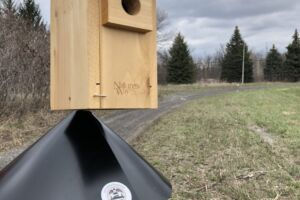
The latest tests of sap found between 2.5 and three micrograms of lead per litre in samples directly from trees using plastic taps, which would translate to an acceptable level of lead in syrup according to industry standards, while plastic bucket samples had up to 10 micrograms of lead.
While 10 micrograms per litre, concentrated into syrup at a 40:1 ratio, would exceed provincial standards, it is still far less than the more than 40 micrograms of lead per litre found in some sap collected in the metal buckets.
According to Kahnawake Education Center (KEC) education director Falen Iakowennaié:was Jacobs, parents were invited to an in-school committee meeting in April to address questions and concerns.
“We haven’t seen a dip in attendance with students, so that indicates to me that students and parents still have trust in KSS and KEC decisions around their students’ safety,” said Jacobs. Environmental updates are going to be a continuing item on the committee agenda, she added.
“We know there are environmental concerns that are happening around us,” said Jacobs. “How do we work together as a community to take a stand against that while ensuring that our school continues to be able to operate and continue its mission and mandate that we have for the school?
“That will come with consistent monitoring, consistent collaboration with KEPO, and working closely to ensure the present grounds of KSS continue to be a safe place for students and staff.”
Jacobs is hopeful the maple program will be up and running again next year, serving its role in helping the school fulfill its mandate.
Sign up for email updates from The Eastern Door
“It teaches students responsibility, respect for the land, respect for the medicines the land provides us,” said Jacobs. “It emphasizes food sovereignty and sustainability and ensuring we’re able to sustain ourselves as a people. There are so many teachings and principles and concepts that are reinforced through a program like that. Collaboration, working with one another, there’s hard work that goes into it,” she said.
“It’s a very beneficial program that we hope to have running at the school for a long time.”
Marcus Bankuti, Local Journalism Initiative Reporter