Supreme Court denies leave to appeal
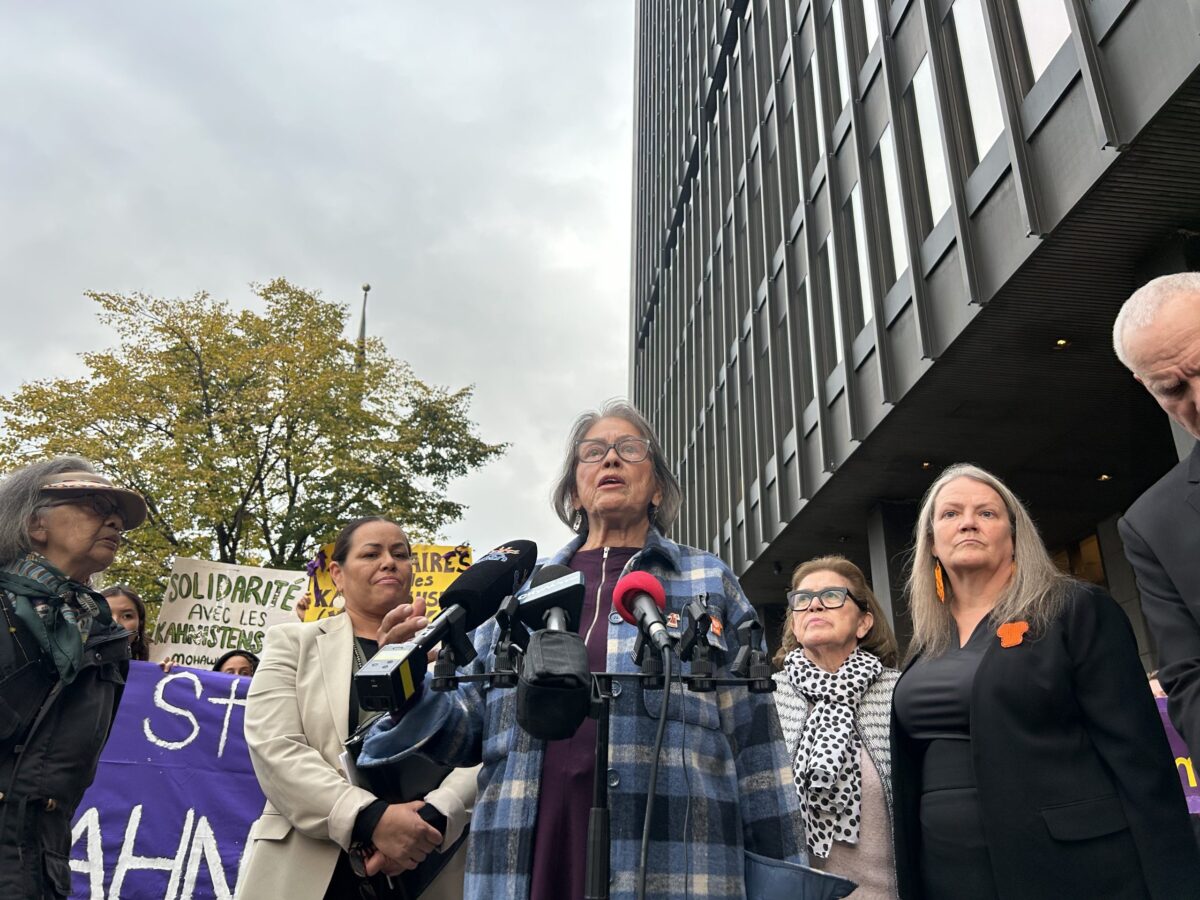
The Supreme Court of Canada has refused to hear an appeal from the Mohawk Mothers that sought to overturn a lower court’s decision to lift a safeguard order initially granted to the group for work being undertaken at the site of the former Royal Victoria Hospital at McGill University.
The Mothers, also known as the Kanien'kehá:ka Kahnistensera, say they have reason to believe there could be unmarked graves at the site, which formerly housed the Alan Memorial Institute, where infamous MK Ultra experiments were undertaken on patients.
The area is currently being redeveloped as part of the New Vic project, with a new teaching hospital slated to be completed by 2028.
The Mothers were initially granted a safeguard order in November of 2023 by Justice Gregory Moore at Quebec’s Superior Court, but that was overturned after McGill University and the Société Québécoise des infrastructures (SQI) took the issue to the Quebec Court of Appeal, which ultimately decided that Moore had “misapprehended the scope of his power” in making his decision.
This aspect of the overall case was the focus of the Mothers’ October 2024 appeal application to the Supreme Court.
The Supreme Court of Canada is the highest court that could hear the Mothers’ appeal of that decision, so their refusal to hear the appeal means that there are no other avenues the group can take to reverse it.
“We’re dealing with a system that is not our system,” said Kwetiio, one of the Mothers.

She said that she knows the Supreme Court accepts very few appeals to hear, but that the group had still been hopeful when they submitted their case.
“We were looking for a different body that could give some clarity, or bring to the public’s attention that this system doesn’t work. It doesn’t give justice. So, by putting it to the Supreme Court and having them say ‘no,’ it’s just reaffirming what we think.”
At the time of their submissions to the Supreme Court, the Mothers were being supported by Kimberly Murray, who was the special interlocutor for missing children and unmarked graves and burial sites associated with Indian residential schools. Since then, her mandate has come to an end, and Murray’s office has been dissolved, meaning that she is no longer an intervenor in the case.
She said that she will be continuing to follow the case despite no longer being an intervenor.
“I feel that it was a missed opportunity for the Supreme Court of Canada to speak to the importance of Indigenous-led collaborative searches for missing and disappeared children. It was disappointing, but not surprising,” Murray said.
In order for the Supreme Court to grant a leave to appeal – which means that they give permission for the appeal to be heard in the Supreme Court – the issue at hand must raise issues of public importance.
“By not granting leave, they’re clearly saying this isn’t of national importance,” Murray said. “And I respectfully disagree.”


The Supreme Court does not publish reasons for making a decision on whether or not to grant a leave to appeal.
“All we can do is infer,” Murray said, adding that it was another disappointing decision in the case, which has been before the courts for years now.
“They’re using the colonial judicial system and laws to hide the truth, and that’s exactly what the Truth and Reconciliation Commission said in its report, that the law has been, and continues to be, a tool to hide the truth,” she said.
The appeal only concerned one aspect of the overall case, and the case is still ongoing in the Superior Court.
“This doesn’t by any means mean that our case is over or that we’re dead in the water,” Kwetiio said. “We’re doing this for our children, we’re trying to find solutions.”
The SQI and McGill University responded to The Eastern Door’s requests for comment via email.
“The SQI has always expressed its willingness to shed light, in a spirit of cooperation, on allegations of the presence of burials,” said Anne-Marie Gagnon, a representative for the SQI. “The SQI and its partners are committed, in good faith and in a rigorous manner, to conducting and pursuing archaeological research accompanied by experts in the field.”
Sign up for email updates from The Eastern Door
McGill said that they are continuing to respect the homologated settlement agreement signed by all parties in April 2023, and that it is important to note that no human remains, or unmarked graves have been found at the site.
“McGill welcomes the Supreme Court decision, one that allows for previous agreements and the spirit in which they were written to stand,” McGill’s media relations office wrote.
Kwetiio said that the group is meeting this week to look over their options, and there will likely be case management hearings at the Superior Court in the coming months.