Remembering what happened in 1990

Thirty-five years after the start of the Siege of Kanehsatake, Kahnawake community members marked the anniversary at the greenspace next to the Mercier Bridge, as some do on an annual basis. Aaron McComber The Eastern Door
On Friday morning, Joe Deom was on the greenspace area near the Mercier Bridge, like he is every year on July 11, to show that Kahnawake is still here, and that it still remembers what happened in 1990.
“I’m here every July 11 to be visible, to have the motorists be reminded of what happened,” said Deom.
He said that this public remembrance is not just a matter of reminding people from outside the community, but also for community members who were not there in 1990.
“We know there’s a lot of young people who have no idea what happened 35 years ago,” said Deom.
That includes the blockade of the Mercier Bridge that same day by Mohawk Warriors from Kahnawake, which lasted until the end of August.
“Every year, people have to remember what happened. There was a raid, and they shot at our people, and we can’t just forget that. What we did here in Kahnawake in order to protect the people in Kanesatake from the raids, it was because the people in Kanesatake were protecting their land from encroachment. It’s all about land, and the protection of our rights to defend it,” said Deom.

Deom shared an anecdote about the events of July 11, 1990, when he was at the Mohawk Nation Office.
“They had the replay on the radio. There was a reporter there from CJAD who was given a play by play, like a football game, and then he’s reporting that the SQ have their loader, and they’re going to go to destroy the barricade,” said Deom.
The reporter corrected himself and said that it was, in fact, a Mohawk behind the wheel.
“Everybody there went ‘yay!’” said Deom.
Upon leaving the office, he found that old habits die hard.
“I was just sitting there, waiting for the light to change in my car. I said, ‘what the hell am I doing sitting here just waiting for the light to change,’ because there’s no traffic, all the entrances are blocked,” said Deom.



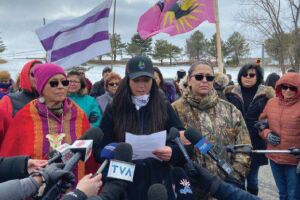
Bryan Akwirente Deer, who spent a lot of his time in 1990 on the Mercier barricade, shared his thoughts on how different the community felt during that time.
“It was really special. It was probably the most memorable summer because of how nice everyone was,” said Deer.
“People who didn’t get along, at that time because we were under crisis, they got along.”
He also felt that that summer was an important one in galvanizing other Indigenous communities to take action.
“Hey, if the Mohawks can do that, we can do that,” said Deer.
Teiowí:sonte Thomas Deer said that it also helped reaffirm the importance of being Kanien’kehá:ka culturally.
Sign up for email updates from The Eastern Door
“It generated interest again in our language and culture, and it was like a shot in the arm, and that blockade generation that went through it, they were the ones that ended up saying, ‘let’s make this happen. Let’s take up the ceremonies, let’s take up the language,’” he said.
“We knew we would get hurt, and for the longest time, there was no benefit at all, materially. But spiritually, it really raised awareness,” said Deom.
“I look internationally, because of what happened in 1990, it caused international Indigenous people all over the world to get their ass in gear and push for our rights.”
With files from Aaron McComber.