Racist murals lead to action
Shantak Vollant has been curling for around five years, but when she first stepped into “the shed,” as members of the Lachine Curling Club call their arena, she was surrounded by something she’d never seen before - something shocking and discomforting to her.
The Innu curler tried to focus on her game, but it wasn’t easy to forget the 12 murals hanging on the walls, scenes from a fictional match on the St. Lawrence River, set hundreds of years ago, between caricatures of Kanien’kehá:ka and French colonists.
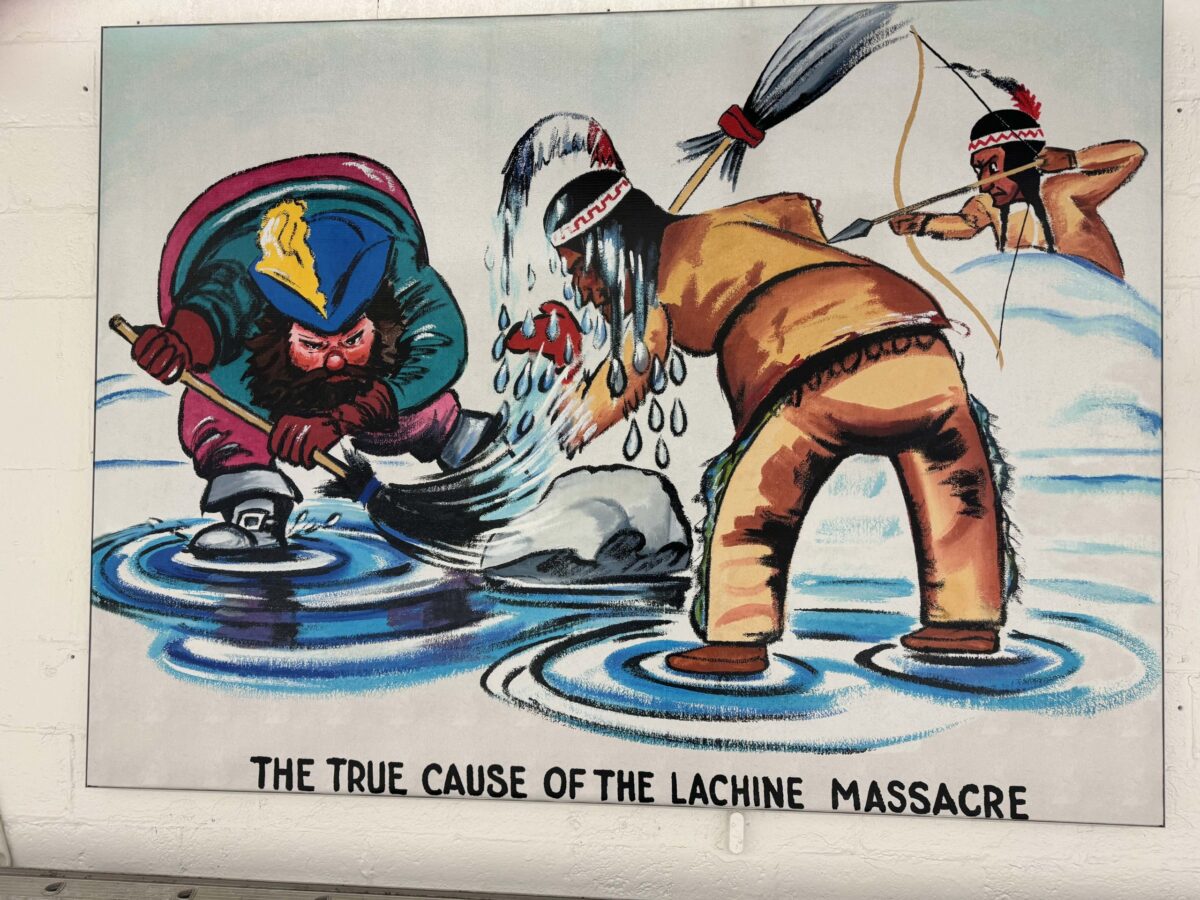
“To sweep or not to sweep,” reads one. The French man, musket on his back, passes his broom in front of a rock as a Mohawk man beside him, feather standing tall above his head, swings an axe.
In another, a teepee is captioned “The first clubhouse.” In front of it, Mohawks and French colonists protest with placards, including one sign held by a caricatured Kanien’kehá:ka man that reads “Want more fire in water.”
One mural (pictured above) depicts a Mohawk - identifiable like the others by his tan clothing, his long braids, his dark complexion, and his headband and feather - being splashed by melting ice as a French man sweeps. “The true cause of the Lachine Massacre,” it reads.
A knot clung to Vollant’s stomach as she threw the rock.
“When I saw that, I felt so sad,” she said.
“I heard so many things about the Indian when I was young,” said Vollant, a residential school survivor. “Now I don’t need to see that hurt.”
The panels appear to be from another era, yet less than 10 years ago, the club paid thousands of dollars to have the murals - originally painted on styrofoam in the 1960s - digitized and reproduced on banners. The club’s president Dave Stanway suggested this would not have been done had there been an inkling amongst the membership that there was anything wrong with them.
More than 95 percent are white, he acknowledged.
The disconnect between the club and Onkwehón:we who have seen the images reflects a schism that has often underpinned relations between Kahnawake and a province that doesn’t seem to understand the nature of the community’s demands for sovereignty and respect.

“In this kind of age, with all the pretention to reconciliation, this is really a bad thing,” said MCK chief Ross Montour. He evoked what happened at the Whiskey Trench in 1990, when Quebecers hurled rocks at Kahnawa’kehró:non elders, women, and children as they were evacuated over the Mercier Bridge at the height of tensions during the so-called Oka Crisis.
“Some of those people that were throwing rocks were from Lachine,” he said.
Upon being asked for comment on the murals by The Eastern Door, Montour instructed staff to draft a letter to be sent to Lachine mayor Maja Vodanovic and to the curling club demanding the murals be removed. The letter was expected to be sent by the end of this week.
“I think you have to confront this very seriously. We can’t really ignore it; it’s right over the river,” said Montour, expressing hope Vodanovic would share the MCK’s concerns.
“Those images, they certainly are racist in my view,” said Montour, who drew comparisons to sports mascots that stereotype Indigenous people.
“To think that these things, that they’re meant to be some kind of a joke - it needs to be gone.”
However, from The Eastern Door’s inquiries, it doesn’t seem a solution is immediately forthcoming. Vodanovic and Curling Quebec, of which the Lachine Curling Club is indirectly a member via the regional curling association, both said the issue is out of their hands.
“The Lachine Curling Club is a private organization that does not fall under the jurisdiction of the city,” said Vodanovic, reached for comment by Lachine communications staff while on vacation.
“We want to maintain our positive ties with our neighbours in Kahnawake. We understand that these images may be perceived in a negative light, which is why we will arrange a meeting between the curling club and the Mohawk Council of Kahnawake in order to open a dialogue, better understand the story behind these images, and find a solution that works for everyone.”
Quebec’s curling association meanwhile said the organization has no involvement in the murals and that the club is independently run. Instead, Curling Quebec’s executive director Alanna Routledge highlighted recent efforts to make curling more inclusive in the province, including a partnership with the Cree Nation of Chisasibi.
“As a courtesy to the Indigenous community, we will ensure that their concerns are communicated with the club,” said Routledge.

However, the curling club has not signaled a willingness to remove the murals, with the club’s president saying the artworks have become part of the character of the club. The panels were created by artist Noel Hollier in 1969 to commemorate the club’s 75th anniversary, with club members at the time even helping to colour the designs with household paints.
“There’s no derogatory connotation in any of them, I don’t believe,” said Stanway. “Some people can look at a cloud and see things differently.”
He noted that the French colonists and, in some panels, Scots in kilts, are caricaturized as well and that Mohawks are simply represented in recognizable garb to aid the depiction in a similar way.
“It’s something that if you were to try to depict in a cartoon an ethnicity, you wouldn’t show a Mohawk in a suit and tie and show a Scot in a suit and a tie and show a Frenchman in a suit and tie,” he said.
“If the Mohawks are going to have a powwow, they’re not going to show a picture of a Mohawk in a suit and tie.”
He said a recent poll was done of the membership asking how they felt about the murals, with only 10 of 110 members responding “needs improvement.”
“Times change, and attitudes change, and things change. It’s a lighthearted portrayal of a game that took place 200 or 250 years ago,” said Stanway. “I don’t think anyone should be offended by them. But that’s my personal opinion. And my personal opinion is held by many at the curling club.”
Stanway did acknowledge that he finds the panel referring to the Lachine Massacre to be in bad taste, but he said an understanding of curling would aid in the interpretation of most of the captions. He said he would be willing to host concerned community members to explain language they might be taking out of context.
However, feedback from Kahnawake community members has not seemed to stem from a lack of curling vocabulary.
“This isn’t freaking 1910,” said Kahnawa’kehró:non Donna McComber. “I know back in the day, even in the 60s it was tolerated, but now? It’s not like we’re not educated on it. It’s insulting.”
McComber has never curled, although her son Frankie McComber, Jr., once tried out the game at another club. So Donna did not encounter the images at a curling tournament, as Vollant did.
Sign up for email updates from The Eastern Door
She was instead at the Kanawaki Golf Club when Vollant took out her phone and shared the images, part of her efforts to let community members know how they were being portrayed for decades at a curling club just over the Mercier Bridge.
Vollant had previously mentioned the issue to an MCK chief, she said, encouraging them to look up the images. It was important to her to ensure Kahnawa’kehró:non could decide for themselves what they thought of the pictures and what should be done about them.
“When I saw this, I thought oh my God, why? We’re playing curling. I don’t know what to say,” Vollant said.
One person she spoke with told her the panels were meant to be humorous, but this didn’t help her make sense of what she had seen on the walls of a Montreal curling club in 2024.
“It’s not funny,” she said.
“Maybe they laughed about the Indian a long time ago, but now the Indian wants to be respected.”
According to Montour, failure to act following the MCK’s letter could result in legal action.