Parents seek Kateri statue removal
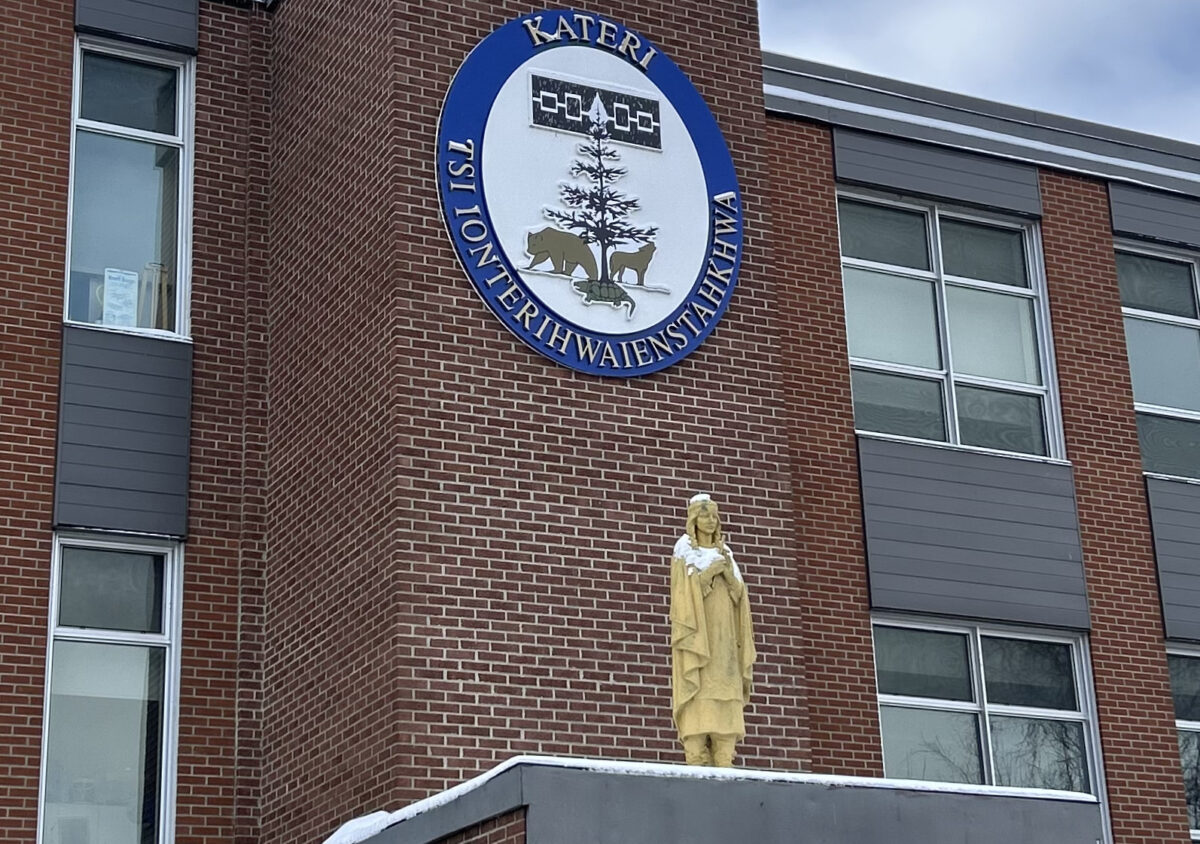
On the roof above the door facing River Road, just below the Kateri School emblem, stands a statue of the only Kanien’kehá:ka saint, the school’s namesake, Kateri Tekakwitha, her hands cradling a cross.
That should change, the in-school committee believes, but following a community meeting Wednesday night, it is unclear how Kahnawa’kehró:non want to move forward.
“The responsible thing as far as we’re concerned is the question needs to be brought to the whole of the community,” said Mohawk Council of Kahnawake (MCK) chief Ross Montour, who is on the education portfolio. Such a decision is the community’s prerogative, he believes – not the school committee’s, Kahnawake Education Center’s (KEC), or even the Council’s.
Tensions about the placement of the statue were unknown to many Kahnawa’kehró:non this time last week. The issue was thrust into the spotlight after a letter outlining its planned removal – and offering it to the St. Francis Xavier Mission Catholic Church – was forwarded by the Church Committee to the MCK, which slotted it into this month’s community meeting agenda.
Expressed on the schedule in just six words, it was the first time many community members had heard that the statue’s removal was under consideration. It didn’t take long for the matter to gain momentum on social media, even with little context.
The issue is the latest flashpoint as Kahnawake wrestles with how to balance the community’s history with a desire to strengthen traditional Kanien’kehá:ka culture, which many view as in conflict with Christianity, and at the same time reconciling abuses suffered by community members at the hands of the church.
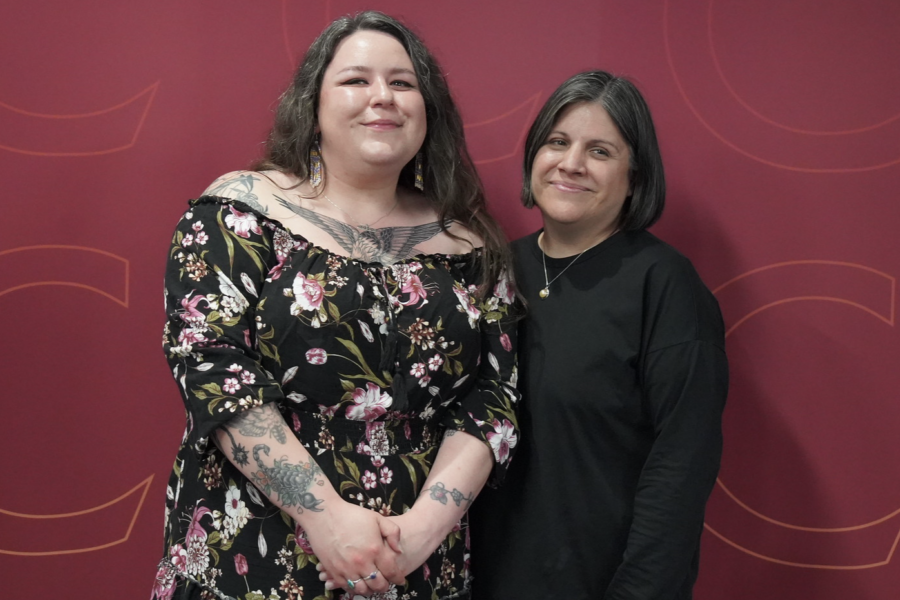
To Marnie Jacobs, a Kateri School mother who participates in the in-school committee, the statue is not in line with the school’s educational direction.
“My personal feeling about that is we are not a Catholic school. What she’s holding in her hand is a religious symbol,” said Jacobs.
“I have no issue with Kateri as an Onkwehón:we woman,” said Jacobs. “She’s Onkwehón:we. She deserves to be respected. I don’t want to see her legacy or the history of her tarnished in any way. That was not the intention with the request to the Church to have her statue placed there.”
Yet the Church Committee – and even many non-Christian community members – want the statue left where it is.
“She was more than just a Christian,” said Church Committee member Rheena Diabo about Kateri, who was canonized in 2012, making her the first Indigenous saint from North America. “She is a community member that has gained recognition all over the world, and it is a positive image that reflects well on our community.”
The Church Committee believes the statue that has long been at the school – which was once a Catholic Indian Day School, where Kanien’kehá:ka culture was systematically stripped away from students – is a common historical landmark on common land, and that it’s not up to just a few committees to decide its fate.

Diabo pointed out that instead of a name like St. Joseph, the school was uncharacteristically given a Mohawk name, which Diabo suggested was an indication that the community itself had lobbied for the school to be named after Kateri Tekakwitha.
In recent years, she said, the Church Committee has been actively advocating for change – cooperating with investigations into abuses at the church, supporting compensation for victims, and lobbying the Vatican for the pope’s apology, for instance.
“I just hope people really listen to each other, really take the time to understand where people are coming from,” said Diabo.
Her first concern when the Church Committee received the letter was for the congregation’s elders, she said.
“When these attempts are made to eradicate us from the community footprint – and that’s what it feels like, that’s how they’re made to feel – I guess I got angry for them because I knew what it was going to do to them,” Diabo said.
“Sure enough, when we had a meeting this week to explain the letters and how we were intending to respond, they were really upset. And I think about the people in the community who were given her name, how this is going to make them feel. I don’t think people really thought this out.”
However, Jacobs believes the MCK was irresponsible in adding the item to the community meeting agenda, particularly with little context, rather than seeking to meet with school committee representatives.
“There was no clarity about it before it was made public. That’s what caused a lot of this controversy in the community when it could have been handled in a better manner,” Jacobs said.
This was echoed by Lynne Norton, chair of the Kahnawake Combined Schools Committee (KCSC), which sent the letter to the church. Norton said the MCK made a mistake in adding it to the agenda without contacting the KCSC to ask for an explanation and that the Church Committee should have called the KCSC instead of forwarding the letter to the Council.
“Maybe we would have left it, maybe we would have agreed with them, maybe they would have agreed with us, listening to the reasons why the parents want it gone,” said Norton.
“For some reason, they really felt it,” she said. “They felt like we were really dishonouring her. We were not dishonouring her. We were not dishonouring them.”
Norton said the statue has bothered parents at Kateri School for years, and when the KCSC received a notice from the in-school committee, it took action on the decision.




“We said okay, let’s offer it to the church. It just sounded logical. I didn’t think it would turn into this,” said Norton.
Regardless, Norton believes it is up to the KEC – at the KCSC’s direction – to determine what happens when it comes to school grounds.
The committee had thought they’d found an ideal location for it by offering it to the church, where it would be more at home than at the school, Norton said.
“On top of that building you’ve got that nice big logo there with the clans, and then you’ve got Kateri standing there. It doesn’t fit,” said Norton, emphasizing her belief that the statue doesn’t reflect the school’s mission when it comes to cultural learning.
However, while the in-school committee parents advised that the statue should be removed, Diabo said others in the community should also have their voices heard.
“I’m a grandmother. I’m 72 years old, and I don’t have a say in Kahnawake education the way it’s set up,” Diabo said.
Montour made similar remarks. At the community meeting, he said, it was invoked that according to custom, elders have a say in community affairs. Yet only those with a custodial relationship to a student can be a part of the in-school committee, he said, which would exclude many elders.
“I, as a grandfather, still wouldn’t be able to be part of the committee and weigh in on those things,” said Montour.
He said now that the issue has come up, it must be considered by the whole community, regardless of whether the KCSC believes a course of action has been decided.
“Our way is really built upon and should be about respecting other people’s views. Hopefully as a committee, they’re not going to act rashly. That goes against peace, in my view. That’s the most important thing,” he said, reiterating that everyone needs to feel they were heard, not just the committee.
“They’ve expressed a view. That’s fine, that’s their opinion, that’s their input, and what they would like to see happen,” he said. “Now it’s our responsibility to reach out to the community at large and determine where they are with it.”
Montour, who attended Kateri School himself, in a different era, expressed his relationship to the statue at the community meeting.
Sign up for email updates from The Eastern Door
“Me, I said it’s not about whether I’m going to say rosaries around the statue of Kateri. That’s not anything that’s going to happen anytime soon,” he recounted. “It’s not an object of religion to me. It’s a part of our history as a people, as a community. Everybody who’s from here, who has family lineage here, has a part of that history. That’s all it is. Whether it actually ends up being moved or not is not for them to decide in the immediate.”
Kateri Tekakwitha, he said, was Turtle Clan, like he is, adding that she spoke her language, knew the customs of her people, even if she became a follower of the Jesuits.
“In my view, embrace all of your history. When you start amputating parts of your history because you don’t feel comfortable with your current view of culture and everything else – and notwithstanding the abuses of the church, that’s real too,” he said.
Kateri’s statue can prompt these kinds of discussions, he said.
Opponents of the statue’s place atop Kateri School, meanwhile, believe these discussions can be prompted somewhere else.
There is no date set, currently, for next steps. KEC did not respond to a request for comment.
Marcus Bankuti, Local Journalism Initiative Reporter