Painting bridges reconciliation and art
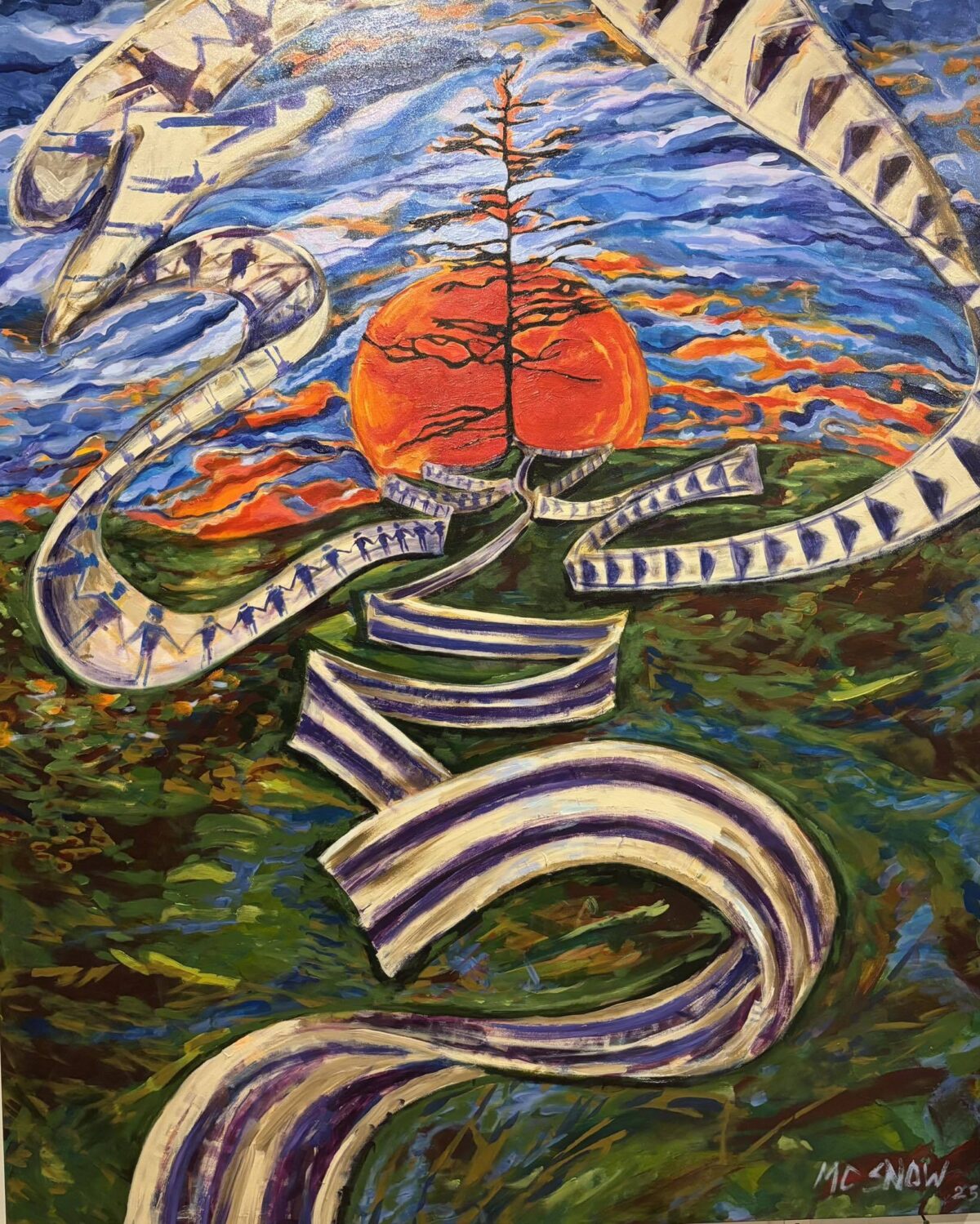
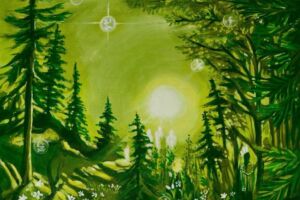
Commissioned for the HSM Adult Education Centre, MC Snow’s painting weaves together the school’s territorial acknowledgment with the deep roots of Kanien’kehá:ka tradition. Courtesy MC Snow
Students, staff, and visitors entering HSM Adult Education Centre in Montreal are now met by a new painting from Kahnawake artist MC Snow, a vivid piece that intertwines the school’s territorial acknowledgment with the deep roots of Kanien’kehá:ka culture, bringing Indigenous presence to the forefront of the school’s walls.
Commissioned by the school with the guidance of Donovan King, who is a member of the board of governors and a union representative, the piece reflects an Indigenous narrative rooted in the Great Law of Peace and the original presence of the Kanien’kehá:ka people on the island of Montreal.
“I wanted the painting to speak to some of our stories here in Kahnawake,” said Snow. “It’s about the Great Tree of Peace, and the wampum belt symbols that represent unity and ongoing growth. It’s also a reminder that we were always here, and that we still have a big presence in and around the city.”
For Snow, whose decades-long career spans fine art and sculpture, the project was an opportunity to expand Indigenous visibility in Montreal’s public and educational spaces. His collaborative outdoor bronze installation with Kyra Revenko for the Peel Street Project in 2023 is one of the few large-scale Indigenous art pieces in the city.
“Every time we have a chance to make our voice heard, we should take it,” Snow said. “Our history is the history of Montreal. Before colonization, our people were already living, trading, and connecting here. That’s the story we need to keep telling.”

The painting incorporates movement, colour, and layered symbolism to connect viewers with the city’s Indigenous roots. One prominent feature, the Great Tree of Peace, also appears on Montreal’s modern flag, a fact many students are unaware of.
“When I tell them it comes from Kanien’kehá:ka culture, they get excited,” Snow said. “It shows our presence is part of the city’s identity.”
King, who sits on HSM’s board of governors and serves as the school’s union representative, initiated the project several years ago after noticing the Lester B. Pearson School Board had territorial acknowledgments in every school. “I thought, why don’t we do that?” King said.
King proposed two motions: to begin every school meeting with a territorial acknowledgment and to commission an artwork embodying it. Both motions were unanimously approved.
The idea eventually found life through Snow’s artistry. King first met Snow while attending a walking tour of the Peel Street Project and was immediately struck by his work. “I asked if he wanted to do this, and he agreed right away,” King recalled. “He had a blank canvas to create what he wanted, and what he came up with is beautiful.”
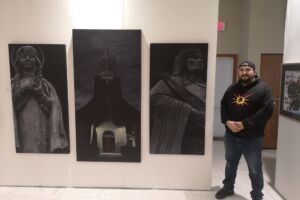
Now installed at the school, the painting functions as both an artwork and a teaching tool. King hopes it serves as a starting point for students, many of whom are newcomers to Canada, to learn about the Indigenous history of the land they occupy.
“A lot of our students are immigrants who might not know that Montreal is on unceded Kanien’kehá:ka territory,” King said. “Having this artwork visible helps them learn that immediately. It’s a small but powerful step toward truth and reconciliation.”
Snow emphasizes the role of visibility in education. Many urban Indigenous children grow up disconnected from their culture, he notes, and exposure to it in schools can spark meaningful engagement. “If they see it in their schools, even during art class, it makes a difference,” Snow said. “It gets them thinking, talking, and remembering.”
For King, the collaboration with Snow and Michael Patten illustrates how art can bridge education and reconciliation. “Colonialism is a problem of representation,” he said. “Through art, we can correct that by showing what has been made invisible and amplifying voices that should have always been there.”
Looking ahead, King hopes this project is only the beginning. Plans for an official unveiling are underway, and he envisions expanding the school’s engagement with Indigenous culture through language courses, guest speakers, and additional artistic projects.
Sign up for email updates from The Eastern Door
“Truth and reconciliation is a long process, and we’re just at the starting point,” he said. “But this painting is a solid foundation to move forward.”