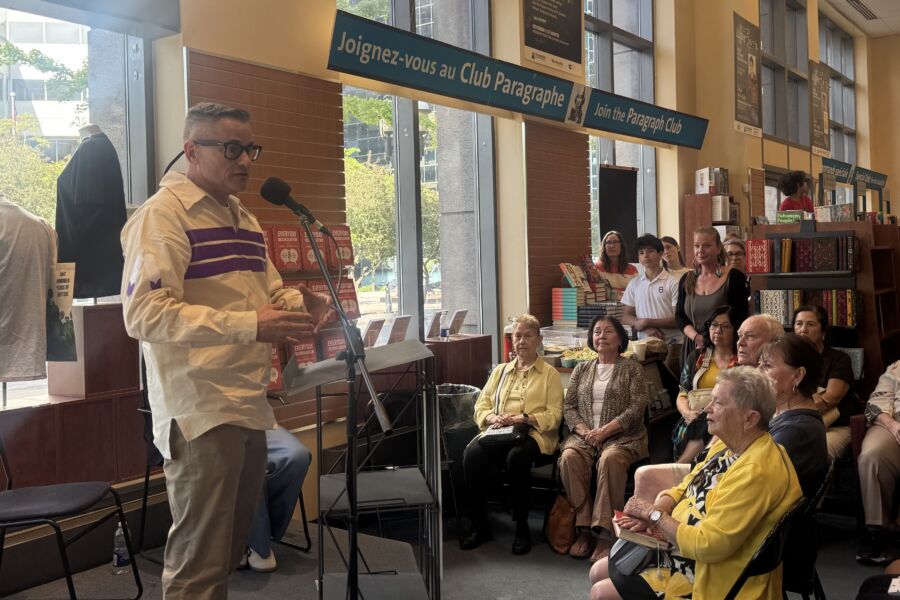
On stage at the Duceppe

What started out as a consultation role ended up turning into a role on the stage for Kahnawa’kehró:non Ka’nasohon Kevin Deer, who plays an elder in the francophone play Tupqan. Courtesy Ondinnok
Tupqan is the latest play to come from Indigenous multidisciplinary art company Ondinnok, which is celebrating its 40th anniversary this year.
To mark the occasion, Dave Jenniss, a member of the Wolastoqiyik Wahsipekuk Nation and the artistic director for Ondinnok and co-writer of the play, decided to put together something big.
The result is a collaboration with two other Montreal-based Indigenous production companies, Menuentakuan and AUEN Productions, for a show that deals with the everyday challenges of contemporary Indigenous life, including questions of spirituality.
In the show, the wampum belt of a community called Wapeyit-Nomehs was stolen 30 years ago, which in turn is said to have caused political strife between two clans wrestling for power.
With the territory faced with an unscrupulous mining company, the main character, Polsam Nicholas, is tasked - more or less willingly - with taking over becoming the band council’s grand chief and finding the wampum.
When the wampum comes to him in a dream, the quest becomes a spiritual one along with a political one.

The play will be performed in French, but there will be some Kanien’kéha as well, courtesy of Ka’nasohon Kevin Deer, who will play an elder in Tupqan.
“They came to see me and asked me to share some information about what I know about wampum, and the meanings and teachings surrounded with that,” said Deer.
Jenniss said that after meeting with him, a few members of the production team decided that Deer would be perfect to play a part, a part that became bigger and bigger as time progressed.
“We had to hear Kanien’kéha, we had to hear his mother tongue in the show,” said Jenniss.
“And, he’s very good. He’s a great storyteller, and he’s a natural on the stage, especially when he is speaking his language. To me, that’s really powerful.”
Deer credits his many public speaking duties for his natural ability on the stage, sometimes speaking to as many as 20,000 people at a time.



Jenniss was also very impressed with Deer’s ability to teach another performer who is playing his daughter some Kanien’kéha, for scenes that they will do together.
“It sounds like it’s her mother tongue already. It’s very surprising,” said Jenniss.
Deer used his experience as an educator to teach her quickly.
“I have my own techniques that I acquired, working with kids, trying to get them to learn. I do a lot of things through miming, through song, a lot of nonverbal cues. She was able to speak it after two weeks. She had the will to learn,” said Deer.
With the play being in French, it was a little bit of a challenge for Deer, but Jenniss and the rest of the production team ensured he was kept in the loop at all times, translating for him when needed.
Deer said he has been very impressed with the look and feel of the show, the songs that accompany the text, the lighting, and the overall message of the show.
Sign up for email updates from The Eastern Door
“It’s based on our ways of knowing, three quarters of the cast are Native, our co-producer is Native. It shows what we as Onkwehón:we people can produce,” said Deer.
The show will run from March 4 to April 4, 2026, at the Duceppe Theatre in Place des Arts. Tickets are available online at duceppe.com/tupqan.
Jenniss said the play being at the Duceppe is meaningful, as Ondinnok’s first shows were in what is now the Place des Arts.
“I told myself that 40 years later, we needed to go back there,” said Jenniss.