New station named for Two-Axe Early

Courtesy Stephen McComber
A new Montreal metro station will bear the name of Mary Two-Axe Earley, a legendary women’s rights activist from Kahnawake.
The station will be part of the Societe de transport de Montreal (STM)’s blue line extension and is set to open in 2031 at the corner of Jean-Talon Street East and Viau Boulevard.
Two-Axe Earley fought tirelessly to change discriminatory sections of the Indian Act, particularly laws that stripped Indigenous women of their status if they married non-Indigenous men, an injustice not applied to men. Her decades-long advocacy culminated in the passage of Bill C-31 in 1985, restoring status to thousands of Indigenous women and their children. Born in 1911 and passing away in 1996, her work significantly advanced Indigenous women’s rights in Canada.
The station naming is part of a broader STM initiative to name all five new Blue Line stations after significant local figures rather than nearby streets.
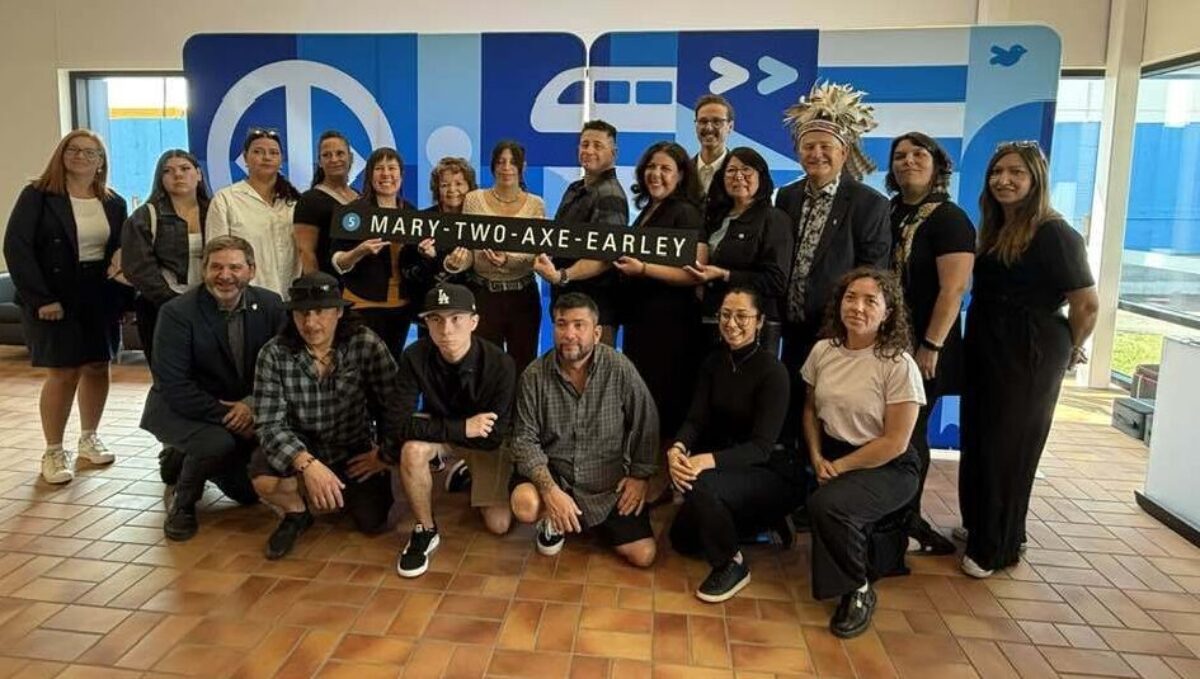
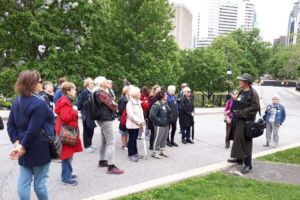
Community members, family of Mary Two-Axe Earley, consultants, STM representatives, and city officials gather to unveil the official station sign for the future Mary Two-Axe Earley metro station, part of Montreal’s blue line extension. Courtesy Stephen McComber
“In Montreal, 92 percent of places are named after men. We needed to do better,” said STM President Eric Alan Caldwell. “This committee was formed with the mission to name the new metro stations after women and people from communities that have been underrepresented.”

The naming was done in close collaboration with community members in Kahnawake and Two-Axe’s family. Mohawk Council of Kahnawake (MCK) chief Stephen McComber personally reached out to Rosemary Two-Axe, Mary’s daughter, to gain the family’s blessing.
“Rosemary was very happy to hear about it,” McComber said. “This is an honour for our family, our community, and First Nations people everywhere. A metro stop named after someone from Kahnawake, it’s awesome. It acknowledges what Mary fought for, the injustice faced by Indigenous women who married out.”
The STM also worked with local filmmaker Courtney Montour, who made the National Film Board (NFB) documentary Mary Two-Axe Earley: I Am Indian Again, which helped bring her story to broader public attention.
At the unveiling event, multiple generations from Mary’s family and the community came together to celebrate. “It was a powerful moment,” said McComber. “People remember what she fought for. She gave women their rights back.”
The new metro station’s name is seen as a milestone in representation and reconciliation. However, it also sparked critical reflection on the process used to arrive at that name.
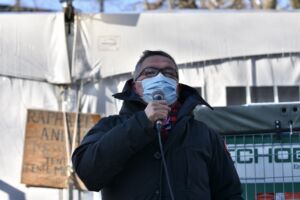
Carling Sioui, a Wendat consultant, expressed concern about how consultation was handled. “I was consulted at the very end. It wasn’t a proper process,” said Sioui, who previously worked on the toponymy renaming of Amherst Street to Atateken.
“They interviewed me for half an hour, didn’t compensate us, and didn’t follow up. That’s not how Indigenous consultation should work.”
While Sioui praised the final choice calling it “a beautiful and powerful name” she criticized the process as lacking integrity, structure, and proper ethical standards.
“There was no real committee, no space for collective agreement, no proper compensation. It felt like my time and knowledge were taken without value. That’s another form of appropriation,” she said. “They’re getting a political win and public praise, but it was built off a consultation process that didn’t respect the very principles of reconciliation they claim to support.”
Despite her criticism, Sioui emphasized that community and family approval was the strongest aspect of the decision. “The name deserves to be there. But true reconciliation means doing things the right way with care, respect, and structure, although I’m grateful to have been consulted.”
Caldwell acknowledged the importance of context and education as part of the naming. The STM has committed to providing information in the station, online, and in public materials to help commuters understand who Mary Two-Axe Earley was and why she matters.
“When we announced the name, people said, ‘I didn’t know her story but now I want to learn more.’ That’s exactly the kind of impact we’re hoping for,” Caldwell said.
Sign up for email updates from The Eastern Door
The station naming is also part of Montreal’s broader “City of Women” initiative, which aims to increase the visibility of women in public spaces and correct historical imbalances in representation.
McComber hopes this is just the beginning of broader efforts. “This should be the beginning of more education especially in schools about the modern achievements of people from our community,” he said. “Not just Mary, but many others as well.”
Despite the flaws in consultation, the station stands as both a tribute and a challenge, a call to do more, include more, and truly honour Indigenous voices not only in name but in practice.
“I think it’s amazing,” said Sioui. “But this can’t be the end. It needs to be the start of rebalancing the narrative of putting Indigenous people, voices, and stories at the centre, where they’ve always belonged.”