Nation-to-nation meeting
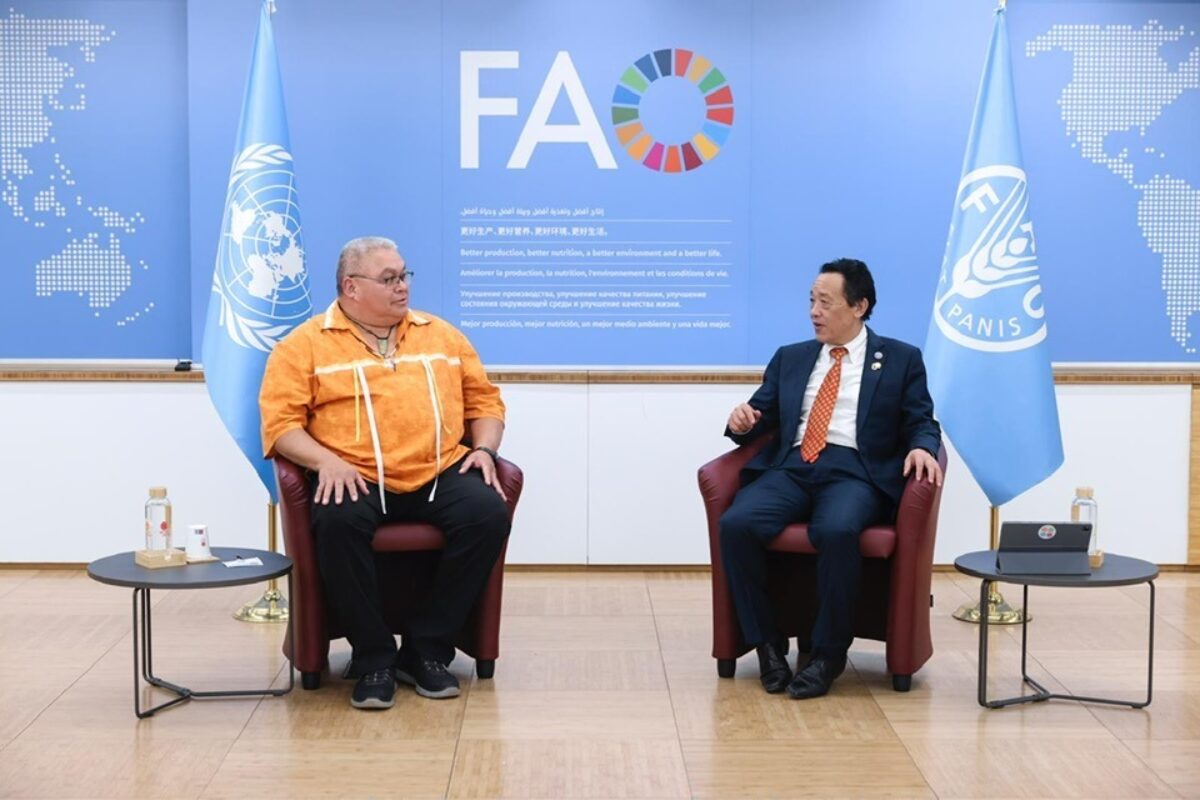
Haudenosaunee Chief Deskaheh (left) meets with the director general of the Food and Agriculture Organization (FAO) Qu Dongyu (right) during a bilateral meeting at the World Food Forum in Rome. The discussion marked a nation-to-nation dialogue, addressing Indigenous participation in global food governance and reaffirming the principles of the Two Row Wampum and Silver Covenant Chain. Courtesy Kenneth Deer
A bilateral meeting took place last week in Rome, where Haudenosaunee Chief Deskaheh Steve Jacobs sat down with the director general of the Food and Agriculture Organization (FAO), Qu Dongyu, during the World Food Forum.
This kind of meeting in a diplomatic format, usually reserved for heads of state, marked a significant moment for the Haudenosaunee on the international stage.
Kenneth Deer, who attended the meeting, emphasized that the encounter was more than ceremonial, it was a reaffirmation of the Haudenosaunee Confederacy’s enduring sovereignty and international recognition.
“It’s always important to me, anything of a head of state or head of an international organization, a UN organization, because it continues our nation-to-nation relationship with states,” said Deer.
“We may not be a nation state, but we are nations and from time immemorial here in North America, meeting with other states at a bilateral level is always important. It’s a continuation of our recognition of our status as people.”
The bilateral meeting came as a surprise even to the Haudenosaunee delegation, who expected a more informal exchange. Instead, they were met with the full formalities and diplomatic structure of a high-level state meeting.

“I was pleasantly surprised about this meeting, we were the only Indigenous people at this process,” Deer said. “We expected it would have been a meeting in a room around a table, where we could have a nice informal dialogue. But when we got there, it was a full-blown bilateral meeting, the kind of format you’d see with heads of state. It was very, very interesting. And the director general showed great respect.”
For Deer, that level of respect carried deep meaning. The FAO is a specialized UN agency with member states from around the world and to receive the Haudenosaunee at this level reaffirmed their standing as a people, not merely as an organization or interest group.
It was, in many ways, the embodiment of the principles behind the Two Row Wampum and the Covenant Chain, symbols of mutual recognition and coexistence between nations, he said.
“As Mohawks and the Haudenosaunee, we believe we are nations. We always deal with other nations on a nation-to-nation basis,” said Deer.
“The Two Row Wampum is about two peoples going down the river of life, not interfering with each other, respecting each other’s right to exist and self-determination. This bilateral meeting is the expression of that friendship, coexistence, and mutual respect. The chain has to be polished, so that relationship continues.”
Discussions during the meeting addressed a range of issues, including Indigenous participation in global food governance, the distinction between Indigenous Peoples and “local communities,” and the ongoing need to protect Indigenous rights within UN processes. Deer noted that while the term “local communities” is increasingly used in international policy, it remains misused in ways that blur or undermine Indigenous sovereignty.



“There’s no definition of what a local community is and that muddies the water,” Deer explained. “Some Indigenous Peoples are calling themselves local communities because their countries don’t recognize them, and that’s a problem. We’re not the same.
“Many local communities take land and natural resources away from Indigenous people, the term “local community” is an issue because of this, so we’ve been fighting at the UN to make sure to separate Indigenous peoples from local communities, and the director general gave us the opportunity to have a good discussion about that issue, and that was probably the biggest value of this discussion.”
That clarity, Deer said, is essential to maintaining Indigenous identity and political legitimacy in global governance spaces like the FAO. It also reflects the Haudenosaunee’s long-standing struggle to be recognized as sovereign nations, a struggle that stretches back to Deskaheh Levi General’s historic address to the League of Nations in 1923.
A century later, this meeting represented a continuation of that diplomatic tradition, a direct assertion of Indigenous nationhood at the highest levels of international dialogue.
“We were not there to complain, we’re not angry; we were there to show the level of diplomacy that we can operate in, and how we can change things at that level,” Deer said. “If we respect their leadership, they can respect our leadership, that’s the equality we’re demonstrating.”
For Deer and the Haudenosaunee delegation, the meeting was more than a discussion of policy; it was an act of reconciliation and renewal. It reflected the living practice of the Two Row Wampum, the Friendship Belt, and the Silver Covenant Chain, agreements built on mutual respect, communication, and equality.
Sign up for email updates from The Eastern Door
By engaging the FAO directly, the Haudenosaunee not only affirmed their sovereignty but also modelled a path for Indigenous nations worldwide to assert their place as equal partners in shaping the future of food security, land, and governance.
“We have to break down the colonial barriers that say we are inferior people,” said Deer. “This kind of meeting helps break that mindset, it’s a nice peaceful expression of equality.”
Both the Haudenosaunee and the director general expressed their commitment to strengthening this relationship, with plans for another bilateral meeting next year.