Motion filed to dismiss Mohawk Mothers’ case
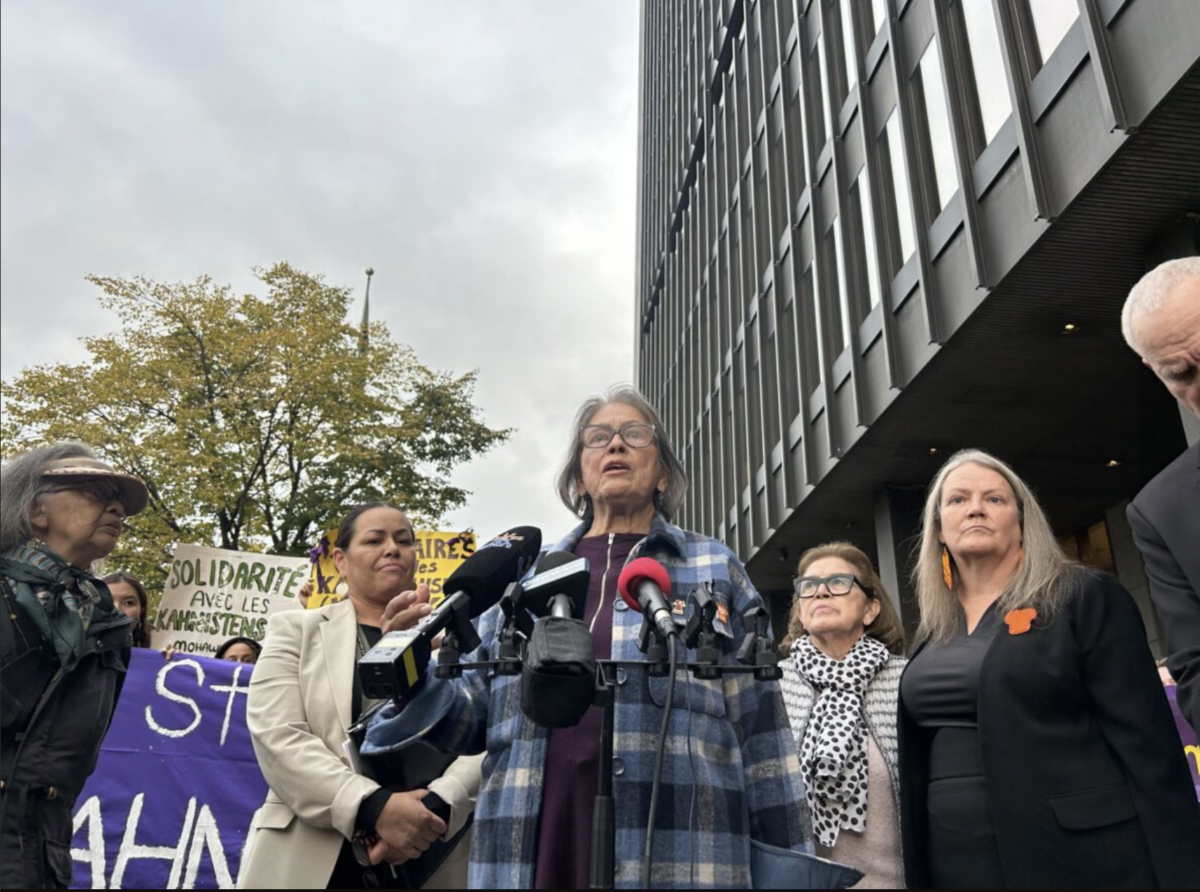
Kahentinetha, one of the Kanien’kehá:ka Kahnistensera, speaks with reporters outside Quebec’s Superior Court in 2023, flanked by other members of the group and former special interlocutor Kimberly Murray. File Photo
The Mohawk Mothers, also known as the Kanien’kehá:ka Kahnistensera, were back in court last week, facing a filing by Quebec’s attorney general and the Société Québécoise des Infrastructures (SQI) that seeks to dismiss their case.
The group has been fighting a legal battle for several years now, alleging that the site of the former Royal Victoria Hospital could contain unmarked graves of Indigenous and non-Indigenous children. The area was also home to the Allan Memorial Institute, where famous MK Ultra experiments were illegally undertaken on patients.
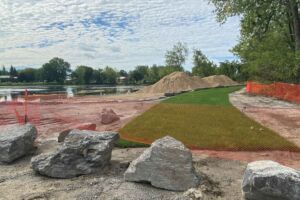
That are is now being developed as part of the New Vic project, a teaching and learning facility that will be part of McGill University.
While McGill, the SQI, and Quebec have long maintained that there is no evidence of human remains at the site, a recent report produced by Askîhk Research Services, an archeological firm specializing in culturally-safe searches for unmarked burials of Indigenous children, allegedly supports the presence of human remains in at least one location on the site. Three separate cadaver dogs also alerted to a spot on the site.
That report, which has not been viewed by The Eastern Door, was allegedly commissioned by the SQI and completed in February 2025, but was not initially provided to the Mothers.

Now, the SQI and Quebec’s attorney general filed the motion asking Superior Court Justice Gregory Moore to dismiss the case entirely, on behalf of themselves as well as the Royal Victoria Hospital, the McGill University Health Centre, McGill University, the City of Montreal, and the attorney general of Canada, who are the other defendants.
“It was really gruelling having to listen to them, not just that it was monotonous and entirely in French, but it was traumatic,” said Kwetiio, one of the Kahnistensera. “I don’t like using the word ‘trauma’ in all that because it’s always used when describing Indigenous people and what they’re experiencing, but this was truly testing us.”
In an email to The Eastern Door, the SQI said that it filed the motion to dismiss the proceedings because “it is unfounded in fact and in law.”
“The SQI’s work on the site is now complete, and the investigations requested by the Mohawk Mothers (archaeological excavations) are continuing, in accordance with the agreement reached with them,” the email reads. “The Mohawk Mothers are being kept informed of the progress of these excavations by the SQI and are welcome to attend. The Mohawk Mothers’ legal action should therefore be dismissed.”
Quebec’s attorney general declined to comment for this article.



The motion to dismiss states that the Mothers’ arguments are “manifestly ill-founded or frivolous and constitute an excessive or unreasonable use of the judicial process.”
The motion addresses a number of declarations previously made by the Kahnistensera that should be rejected, including their declaration that the Quebec Cultural Heritage Act is invalid and unconstitutional, that the defendants have illegally bought and stolen Indigenous property, that Mount Royal is Mohawk land and the Kahnistensera’s permission must be sought for everything concerning it, and that the Kahnistensera are the only representatives of the traditional Kanien’kehá:ka people following the Kaianere’kó:wa (Great Law of Peace), as well as an order for the defendants to publish and disseminate all past and upcoming archaeological information.
The filing argues that the Mothers’ arguments are invalid, pointing to how they’d have to hold the “Aboriginal title” to Mount Royal to make the demands they’re making, and as individuals they don’t have the right to argue it, since Aboriginal titles are a collective right. The defendants also argue that the group doesn’t specify how the Cultural Heritage Act infringes on any rights the Kahnistensera claim to have, amongst other arguments.
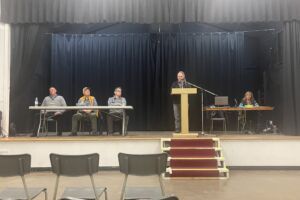
In court last Thursday and Friday, the Kahnistensera made oral arguments against the claims, with Kahentinetha, another of the Mothers, arguing that Quebec is effectively making it logically impossible for Indigenous people to claim rights on their lands.
“By making it impossible for us to argue our rights to use our land and to enforce our traditional duties to watch over our ancestors who are in the ground, Quebec’s arguments violate the spirit of reconciliation, our human rights, and the United Nations Declaration on the Rights of Indigenous Peoples (UNDRIP),” she said.
Sign up for email updates from The Eastern Door
Kwetiio said that the court was packed with supporters of the Kahnistensera - the group has rallied a large amount of support throughout the years, with many people showing up outside the court at most of their appearances.
“These people truly understand and believe in what we’re doing, and the support is even growing as we go,” she said. “It was nice to go to the court and have that feeling and support when you’re speaking, and you could really feel it in the atmosphere.”
The Mothers will now submit their response to the filing, after which the defendants must submit their own response by July 11. After that’s complete, Justice Moore will evaluate all submissions and make a decision on whether or not the case will be dismissed.