Late civil rights icon’s connection to town
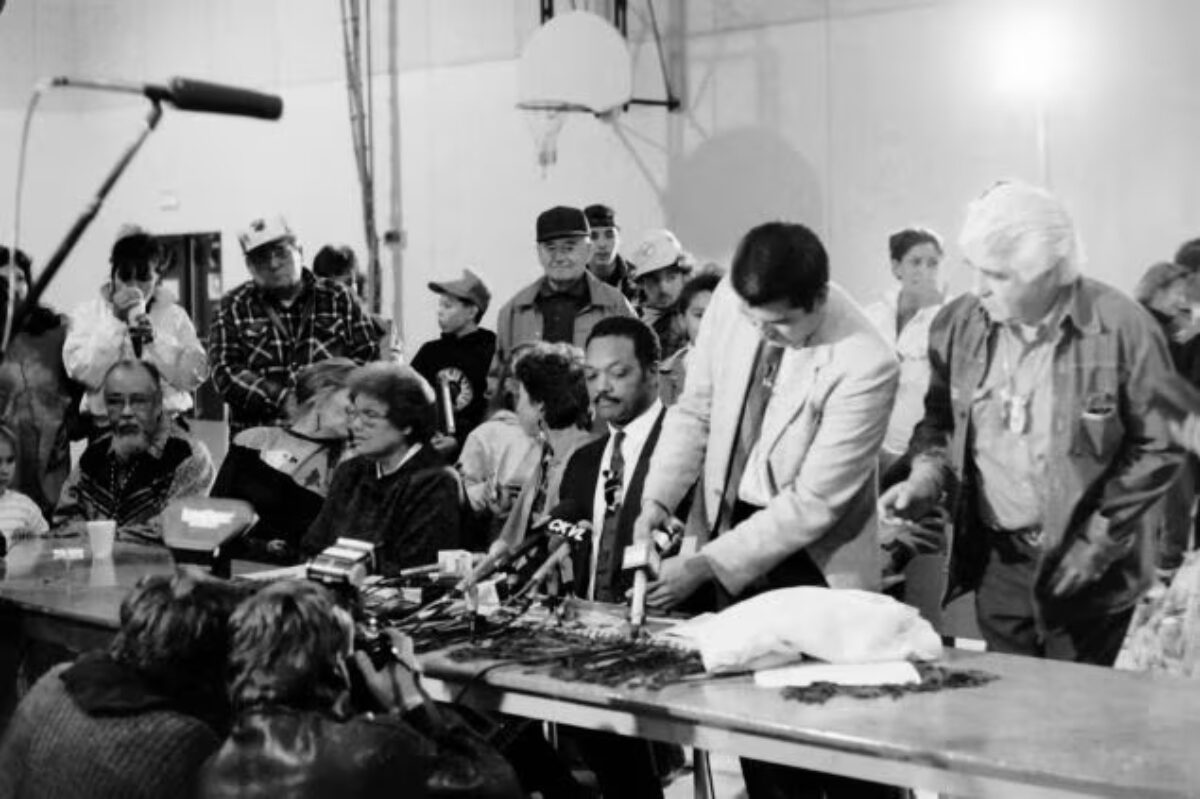
Jesse Jackson came to both Kahnawake and Kanesatake in September 1990, drawing international attention to the Siege of Kanehsatake. Courtesy Kanien’kehá:ka Onkwawén:na Raotitióhkwa Language and Cultural Center
Crossing the Mercier Bridge was no easy feat in September 1990, as the Siege of Kanehsatake wore on, when Kahnawa’kehró:non Mike Bush drove out of the community to pick up civil rights legend Jesse Jackson from the Dorval Airport.
The Surete du Quebec (SQ) stopped the car, giving him and his companion a hard time. The police finally backed off, Bush remembers, after he flashed his student card from McGill University’s law school.
The way back wasn’t so hard.
“When they found out he was with us, they just let us through,” said Bush.
As the world mourns the loss of Jackson, who died Tuesday morning at 84 years old, many in the community are reminded of when the Black leader turned his attention to the plight of local Kanien’kehá:ka, lending his support, solidarity, and platform during the Siege of Kanehsatake.
Jackson, who marched with Martin Luther King, Jr., spent the rest of his life as a leading advocate for equality and dignity for all peoples, notably through his Rainbow PUSH Coalition (RPC) initiative - formerly two separate entities - a multiracial progressive advocacy organization aimed at fighting for social change.
Jackson visited Kahnawake and Kanesatake in 1990 in hopes of brokering talks with the government and bringing the world’s eye to the injustices happening here.
He had just been to Kuwait, where he was instrumental in pushing Saddam Hussein to release foreign hostages, and he was hopeful - armed with the platform of his new news magazine show, to which he dedicated half of the first episode to the Siege of Kanehsatake - that he could make a difference here, too.
“It’s the military that took over, so there was a lot of anxiety in both communities,” said Bush, who acted as a liaison on Jackson’s trip, shepherding him first to the old Kahnawake Survival School (KSS) gym and subsequently to the treatment centre in Kanesatake, among other destinations.

Bush was disappointed that the provincial government was not as open to receiving the civil rights icon as he feels it should have been, but he will always remember Jackson’s kindness and humanity.
“I’d say I feel sorry, but that doesn’t quite cover it. It’s a shame that somebody of that calibre has passed,” said Bush, who held no official capacity at the time of the visit, but had been asked by a friend of his on Jackson’s staff to accompany the civil rights leader.
“He seemed genuinely interested in people like myself or people around me or in the community itself. I was kind of impressed by that.”
Asked whether Jackson was as empathetic behind closed doors as he was publicly, Bush didn’t hesitate.
“If anything he was more real off camera than he was on camera,” Bush said.
News reports at the time detail Jackson’s visit following his arrival on September 23, just days before the Siege of Kanehsatake ended on September 26, 1990, outlining the portrait of a man who hoped to make a difference.
“Jackson made it clear he wants to do more than observe,” reads an article on the front page of the September 24, 1990, edition of the Montreal Gazette.
Even before his arrival at the treatment centre in Kanesatake, inside of which around 50 Kanien’kehá:ka were beleaguered by soldiers, a Canadian Army spokesman declared Jackson would be refused entry, like other reporters who had “no business” there.
The September 25, 1990, issue of the Gazette reports a two-hour meeting between Jackson and then-Quebec Native Affairs minister John Ciaccia. “I feel that if there are some bonds of trust established it could bridge the gap,” Jackson told the media following the meeting.


In Kanesatake, outside the barricades, he said, “It’s a life-and-death situation. It’s a situation where we believe communications could be a factor in resolving conflict.”
At the time, the government and military were restricting communications for those in the treatment centre, the article points out.
Jackson even compared the situation to the one in Kuwait, which Iraq had invaded several weeks earlier.
“A military occupation is a military occupation,” he is quoted as saying in the Gazette.
“This is essentially a political crisis that has been handed over to the military,” he said. “Mr. Bourassa and Mr. Mulroney must accept responsibility for this situation.”
The message was far from universally accepted, a reading of the era’s newspapers suggest. A page-two column the day after the Siege ended is titled, “It’s hard to know who was right in the Oka crisis,” with comparisons to schoolyard bickering and a family squabble over who should wash the dishes after dinner.
Another column in the Gazette at the time cast Jackson’s visit as a publicity stunt.
However, for Kanien’kehá:ka in need of allies and for the world to hear the truth, Jackson’s visit at a tense moment was welcome.
“It meant a lot,” said Kanehsata’kehró:non John Cree. “He showed what the Canadian government was doing and everything, and the provincial government. It kind of confirmed everything we were saying.”
Sign up for email updates from The Eastern Door
Cree saw Jackson in Kanesatake, but didn’t get a chance to meet him. Nevertheless, he was saddened by the news of his death.
“He was a good person. He cared. He cared for Native people, he fought for them. So you’ve got to have that respect for him.”
Jackson, who ran for US president in 1984 and 1988 as a high-profile candidate in the Democratic Party primaries, was deeply moved when Barack Obama was elected as the first Black president in US history, an admiration that was mutual. “For more than 60 years, Reverend Jackson helped lead some of the most significant movements for change in human history,” said Obama in a statement following news of Jackson’s death. “From organizing boycotts and sit-ins, to registering millions of voters, to advocating for freedom and democracy around the world, he was relentless in his belief that we are all children of God, deserving of dignity and respect.”
The cause of Jackson’s death was undisclosed in the announcement of his death, which said that he died peacefully. However, in November his Rainbow PUSH Coalition announced that he had been hospitalized with progressive supranuclear palsy, a rare neurological disorder; in 2017, he announced he had been diagnosed with Parkinson’s disease, which shares many of the same symptoms.
Marcus Bankuti, Local Journalism Initiative Reporter