Empire highlights Kahnawake ironworkers
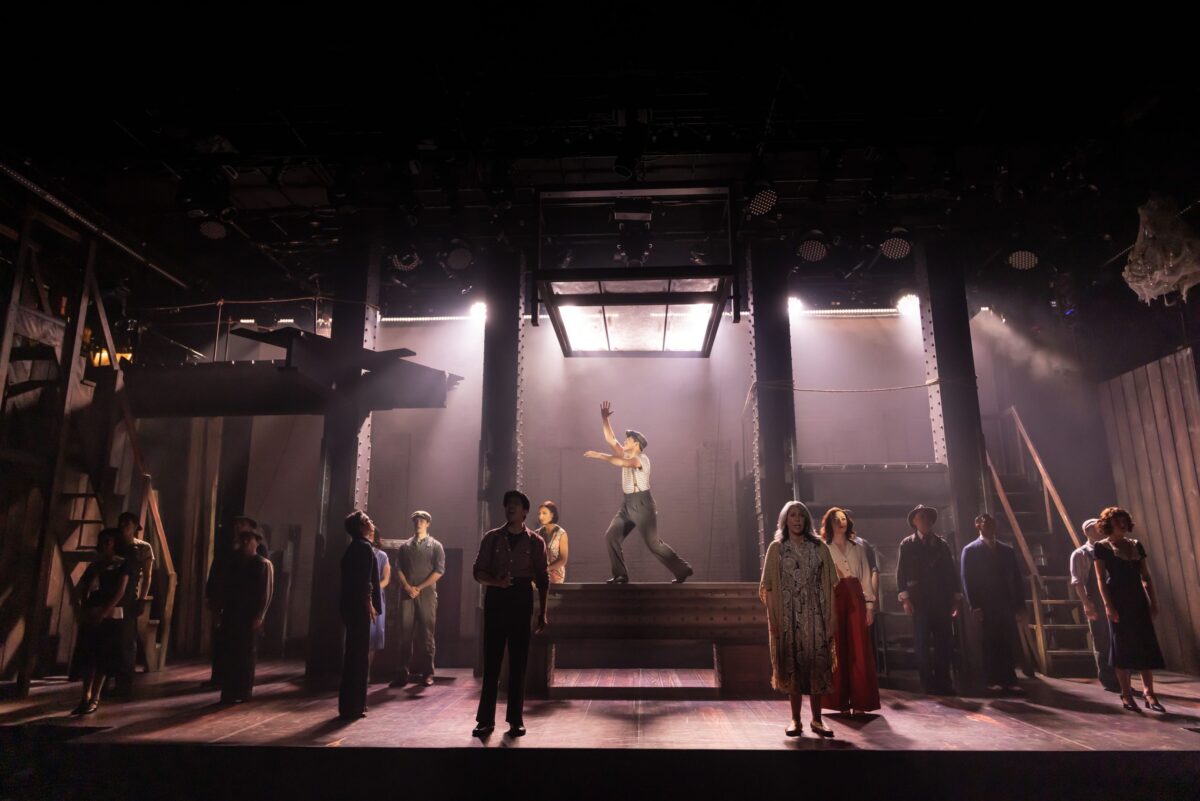
What does a real Kahnawake ironworker think of Empire the Musical?
“Personally, I think it’s fantastic,” said Chester Deer. “But to tell you the truth, I don’t remember too many ironworkers singing on the job.”
The new off-Broadway production uses music to tell the story of one of New York City’s best-loved landmarks, the Empire State Building, which could not have gone up without the grit and determination of the Mohawk skywalkers from Kahnawake.
The production’s writers, Caroline Sherman and Robert Hull, have staged the play four times before, but the prominence of Kanien’kehá:ka in the narrative has only grown leading up to this iteration, the New York City debut.
“Knowing the story of the Empire State Building, the Mohawk workers always played a big role,” Hull said. “However, over time, the role has become refined, and certainly as we’ve learned more.”
As Kanien’kehá:ka workers and family members grew more important to the story, Sherman and Hull realized they needed to deepen their research, reaching out to PlanIt Consulting and finding an enthusiastic partner in founder Charleen Schurman. Reaghan Tarbell, lead consultant with PlanIt, had even created a 2008 documentary about 20th-century Kahnawake ironworkers in New York City, Little Caughnawaga: To Brooklyn and Back.
“Most of the work PlanIt does is serious work,” said Schurman. “Not to say Empire isn’t serious, but it was fun. First of all, to think somebody is out there writing an off-Broadway musical that has to do with not just Mohawk but Kahnawake ironworkers building the Empire State Building, that was a mindblower in itself.”
Schurman and Tarbell, along with two other PlanIt staff, attended opening night Thursday as guests of the production, in acknowledgment of their contributions.

“They wanted to ensure the accuracy and integrity of the Mohawk storyline that is involved within this musical,” said Schurman.
As she researched for the project, she came to better understand herself how pivotal Kahnawake was in the construction of the world-renowned landmark.
“It opened up some new doors for me in terms of history, historical aspects of the ironworkers in New York. I went down a rabbit hole. I just kept going deeper and deeper, this happened and that happened,” she said.
“I have to be honest, I had never thought a whole lot about who or how many Kahnawake Mohawk ironworkers were on the Empire State Building."
The cast and crew of the production even had a meeting with local actor and former ironworker George Wahiakeron Gilbert to learn more about the experience of Mohawk ironworkers.
“I had a lot of fun. Every question they asked I was able to answer,” said Gilbert.
“They asked me multiple questions about my time in New York, which was most of my time, and if there was any racism. I said, well, racism is everywhere, no matter where you go. It’s how you take it. Me, it’s like water off a duck’s back. I’m not going to put up with it,” said Gilbert.
It takes a strong constitution to be an ironworker on skyscrapers, he said, with labourers even having to work unharnessed.
“Ironworkers, we would never win the most gentlemanly player award because we’re like our business, rough.”
He’s glad to see Mohawk ironworkers represented on the stage, and he thinks others will agree. “I’m pretty sure that place will be full of ironworkers of all kinds,” he said.
Community member Kaweras Bush was also involved, getting commissioned to create a belt for the production.
“I had to dig my looms out of the basement closet for this project, had to sweep off the cobwebs even,” said Bush.
Despite how long it had been since she did loom work, Bush didn’t hesitate to agree to be a part of it.
“I didn’t even think to ask more about what the production was about,” she said. “I was just so excited to get started on the beadwork.”
For the musical’s creators, the involvement of Kahnawake has become pivotal to expressing their artistic vision.
“When we originally wrote the show, we started with a very simple idea that just set us off in terms of how we wrote the show, which is why does this building capture a place in our hearts in this country in a way no other building does?” said Hull.
Sign up for email updates from The Eastern Door
However, they found they needed a way to make the production more human.
“When we’ve done prior adaptations of this, we found it was too focused on the building,” said Sherman. “To drill down into the characters, we found our best way in was through different people who were involved.
“We wanted to tell an intergenerational story. And we found it very compelling to start in 1976, and this is the first time we’ve done this, find a woman who has some connection to the Empire State Building that is unsettled, and for her to go back in time and resolve it. And we do that through three generations of Mohawk ironworkers.”
The woman, the fictional Sylvie Lee, is played by Red River Metis actress Jessica Ranville.
Deer hopes the production will teach people not only about Kanien’kehá:ka contributions to the New York skyline, but also about Kanien’kehá:ka themselves – “just a better understanding that Mohawk people are just like everybody else,” he said. “We have families. We want to stay together as families. We’re just as capable of working hard as everybody else. That most ironworkers wanted a better future for their children.”
Empire the Musical continues through September 22 at New World Stages in New York City.
This article was originally published in print on July 12 in issue 33.28 of The Eastern Door.