Economic reconciliation summit

The Ashukan Institute and the KWE! Meet With Indigenous Peoples Festival are coming together to hold the first Indigenous Connections Summit at the Montreal Convention Centre in March.
The summit, which will be held between March 11-13 next year, will focus on economic reconciliation for its first edition.
“Of course, reconciliation touches subjects like health and social services, education, and justice, but for this first edition of the summit, we wanted it to be about a subject that was easier to measure concretely, that being economic reconciliation,” said Alexandre Bacon, president of the Ashukan Institute.
The summit will feature five roundtable discussions, each concerning a different aspect of economic reconciliation.
Bacon said that these roundtable subjects will help see where things are at concretely in Indigenous communities relating to their economic situations and agreements with the public and private sectors.
“What we’ve seen is that reconciliation has been a topic for decades, but very few indicators have been put out there to see where things are at, measure where we are with that,” said Bacon. “Are we going forwards? Are we going backwards? Is it all window dressing? What is really being done in terms of reconciliation with Indigenous Peoples? We’re interested in what has been done in terms of concrete actions.”

The event will be co-chaired by Michel Sabia, president and CEO of Hydro Quebec, and Canadian senator Michèle Audette.
The choice of chairs was made to show the multiple perspectives the summit is looking for.
According to Bacon, it was important to have one male and one female chair, one from the business world and one from politics, and to have one Indigenous and one non-Indigenous chair.
The announcement of the summit and Sabia’s involvement with it comes on the heels of Hydro Quebec’s announcement last week of its new Strategy for Economic Reconciliation and to Strengthen Relations with First Nations and Inuit.
In its publicly available announcement, the Crown Corporation stated its goals are “to support the economic, social, and cultural development of Indigenous communities, including through the sharing of wealth generated by energy projects, and to make our organization more open and inclusive, for our Indigenous employees, customers, suppliers and partners.”
At times in its history, Hydro Quebec has had a tumultuous relationship with Quebec’s Indigenous communities. For the James Bay hydroelectric projects of the 1970s and 1980s, for example, infrastructure was built over objections of the Cree populations to whom the land belonged. Phase one of the project flooded land on the Island of Fort George, forcing them to move onto the mainland.





The second phase, which would have threatened the Great Whale River, was only stopped because of years of resistance by the Cree.
Bacon said that Sabia’s attitude as head of Hydro Quebec has been different, and that he wants to work with Indigenous populations, not against them.
“Michel Sabia is, of all the CEOs in Quebec, the one who has pushed the most to make Indigenous peoples real partners in projects,” said Bacon.
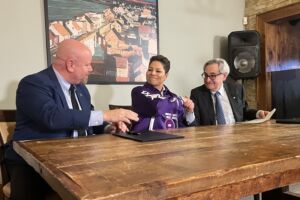
The MCK and Hydro Quebec signed an agreement earlier this year to co-own the new Hertel-New York Interconnection Transmission Line, with the MCK holding a minority stake in the 58-KM project. The project was heralded as an example of economic reconciliation.
“For us, it is a chance to put that into perspective and explore the efforts of Hydro Quebec to rethink the way it interacts with Indigenous people, not just that they are consulted, but that they become partners, and that their wants and needs are taken into account.”
Lynn St-Jacques, senior communications advisor for Hydro Quebec, said that the alignment of the summit with Hydro Quebec’s newly released strategy - as well as its pre-existing sponsorship of the KWE! Meet with Indigenous Peoples Festival - made chairing the event an easy opportunity to accept.
Sign up for email updates from The Eastern Door
“The Indigenous Connections Summit and the strategy are, of course, two distinct initiatives, but they share the same theme. The summit will be a great forum for us to further discuss and foster reflections on our strategy, which is intended to be an evolving process,” said St-Jacques.
The Assembly of First Nations Quebec-Labrador (AFNQL) has already reacted positively to the announcement of Hydro Quebec’s strategy. In a statement, AFNQL regional chief Ghislain Picard said that “Hydro Québec’s Strategy for Economic Reconciliation is a first step in the right direction. It is based on principles on which First Nations agree. We have rights that deserve recognition and respect. We appreciate that Hydro Quebec and Mr. Sabia are committed to this path.”
Mohawk Council of Kahnawake grand chief Cody Diabo is currently slated to speak at the summit’s “Guest of Honor and Honorary Co-Presidency Address,” on Wednesday, March 12, at 9:45 a.m., pending confirmation from Diabo.