Delaronde delivers first solo exhibition

Russell Delaronde poses in front of two cradleboards that form part of his first solo exhibition. Marcus Bankuti The Eastern Door
If you were to crack open Russell Delaronde’s math books when he was growing up, you’d find the margins full of doodles, and if you wanted a word with him, you’d probably look outside somewhere.
The Kahnawake artist was raised to do what he loves, and he has always loved the great outdoors. Still today he can often be found spearfishing, collecting mushrooms, watching animals, and planting garlic, basking in the natural world that has inspired so much of his art.
Yet when Delaronde was invited to put on his first solo exhibition, and he was asked to examine the themes that connect his pieces, he wasn’t sure what to say. He’d always seen each artwork as representative of an era. “When I look at all these, they’re all different moments of things I was going through,” he said.

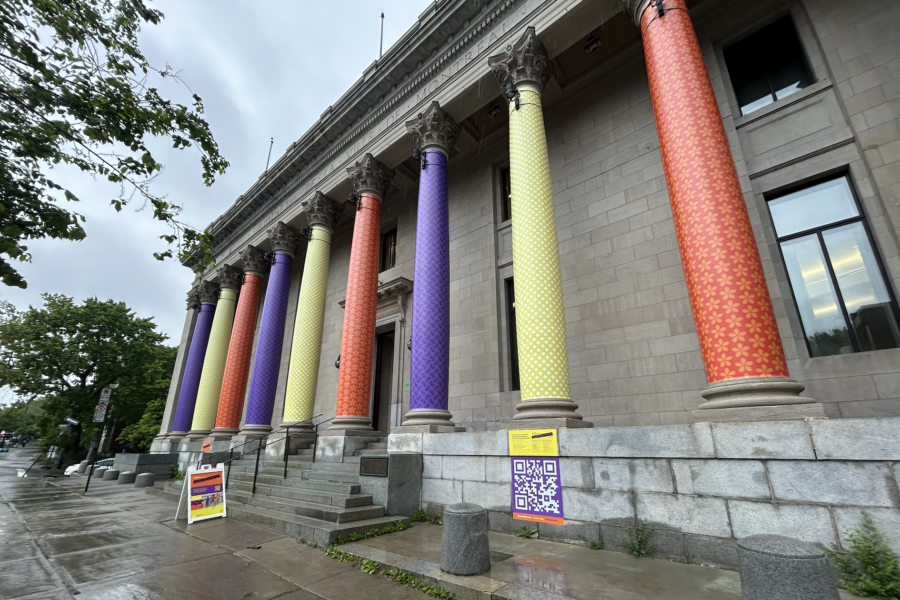
Kontitie’s, seen here in its original form at the “Tiohnhéhkwen - The Instruments that Sustain Life” exhibition, is among the local artworks reproduced on banners lining the Mercier Bridge. Marcus Bankuti The Eastern Door
But he was able to identify a common thread. The result - “Tiohnhéhkwen – The Instruments that Sustain Life” - brings to Tiohtià:ke Delaronde’’ own vision of Kahnawake, full of birds and plants. His affinity for the environment is even expressed in his use of mushroom ink.
“Prior to this show, I haven’t really seen all my work as one, but having this kind of helped me to see what ties it in together,” he said. “To be real blunt, I guess, it’s very reflective of the natural world and how the natural world reflects in my life and how I see it and view it, how I view the world.”
His parents always emphasized playing outdoors and it’s something that always stuck with the young artist.
“Outdoors, that’s his passion, and the subject matter comes out,” said his father, Harley Delaronde.
But the drawing was always there, too.

“We always would just get him a piece of paper, anything, the back of something,” said Harley. “He always wanted to do that. He didn’t want to do other things.”
On his way home from excursions through the youth centre, Russell would get a seat close to a particular monitor, who would share a piece of paper or two and a pencil, something he only mentioned to his parents later on.
“It doesn’t matter, anything else. Do what you love to do. And he’s doing what he loves to do, and we’re just very proud of that,” said Harley, who attended the opening event that took place on Saturday.
“My heart is really happy.”
The exhibition, running at Shé:kon Gallery in Montreal, was curated by Kahnawa’kehró:non Aaron Rice, for whom the show is also a new step. It’s his first show since graduating from the Emily Carr University of Art and Design in Vancouver, where he lived for three decades.
Rice knew that for his first solo show, he wanted to feature a Kahnawake artist, and Russell’s work made an impact on him.
“I wanted it to be something that’s representative of our culture and values. That connection to the plant beings, the birds, the waters, it’s all there in his artwork,” said Rice.
His experience living away also influenced the direction he sought for the show, seeing significance in the gallery’s presence in Tiohtià:ke.
“My focus is kind of bringing our presence, Kanien’kehá:ka presence, into the city,” said Rice. “I’m coming from Vancouver, and the art and the language is really present. When I come to the city, I’m like, where is all the Mohawk stuff? I don’t see it. This is our territory, and we need to make space for that, and we need to reclaim that.”

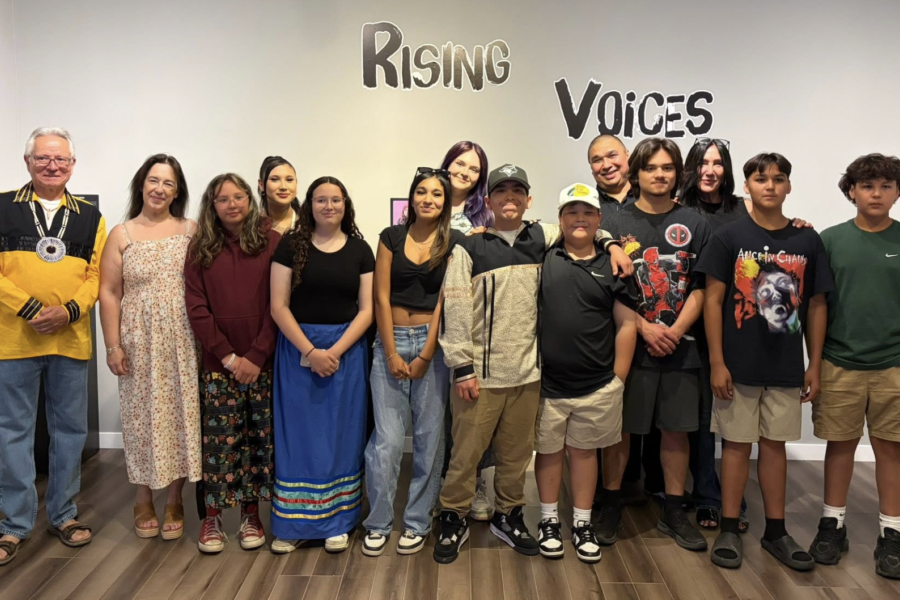
When he was growing up, sports were already celebrated, he said, but there was less exposure for the arts. He’s pleased to see that changing, and the turnout for the event last weekend was a sure sign of interest. Russell’s family, friends, and other community members were among the patrons who attended the reception.
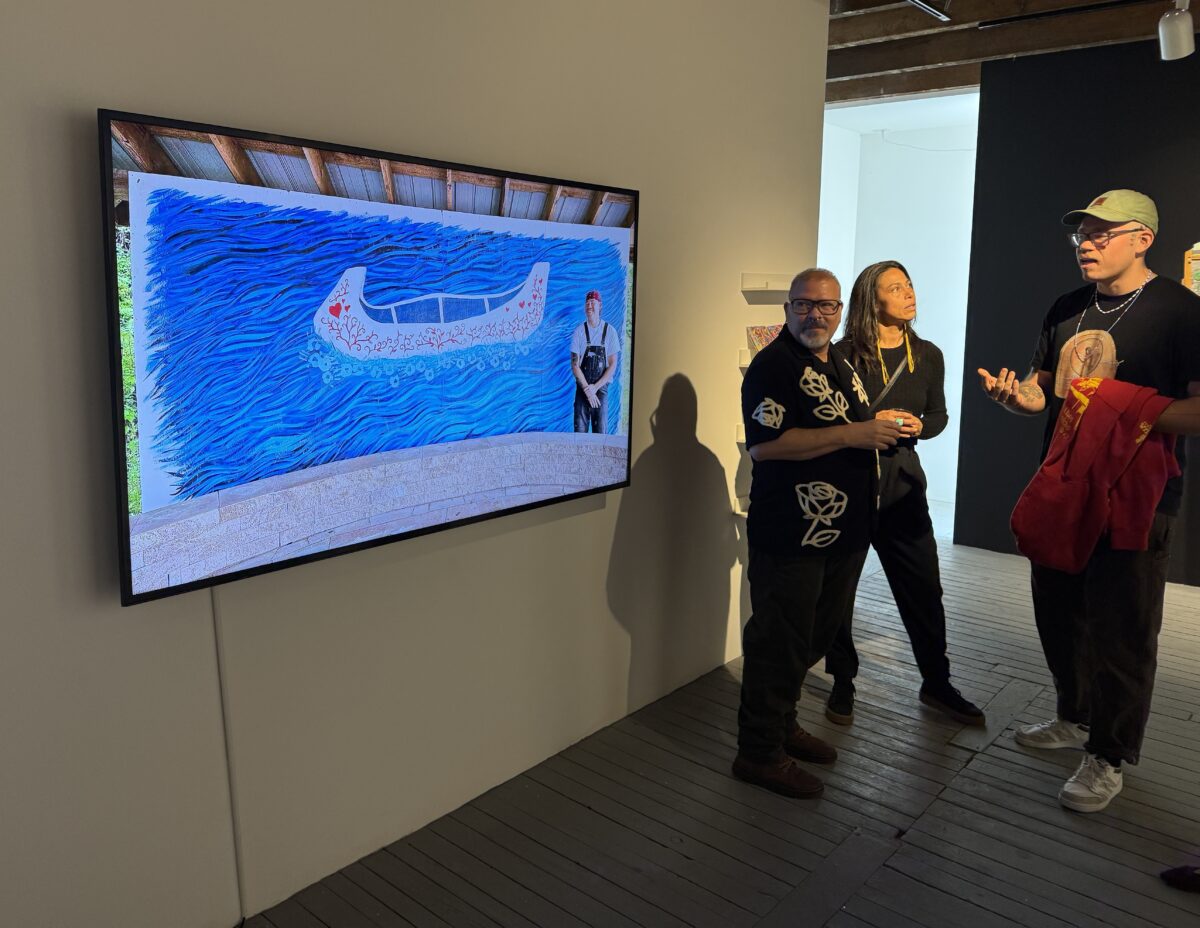
“I was curious to learn more about his art style, what he’s trying to express in his artwork,” said Tharonhianente Barnes, who teaches at Kahnawake Survival School (KSS), where Russell did some mural work - something he has been doing more and more lately.
He appreciated the focus on fungus, but the piece that stood out to him most was Kontitie’s, which is reproduced on a banner on the Mercier Bridge.
“I don’t want to assume author intent, but from what I’m interpreting here is this display that in nature, it’s the male that’s more colourful, more outgoing, it’s the male that’s the one being attractive with its colours,” said Barnes. “Whereas men, there’s this gender stereotype that the man is supposed to be more stoic, muted in colours and expression.”
Marcus Bankuti The Eastern Door
Barnes also connected with the painting as a broader statement on modern society, though he noted again the artist may well have had a different idea in mind.
“I’m fascinated a little bit with birds because they’re a symbol of freedom. Humans today, with everything we’re going through today, it’s really restrictive. It feels like we’re always controlled, is my interpretation.”
It was not only Kahnawa’kehró:non or Onkwehón:we in attendance, however.
“I wanted to go see some art on a rainy day, and it was open, and I love seeing Indigenous art,” said Montrealer Hussein Shire. “I go to the McCord sometimes, and I’m always curious about where they get their pieces from. There’s a shady history. So I wanted to go support local Indigenous artists.”
Sign up for email updates from The Eastern Door
Shé:kon Gallery, located on the second floor of Art Mur and managed by Contemporary Native Art Biennial, is a space focused on showcasing up-and-coming Indigenous artists and curators.
For Russell, the experience has given him a chance to reflect on where he’s been as an artist - and where he’s going.
“I get to see my own evolution over time, which is weird saying that. It’s cool saying that now, to see it as a reflection of that,” he said.
“Tiohnhéhkwen - The Instruments that Sustain Life” runs at the Shé:kon Gallery in Montreal until June 21.
Marcus Bankuti, Local Journalism Initiative Reporter