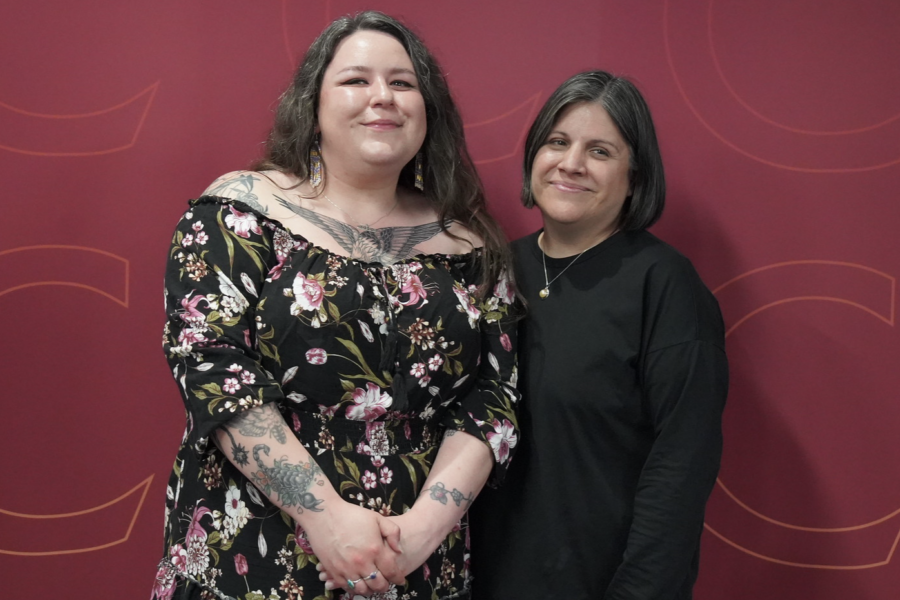
Dawson students say no to Law 14
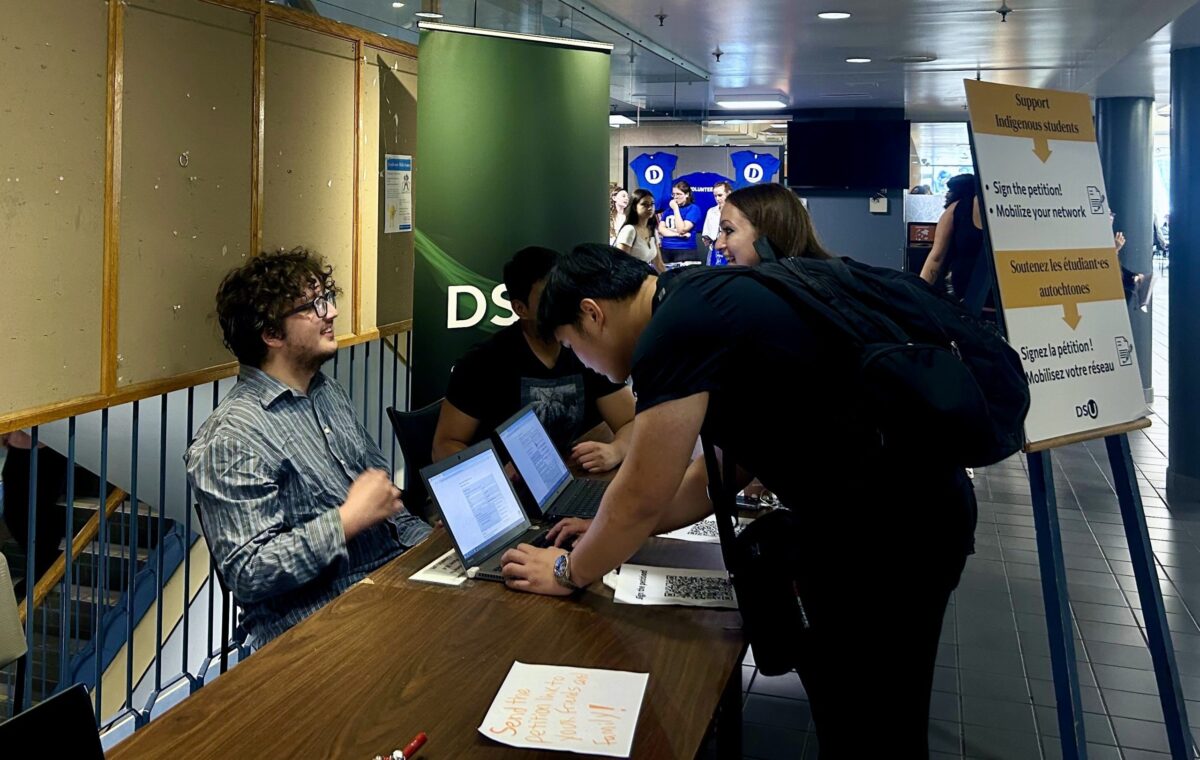
Members of Dawson College CEGEP’s student union were cheering and ringing bells in the college’s atrium this Tuesday, celebrating their petition reaching over 1,000 signatures.
As of publishing time, that number has climbed to more than 1,500, with individuals eager to sign on and support exemptions to Law 14 for Indigenous students in CEGEPs.
Under Law 14, previously known as Bill 96, all students are subject to more French courses, with many students forced to take a French-language exam to prove their knowledge at the end of CEGEP.
While students from Kahnawake should be eligible for a certificate of English eligibility which would exempt them from taking the French exam, they’re still on the hook for an increased number of French classes, needing to take five to graduate.
“I’ve already, in just one year, watched how many students from Kahnawake and other Native communities have dropped out of school or stopped pursuing their original goals and given up,” said Kahnawa’kehró:non Zye Mayo, a current student at Dawson. “It’s a lot of stress already to go to CEGEP, and then when you’re given the extra stress of new French classes, and you take away classes that focus on our culture, it’s a lot. A lot of students just go, ‘I’m done, that’s it,’ and they’re gone.”
Having learned limited French during his schooling in Kahnawake, Mayo said he’s concerned for upcoming cohorts of students, who might know little to no French coming into the CEGEP system. He’s also concerned that the law could lead to high drop-out rates for students coming from up North.
“For Cree students or Inuk students, they’re hours away from their families. They’re the only ones over here, and the languages they know are Cree or Inuktitut, and maybe English,” he said. “There’s some students that come here with kids, and they have to teach their kids their own languages and teach them English. Then they have to get their kids into French schools. It’s a lot.”
The petition has been spearheaded by the Dawson Student Union (DSU), who were sharing information about the cause and collecting signatures this week.

“Exempting Indigenous students would give them the opportunity to learn their own language if they don’t, and to be able to participate in their own culture,” said DSU representative Victoria Ormiston. “We really need to educate ourselves on what settler-colonialism is, especially as a school founded on territories that are not our own. It’s our duty to stand here and protect our Indigenous students.”
Ormiston said she feels that the law is a continuation of years of racist government policy.
“It’s colonialism at its core, and we can’t continue to take the footsteps that our ancestors have taken in the past,” she said.
Fellow DSU representative Leila Pozzi said the group was pleased to be able to share more with the student body about the impact of Law 14, adding that even students subject to the new requirements often have a hard time understanding the layers of the legislation.
“A lot of people are not necessarily aware of the whole complexities of it, and with the petition and us tabling, students are beginning to understand what this really means, and what it really involves,” she said. “My goal is to plant that seed in other students’ head and make them understand that this is a cause that affects us all.”
The petition is being sponsored by Jennifer Maccarone, a Liberal party member of the National Assembly (MNA) for Westmount-Saint-Louis. Once the signing period for the petition concludes on September 30 – which is also the National Day for Truth and Reconciliation – Maccarone will be scheduled present it to the National Assembly.
After that, she’ll be asking the government for a working session to discuss the petition, which they have to accept – when a MNA requests this type of session, the government must comply. At that point, there will be an on-camera debate discussing the petition and whether it should be thoroughly studied.
Maccarone said she’s looking forward to advocating for the petition in front of the assembly.





“The government has everything to gain by working with these students, and everything to lose by continuing to penalize them,” she said. “This will not protect and promote the French language.”
She said that the legislation has so far failed Indigenous students.
“It’s going to impact their ability to have access to education and to graduate with a diploma, which will impact their ability to have gainful employment,” she said.
“The government has for now, at least, had a deaf ear for the plight of students.”
Students were keen to support their Indigenous peers at the tabling event on Tuesday. Many said they related to the difficulties of learning another language and being away from their home communities.
“Personally, I’m Haitian, and I speak three languages, and I know how it is to have another language,” said Dawson student Rodney Alexis, who signed the petition. “I think they shouldn’t be oppressed by the government. They were here before us, they should be exempt from the law.”
Fellow student Jeremy Caron said he was compelled to sign the petition for similar reasons.
“We’re on their land. This land isn’t owned by us. And I can understand being oppressed because I wasn’t born here, I was born somewhere else, in a place of oppression, so I can really relate to Indigenous people here in their cause, and I want to support them,” he said.
Sign up for email updates from The Eastern Door
Another student that signed the petition, Mohammed Bennoussa, said that the law was another unfair barrier to Indigenous students seeking post-secondary education.
“I know that Indigenous people already have a lot of struggles. I don’t want them to have another struggle with the language and with education. So I wanted to help,” he said.
Students in Kahnawake are able to reach out to the Kahnawake Education Center (KEC)’s post-secondary distance counsellor Bethany Douglas, who liaises with students after high school. However, Douglas said that the main help she’s been receiving in relation to the complex legislation has actually been from CEGEPs themselves, rather than from the province.
“As far as official government correspondence, the provincial government is not super reachable, especially for us, and especially in English,” she said. “We’ve sent letters and requests for information in the past and received no response other than ‘we have received your letter.’ That’s it.”
The petition will remain open until the end of September and can be signed by anyone in the province, including those under 18. The petition can be found by searching on www.assnat.qc.ca.