Cultural safety bill officially adopted

Nearly a year-and-a-half after being brought to Quebec’s National Assembly, a bill aimed at establishing cultural safety for Indigenous people in healthcare settings has been officially adopted - though many Indigenous groups say that the legislation doesn’t go far enough, and that their organizations weren’t adequately consulted.
“‘Cultural security’ needed to be defined with us, we needed to have a mutual definition, because each person can define and interpret differently,” said Marjolaine Étienne, executive director of Quebec Native Women (QNW).
QNW was one of multiple organizations that publicly expressed their dissatisfaction with Bill 32 last week, alongside the Assembly of First Nations Quebec-Labrador (AFNQL), the Conseil des Atikamekw de Manawan (CDAM), the Joyce’s Principle Office, and the First Nations of Quebec and Labrador Health and Social Services Commission (FNQLHSSC).
“What are we working for? That’s the question. Are we just putting a bandage on the issue, or are we working on something with more depth?” Étienne said. “We’re not actually working on these things to meet the real needs of First Nations women and girls.”
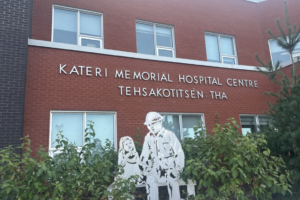
The bill itself came about in the wake of the death of Joyce Echaquan, an Atikamekw woman who passed away in September 2020 at a hospital near Manawan. A public inquiry was launched into her death and the coroner’s report recommended that the Quebec government acknowledge the existence of systemic racism within healthcare institutions and commit to helping eliminate it.
From that sprung Joyce’s Principle, a document created by the Atikamekw Nation which outlines measures aimed at guaranteeing all Indigenous people the right of equitable access to all social and health services without discrimination.

However, there’s a reason the government cannot adopt Joyce’s Principle.
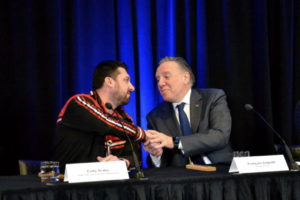
“To be transparent, to put Joyce’s Principle in place, we need to recognize systemic racism, and we’ve still got the same position on that,” said Quebec’s minister responsible for relations with First Nations and Inuit Ian Lafrenière.
The government has repeatedly refused to recognize the existence of systemic racism, leading it instead to create Bill 32, which was officially passed last Thursday.
The bill requires every institution in the health and social services network to adopt a cultural safety approach towards Indigenous people that “takes their cultural and historical realities into account in all interactions with them.”
Ghislain Picard, chief of the AFNQL, said that there’s a lack of accountability within the bill, with health networks only having to release their plans to ensure safe practices to the government.
Part of the problem, he said, is that Quebec did not listen to Indigenous communities when deciding what measures needed to be taken.


“It’s not up to Quebec to do that. It’s up to us to determine what Quebec needs to do to provide cultural safety,” Picard said.
“We’ve always been open to adhering to a process that would’ve seen us really, genuinely involved. The government had a very good opportunity to co-construct and co-develop a law with us, and they didn’t choose that route.”
Lafrenière said that the bill does include accountability - health and social services networks must report back to the government with a list of practices implemented to ensure cultural safety, which are to be published annually.
“It’s going to be transparent, people will see that. It’s a very important aspect of the bill. I heard comments that there are no obligations, but I don’t agree with that,” he said.
Lafrenière also said that the use - or lack thereof - of the term “systemic racism” has led to roadblocks in addressing racism in the province.
“Each time this expression is used, I get some people that completely are not open to talk about it anymore, they shut down,” he said.
Sign up for email updates from The Eastern Door
“At the end of the day, let’s fight racism instead of fighting about expressions.”
He said he acknowledges the reactions of some Indigenous groups to the passage of the bill.
“It’s a reaction, I think it’s a human reaction, and I do respect and understand that,” he said. “I’m not saying it’s perfect, I’m not saying everything’s going to change because of it, but we need to start somewhere.”
Picard said that AFNQL will be monitoring whether the bill leads to real change.
“We’ll just have to wait and see how all of this unfolds in the coming weeks and months,” he said.