Confronting audiences with the real history
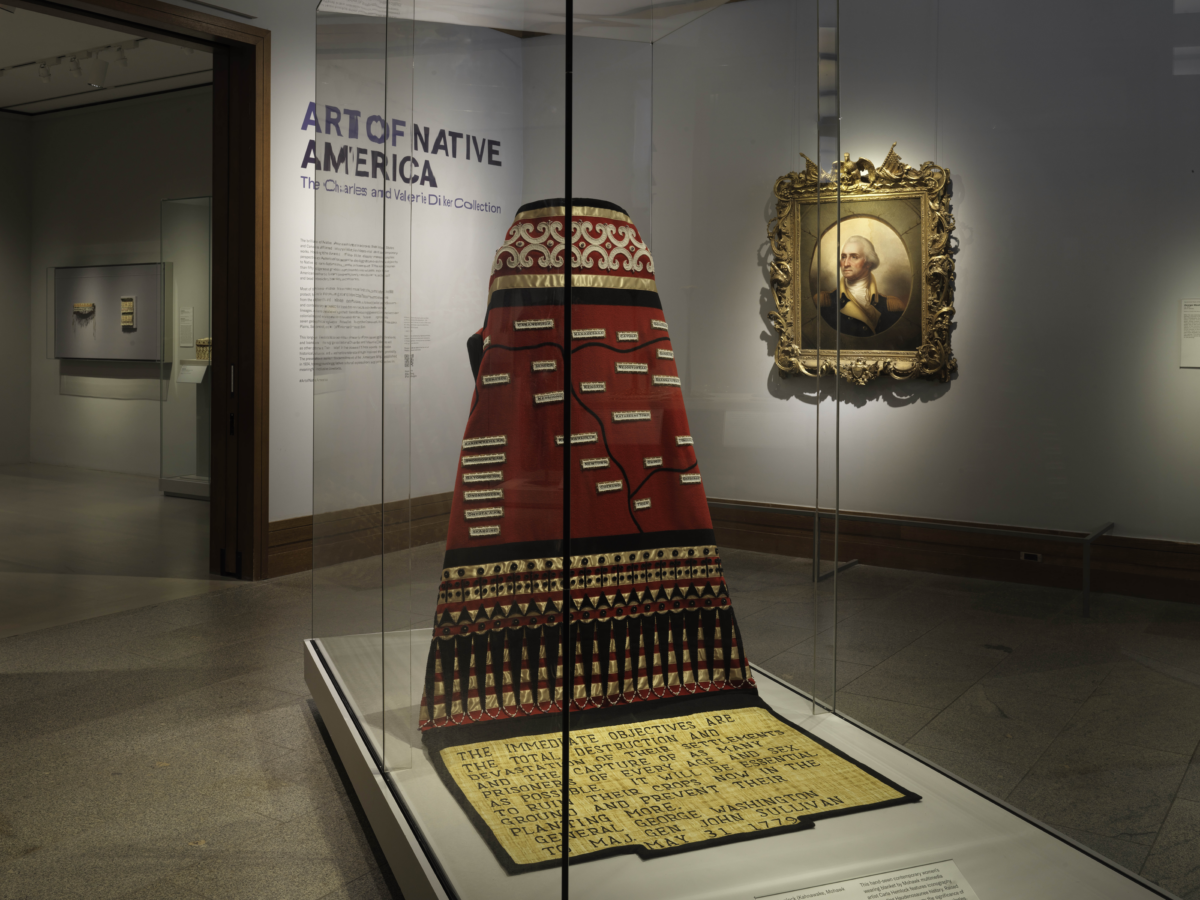
“The Homelands” by Carla Hemlock is on display at the Met. Courtesy Carla Hemlock
In the most famous art museum in the United States hangs a portrait of the country’s most famous historical figure, the man who led the American Revolution and became the country’s first president.
But the installation, currently on display at the Metropolitan Museum of Art in New York City, part of its effort to commemorate the 250th anniversary of the Declaration of Independence, does not lionize George Washington. Steps from his enigmatic gaze, a blanket, hot with wool, heavily beaded.
The Homelands, handmade by Kahnawa’kehró:non artist Carla Hemlock, highlights the orders Washington gave in 1779 in what is known as the Sullivan Campaign.
Sewn in the blanket’s foot on a yellow patch, like aging parchment, is this quote attributed to the man American school children are taught to revere:
The immediate objectives are the total destruction and devastation of their settlements and the capture of as many prisoners of every age and sex as possible. It will be essential to ruin their crops now in the ground and prevent their planting more.
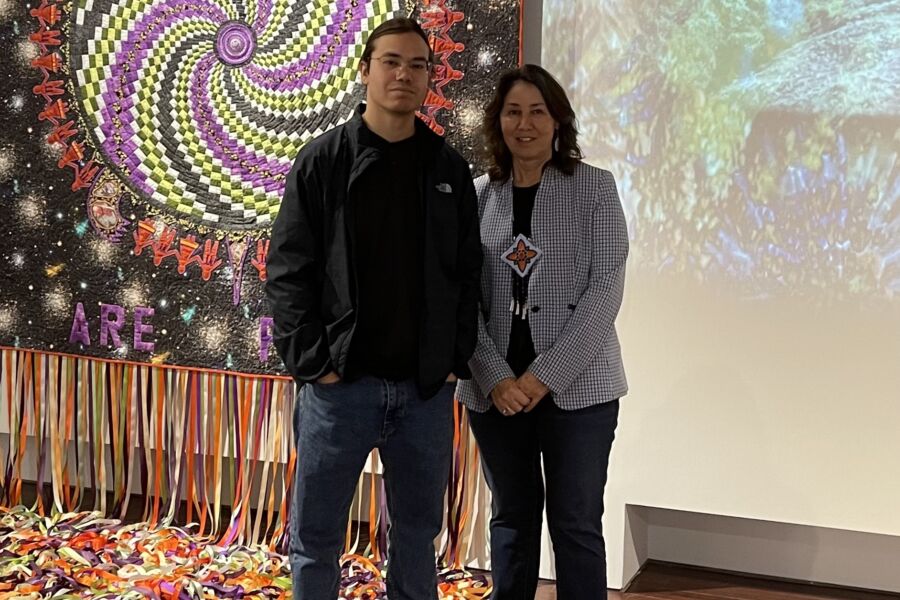
The blanket is embellished with Haudenosaunee designs representing both male and female and a map of the destroyed villages.
“Those orders were to destroy all the Haudenosaunee villages and to just annihilate our homelands and our people,” she said.
“By them placing it facing George Washington, that’s huge. That’s a huge impact for anybody who’s going to see it.”

The piece, which she submitted to the MET in 2024 after being approached by two of its curators, represents not only a re-examination of George Washington, laying bare the underbelly of the American project, it is also a remarkable milestone in the career of a leading Kahnawake artist.
Her first thought when she was contacted by the museum, known colloquially as the Met, was that it must have been a prank. She’s been to the Met; she knows what it means. When she finally connected with the curators and pitched them this artwork, they gave her the green light.
While The Homelands has been on display since March, Hemlock took her time to let friends and family know about it.
“I’m still trying to process it, where it is and the impact that it’s making,” she said.
The piece is now part of the museum’s collection, and she’s been asked to do additional work.
“It was never in my thoughts to say my work would end up at the Met,” Hemlock said. “It’s just not something that you dream of. It was too big. For me, it was too big. So I never even went there in my thoughts.”
She hasn’t seen the exhibit in person yet, but she expects to get a little emotional.
Hemlock has long made clothing, blankets, and quilts, starting out as a young mother making tradition clothing for her children. “It was just always something I love to do,” she said. In her 40s, she decided she wanted to push herself and see what might happen. She started doing art shows in the US, until the COVID-19 pandemic took her off the circuit.
She used that interruption as an opportunity to take a step back from the show routine and take a breath. “It’s a constant wheel where you can’t get off if it,” she said.
Yet, to her surprise, she became busier than ever as curators and institutions began reaching out. But she’s able to take her time with her artworks and finish them on her own timeline.
One of these pieces, which has been exhibited previously in Drummondville’s contemporary art museum, the DRAC, was recently donated to the Montreal Museum of Fine Arts (MMFA), its new permanent home. It is currently on display there as part of an exhibition called Rising Suns: Art from the Confederacies of the Great Lakes and Rivers.
The piece, a collaboration with her son, filmmaker Raohserahawi Hemlock, is called In the Arms of the Natural World. The installation, which is comprised of three quilts by Carla and two films by Raohserahawi, explores the legacy of residential schools.
“Because it’s such a difficult, difficult subject to approach, we both approached it with absolute delicacy and care,” said Hemlock, adding she was blown away by Raohserahawi’s professionalism and quality of work.
It’s a feeling that’s mutual.
“She’s been upping her game constantly,” said Raohserahawi of his mother’s art.
“The place where she currently landed on was these beautiful quilts that are painstakingly made, but they’re not just there anymore just to be pretty. It wasn’t always just that, but it’s kind of like you as a viewer are a bit more challenged by looking at the art now.”
For the MMFA’s curator of Indigenous practices Léuli Eshrāghi, the Hemlocks’ work is a boon to the gallery’s collection.
“This is a huge work,” they said. “It’s really powerful and took so much time for them to make.” The piece took a year to put together, according to Carla.
Sign up for email updates from The Eastern Door
Eshrāghi, who is Tagata Sāmoa, is working to enrich the MMFA’s Indigenous collection by modernizing and growing it since joining the museum three years ago.
“When I arrived, there was only one Kanien’keha:ka artist in the collection and I was super shocked,” they said. There are now seven.
To Eshrāghi, the latest acquisition is part of an effort to recentre the narrative and deepen the understanding of Indigenous stories and histories.
“The arts are just really needed,” Carla said. “It’s a crazy time right now, all over the place. People can’t really express freely, especially in the United States.
“The arts give you that freedom to express an idea or to lift people. I’ve always thought the arts are just an incredible vehicle for people to express themselves.”
The Rising Suns exhibition runs at the MMFA until October 11. Entry is free for Onkwehón:we.
Marcus Bankuti, Local Journalism Initiative Reporter