Bridge contract dissolved
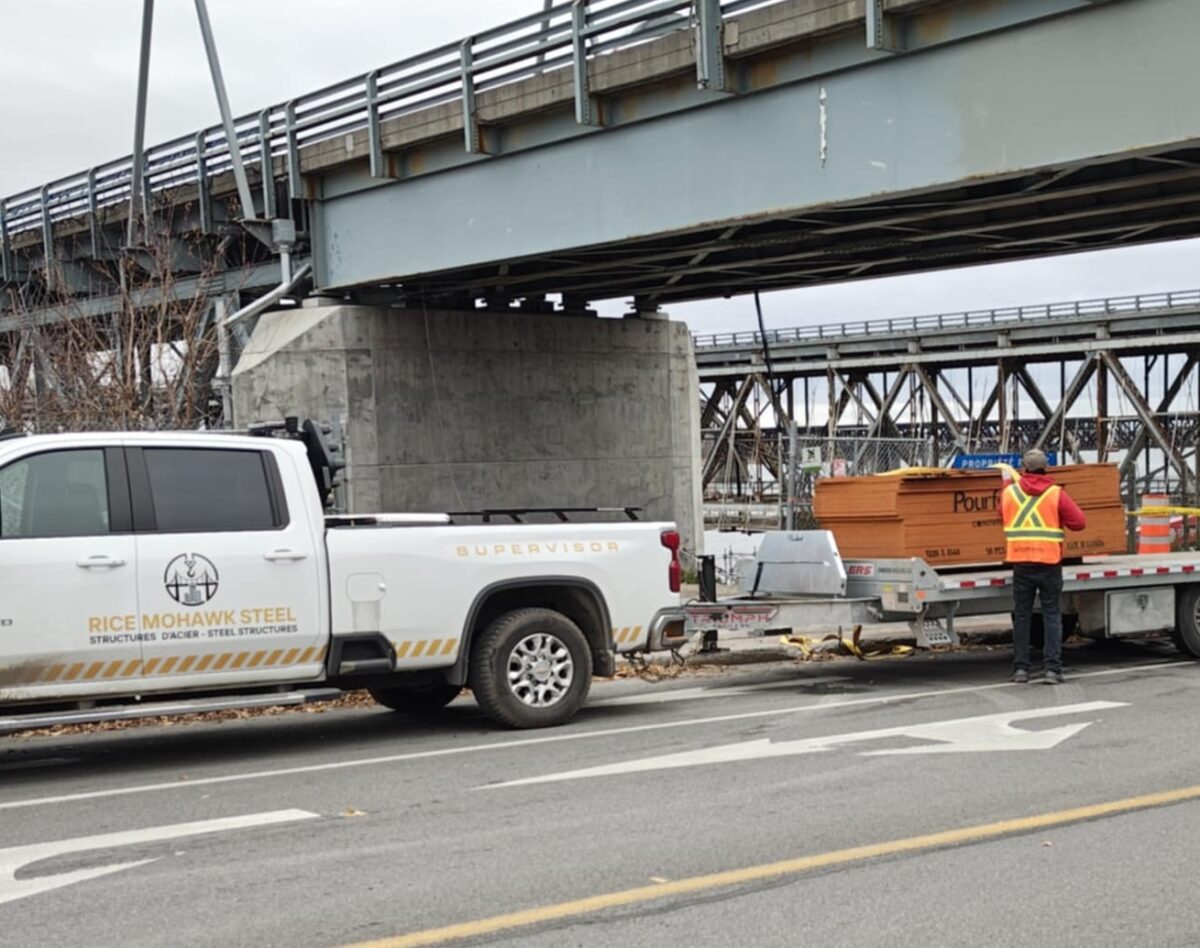
Just four months into the job, Rice Mohawk Steel and Quebec have agreed to tear up a $36 million contract to maintain the LaSalle side of the Mercier Bridge following lengthy delays - and a failure to secure access to community land occupied by rival contractor Mohawk Bridge Consortium (MBC).
“The job could have been great,” said a former Rice Mohawk Steel worker in an interview with The Eastern Door, who participated on the condition of anonymity. “We had an awesome crew to do the job, and now, it’s a sour taste.”
The Kahnawa’kehró:non worker believes there’s plenty of blame to go around, with harsh words for both MBC and the administration of Rice Mohawk Steel, whom he blames for mismanaging the project.
Meanwhile, representatives of Rice Mohawk Steel blame MBC for doing everything it could to torpedo the contract after submitting a failed $49 million bid for the job.
“I believe that MBC are definitely sore losers,” said Maggie Mayo, health and safety coordinator with Rice Mohawk Steel, who spoke to The Eastern Door alongside Oliver Montour, who was the site’s project manager and safety supervisor, but said he will no longer be working there.
“You know what happens when you have no competition? You put whatever number you want. Of course there was going to be sabotage to get us out of there,” said Montour.
“As a community member, I feel it was unfair. It was like cheating. They put community members’ lives in danger.”
MBC owners Sterling Deer and Amy Rice could not be reached for comment for this article.
According to the Quebec transport ministry (MTMD), MBC will now instead be doing the priority repairs needed on the LaSalle side of the bridge for winter while the province sorts out what to do next.
Only local contractors are eligible to work on the Mercier Bridge. Rice Mohawk Steel continues to be in good standing, according to MTMD, and will be eligible to bid on contracts in the future.
The 27-month Rice Mohawk Steel contract might have heralded a new era for the site, where MBC has had a virtual monopoly, and perhaps even for Kahnawake’s labour force: Rice Mohawk Steel’s labourers, more than 20 in all, unanimously opted to be represented by the Ironworkers Local 711 around the beginning of September, making it the first ever Kahnawake construction site to go union.
However, not long after, workers walked off the site because of unsafe conditions. The next day, September 12, the Kahnawake Labour Office (KLO), which exercises the community’s jurisdiction over labour on the territory, investigated and issued an order stopping the work pending fixes to make the site safe.

“I hope people understand that this isn’t on the men’s back. The only thing they did was they stood up in an environment that wasn’t safe,” said Local 711 president Matthew Fortin.
The biggest sticking point was the lack of emergency egress, meaning exit, which had been planned to be at Pier 14, located at the North Wall. Rice Mohawk Steel contended in court filings this was undermined by MBC.
“Once we really investigated that, we found out there was no other way off, other than to jump more or less, or the way you came in,” said Jeff Morris, director of the KLO, explaining this created an untenable threat to worker safety.
Morris noted that the rules followed in Kahnawake are clear that labourers have the right to refuse unsafe work, union or not.
“I think the whole situation’s very unfortunate. Nobody here wants to see an abrupt end or dissolution of a contract,” said Morris.
On October 11, KLO gave the conditional go ahead for work to continue, but the MTMD, which included safety requirements in a 400-page contract with Rice Mohawk Steel, issued its own suspension of work just days later, according to Morris.
“To have MTMD exercise those clauses in those contracts was a huge disappointment. That’s between Rice Mohawk and MTMD because it’s a signed contract. Everybody worked hard to try to make the work happen. At the end of the day, it’s the workers who are suffering,” said Morris.
Other safety concerns included questions about the platforms on which labourers work. There were particularly concerns over older platforms, no longer to code, that were deemed structurally sound according to inspection notes, Morris said, but which were riddled with hazards, requiring weight load limits and other disruptive measures.
The anonymous worker who spoke with The Eastern Door believes the problems around the platforms were foreseeable.
“I said it from day one. The platforms are garbage,” he said. The labourers were changing handrails, kick plates, and cleaning garbage left behind by the previous contractor, he added.
“In the meantime, that’s just time lost, time lost, time lost,” he said.
He blamed this on a lack of bridge expertise in the office, something Montour denied.





Montour compared the reports to buying a car with a 150-point inspection.
“You won’t go to a mechanic and say listen man, just double check the battery for me. You take in the inspection report that’s certified from an engineer for what it’s worth,” he said.
The company didn’t have access to the site until the contract began, he said.
“We did what we could within the parameters. There’s no reason we should second guess an engineer. An engineer’s stamp is good as gold.”
Montour acknowledged that there were fines levied against Rice Mohawk Steel, but argued this is a routine aspect of any job, with a push and pull of appeals. He also confirmed that property was seized at the Rice Mohawk Steel headquarters on the LaSalle side on Thursday by a supplier with a court order. He characterized the dispute as personally motivated, saying Rice Mohawk Steel owner Burton Rice would challenge it.
Maline Island
There were two strands to the North Wall dispute - the emergency egress and the use of the land to facilitate the work, which was a right of way Rice Mohawk Steel had anticipated, and which was logistically important because of the distance from the shore of LaSalle to that section.
These were the subject of an injunction application filed in court by Rice Mohawk Steel, accusing MBC of blocking access to community land with cement blocks and chains.
However, the injunction was rejected, leaving Rice Mohawk Steel with no recourse but a glacial Mohawk Council of Kahnawake (MCK), which is responsible for administering community land such as the North Wall.
While MCK grand chief Cody Diabo in early September expressed a willingness to help facilitate an emergency egress in an interview with The Eastern Door, he avoided committing to facilitating access to the land for business purposes, a position he maintained in an interview this week.
“We’re neutral, but we also don’t get involved in private business decisions,” Diabo said.
He seemed to object to Rice Mohawk Steel resorting to the courts.
Sign up for email updates from The Eastern Door
“I know they put in an injunction there,” said Diabo. “Our stance at that point is no Quebec judge is going to interfere in terms of lands. We have our own processes here.”
However, Rice Mohawk Steel and the MCK were in discussions about this issue at least as early as July, according to emails obtained by The Eastern Door.
Diabo suggested the correct process was not followed and that a request through proper channels, namely the Land Management Committee, was not made until weeks after the injunction failed.
He also said it takes time to navigate requests such as this one.
“We’re not trying to make things difficult, but we’re also not going to sit there and say this is fine. We’ll do our due diligence,” he said.
The MCK did not respond the next day to a request for clarification on Wednesday evening asking when a request was first submitted by Rice Mohawk Steel and whether Quebec’s transport ministry had attempted to coordinate the right of way, and, if so, when.
The Rice Mohawk Steel worker who spoke with The Eastern Door was angry about how North Wall access was handled by his employer. He believed the work was possible without it, and said Rice erred in seeking intervention from the courts. He believes MBC acted in bad faith, but ultimately attributes the failure to adapt to Rice Mohawk Steel management.
Regardless of the cause of the breakdown, it’s too late for the Kahnawa’kehró:non workers who had so much hope for the project only a few months ago.
“Once they got the accesses, the men were ready to go back to work, but it was always an issue with one of the actors that was in the whole scene,” said Fortin, adding the union plans to conduct its own investigation.
“Nobody really gave them a chance to show what they’re made of.”
Marcus Bankuti, Local Journalism Initiative Reporter