Archeological project launched

Courtesy Mohawk Council of Kahnawake
The Mohawk Council of Kahnawake (MCK) is one of three core members of a research project looking to re-examine the understanding of the history of what the project is calling Ancestral Iroquoia - namely the relationships between the Haudenosaunee, Huron-Wendat, and other Iroquoian-speaking peoples.
“There’s a general objective of the research of supporting and participating in and advancing research to bring us all collectively to a greater understanding of the history of this land, who people were in ancestral times, and their relationships with places and people,” said Gerald Taiaiake Alfred, one of the project’s co-directors.
Major aspects of the research will be an examination of the St. Lawrence Iroquois theory - that what Jacques Cartier and other early French settlers called the Iroquois were a distinct culture from the Haudenosaunee.
“That particular point, of course, has political implications - implications for our own identity and our relationship to our territory, and our understanding of ourselves,” said Alfred.
“Some of that theory is currently under revisions with new technique in archeology, new insights coming from linguistics and our histories.”
Alfred said that insights from Indigenous people will be helpful not just for the research, but also to potentially assist in the shaping of legal frameworks on identity.
“We very clearly acknowledge the political and legal importance of this work, because all of the work that’s being done in universities is used by lawyers and political advocates in various processes, whether it’s land claims or anything like that,” said Alfred.

“And so we have a situation now where we have the opportunity to actually be part of shaping that understanding, that which people who engage in these processes, political, or legal, in the future, are going to draw from this information.”
Other big research points will be the evolution of Indigenous settlements, cultural exchanges and diplomatic relations between the different peoples pre-colonial contact, the repatriation of Iroquoian ancestors, and digitization and preservation of traditional knowledge and heritage.
The research partnership, which is scheduled to last seven years after launching this month, will encompass dozens of researchers from across North America and Europe; it is a continuation of a collaboration between the MCK, the Pointe-à-Callière Museum, and the University of Montreal, which form the core partners centering the project, the Steering Circle.
Isabelle Coupal, the archeologist who is acting as representative of the Pointe-à-Callière Museum on the Steering Circle, said that the active participation of Indigenous people in the research is a great opportunity to expand the research with Indigenous sources, which have been neglected or discarded in the past.
“We have lots of archeology and historical documents that came from settler sources, but obviously they’re not the only voice,” said Coupal.
“The oral tradition, spiritual knowledge, ancestral knowledge of the land, it’s really enriching for our historical research.”
Coupal said that the museum is focused on helping the MCK and other Indigenous partners on the research with what they are trying to answer.

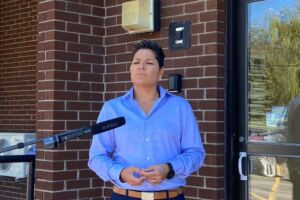
“What’s important for us in this project is the fact that it’s a project that was spearheaded by the MCK,” said Coupal.
“To me, that’s what defines a truly collaborative project between Indigenous and non-Indigenous partners.”
Alfred said that it was agreed upon by the Steering Circle and the other researchers in an online meeting last week that the MCK be centered in the project, and that even with the advances in archeological and anthropological work that have occurred in the past few years, the knowledge imparted by the Indigenous perspective is vital to the project.
“Our perspective, for the greater part, has been ignored, and we have not had, in the past, when this work was first done, any types of involvement at all in helping scholars understand the relationships between artifacts and living cultures, and that, I think, is going to be the major difference between what’s being done in this project and work that was being done in the past,” said Alfred.
Jennifer Bracewell, the archeologist who is the project’s coordinator, said that while she has coordinated many projects in the past, including with the MCK, the more than 70 researchers currently on the project is by far the largest number for one project she has been a part of.
“The nice thing is everybody really wants to be on this project. It’s a great group of people who are really, really engaged, including in the central partnership of this project,” said Bracewell.
She said that the digitization efforts of the project were an important way of making sure the research would be accessible not just to scholars, but anyone interested.
Sign up for email updates from The Eastern Door
“Sometimes we forget, as archeologists, that we kind of have privileged access, and it’s not okay that we have privileged access, but certain communities do not,” said Bracewell.
After holding a first online meeting earlier in July, the project is planning an in-person general meeting next spring.
“I’m really looking forward to that, because there’s an energy that comes with being in-person. Seeing people really helps build on each other’s thoughts, something that is harder to come up with in a Zoom call,” said Bracewell.