Brazil hosts climate gathering

Ninawa Inu Huni Kuī (left) of the Huni Kuin tribe, who represents around 17,000 Indigenous people from Brazil and Peru in the People’s Federation of Acre. He shared his peoples’ stories with Rice at the gathering. Courtesy Brooke Rice
When community member Brooke Rice was first encouraged to attend the Renew Our Power gathering in Brazil by a friend, she wasn’t sure if she had the appropriate experience to go.
“I was like, ‘I don’t do any climate work,’” Rice said. “But my friend said, ‘No, everything you do with Tkà:nios is about that, about giving back to the land and working with the land.”
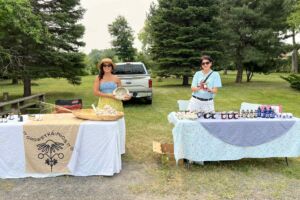
Thinking it through, Rice realized that her Tkà:nios project, which focuses on food sovereignty and sustainable agriculture, is inherently tied to climate justice, and so she took a chance and applied to attend the gathering.
Her application was accepted by the gathering’s organizers, 350.org, and soon she was setting off to Brasilia, connecting with 200 fellow activists and changemakers from around the world, with thousands more attendees joining panel discussions online.
“It was really empowering to hear about all of these different community-led initiatives from the ground-up, and really focus on resting clean, affordable, accessible energy solutions,” Rice said. “It was really eye-opening, and it made me realize that we’re very wasteful when it comes to energy, we’re overconsuming, we’re not energy-efficient at all.”
A highlight of the event was connecting with hereditary chiefs from the Amazon, including the Huni Kuin. She heard how many Amazonian tribes have had their homelands threatened by mining companies, many of them Canadian.


Rice met several other organizers from Turtle Island at the event, with communities from coast to coast representing in Brasilia. Courtesy Brooke Rice
“They were sharing how some of their people are untouched, they’ve had zero contact, and their lives are so deeply connected to the land and spirituality,” Rice said. “Hearing them share this deep profound wisdom was really inspiring, but it also broke my heart, because I was like, ‘Wow, our people went through colonization 500 years ago, and now these people are about to endure it.’”
The whole experience felt like a call to action, Rice said.
“It was just this gut-wrenching feeling of how do I help, how do I mobilize, how do we get people together to help defend what is considered the lungs of Mother Earth?” she said. “It was a real rollercoaster of emotions, looking at these projects, but then also the reality of the Earth and capitalism and climate injustice.”
Many of the conversations she had left her feeling inspired to drive the mission of Tkà:nios forward.
“The work we do at Tkà:nios is about creating regenerative practices, connecting back to the lang, giving back to the Earth with seeds, and planting,” she said. “It’s an act of resistance and climate mitigation.”


She stayed at an “eco village” near the conference, where everything was farm-to-table, and there were vast gardens, and ponds full of fish.
“Everything we were eating was from the land,” she said. “I was very inspired. I was sad knowing I had to come back to Quebec with all of our realities, but I was super motivated by the possibilities. We can have ponds, and we can have big edible landscapes and farm-to-table operations, and solar water pumps or geothermal energy. We just need innovation.”
One of the best panels was one that guided participants through a step-by-step process of how organizers can create plans, execute them, and do meaningful community consultation.
With so many attendees from so many different communities, that kind of panel brought a wealth of different perspectives to the table.
“I was just so renewed and refreshed. I was able to fill my cup, because it’s a lot of hard work when you do community work and land work,” Rice said. “I just felt renewed to be gathering with so many beautiful people that have this real, pure, vital love and connection for Mother Earth.”
It’s important, when working in land-based initiatives, to have awareness of what other communities are doing, Rice added.
Sign up for email updates from The Eastern Door
“I was like ‘Ah, what are they doing, what are the Māori doing, what are the people in the Philippines doing, and the people in Hawaii or Macau?’” she said.
“I was able to paint this global picture, and it’s a good reminder that we’re all children of the Earth, we can’t just take from her, we also have to give back.”