Appeal heard at Supreme Court
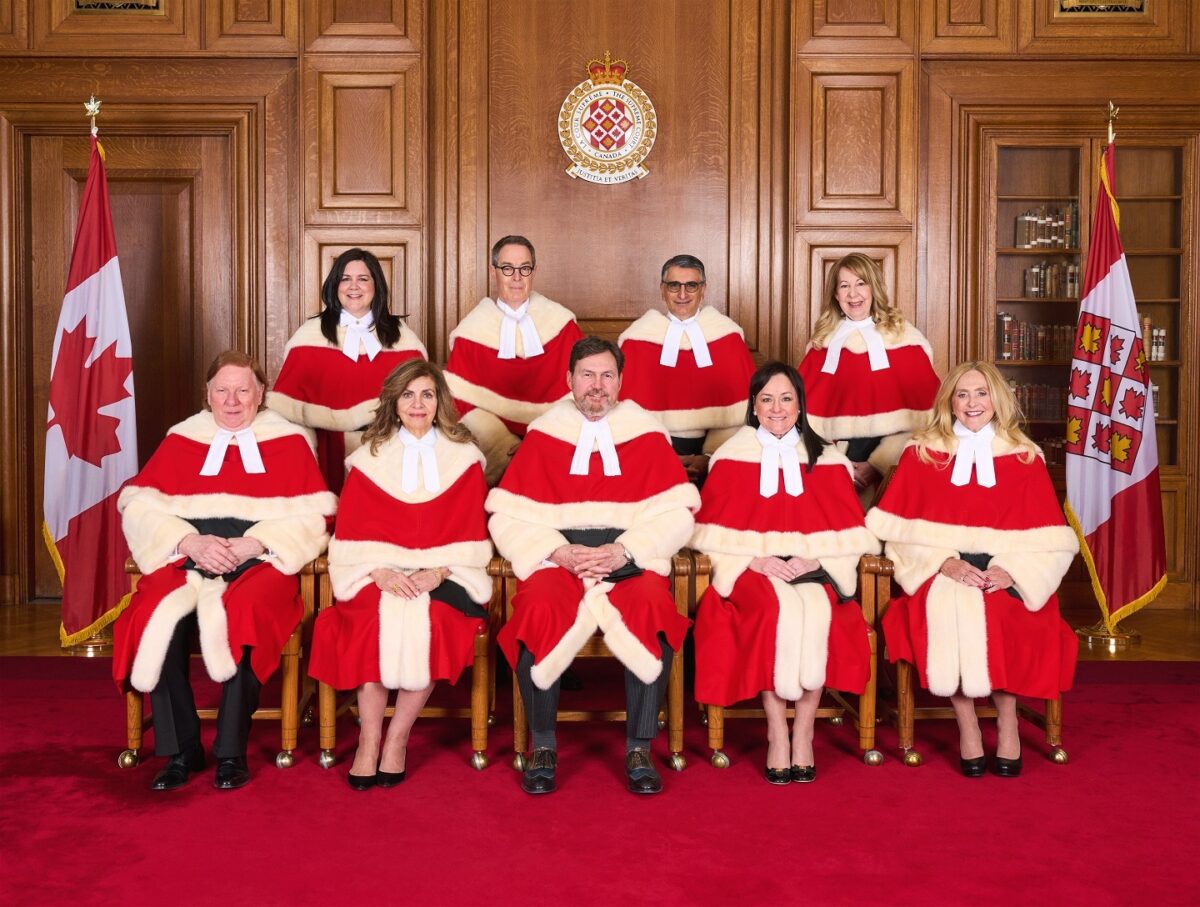
Judges on the Supreme Court of Canada.
The Mohawk Council Kanesatake (MCK) had its day in court Wednesday – the highest court in the country, that is.
On the morning of March 19, the Supreme Court of Canada heard the MCK’s appeal in Mohawk Council of Kanesatake v. Louis-Victor Sylvestre et al. The appeal had previously been dismissed by the Court of Appeal of Quebec in December 2023.
No judgment has yet been rendered, with a decision reserved until a later date, according to a press release published by the court following the hearing.
“I’ve been dealing with Sylvestre when I was grand chief and now another two years of my life dealing with him, and today it comes down to this one day,” said MCK chief Serge Otsi Simon on the morning of the hearing, which he attended.
“I can say we fought this till the end, and when we win, it’ll be a win for all First Nations against any unscrupulous creditor,” said Simon.

The MCK commissioned the services of a group including Sylvestre, a lawyer, between 2001 and 2003 to fight an Oka mining project. However, Kanesatake was put into third-party financial management from 2003-2006.
A 2004 judgment ordered the MCK to pay $700,000 plus interest, but the group was unable to collect the payment. The third-party manager offered about 24 percent of that amount as a settlement, but it was refused.
A major element of the case is whether Kanesatake’s property is protected from seizure by Section 89 of the Indian Act. That section exempts property on a reserve from being taken by non-First Nations creditors.
When the Supreme Court announced it would hear the case, it required the parties to argue whether the MCK’s property is “situated on a reserve.”
Technically, Kanesatake is not considered a reserve, as made clear in the 2001 Kanesatake Interim Land Base Governance Act, which specifies that although lands are reserved for Kanesatake Mohawks under the Constitution Act, they do not constitute a reserve within the meaning of the Indian Act.






However, the Caisse populaire Kahnawake, Canada Revenue Agency, and Revenu Quebec all refused to hand over Kanesatake’s property, citing Section 89 of the Indian Act.
Also at issue is whether rights from the 2004 judgment are voided by a failure to exercise within 10 years. When these rights are exercised, they are renewed, so the question is whether the clock was reset after Sylvestre et al attempted to seize property in 2016, even though these were unsuccessful.
In 2022, the Superior Court of Quebec ruled in favour of Sylvestre et al., leading to the appeal in 2023, and finally a hearing at the Supreme Court this week.
According to Simon, the amount at stake has climbed to nearly $2 million.
Sign up for email updates from The Eastern Door
Marcus Bankuti, Local Journalism Initiative Reporter