Akwesasne land claim over?
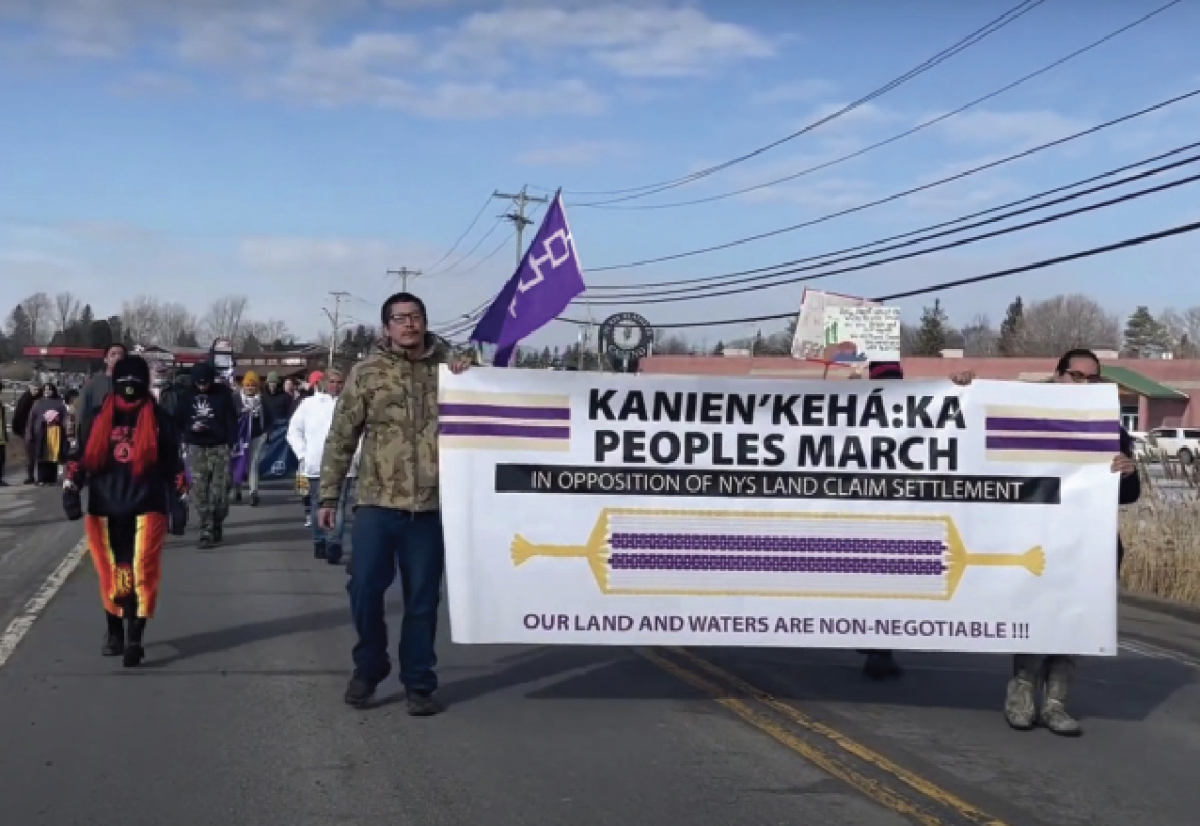
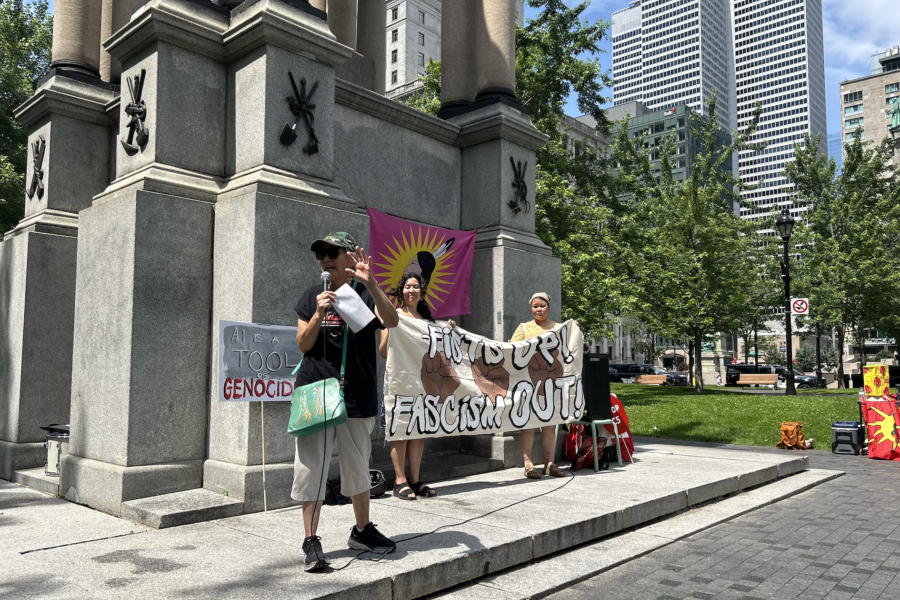
A Peoples’ March held in Akwesasne in 2024 opposed the land claim settlement, which is moving ahead with the support of a New York governor. File photo
The Saint Regis Mohawk Tribe (SRMT) has reached an agreement with a New York governor that could spell the end of a decades-long land grievance – but many who have been following the case say that the deal symbolizes a loss of sovereignty in Akwesasne and beyond.
“Ultimately this is wrong, this is weakness where there needs to be strength,” said Isaac White, a community member from Akwesasne.
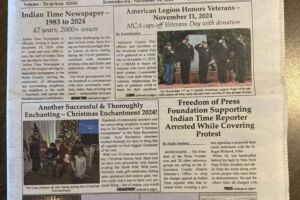
White was formerly a reporter for the now defunct Indian Time, which shuttered its doors in 2024 after more than 40 years of news coverage in Akwesasne.
This land claim is about the same age as the newspaper was, and Indian Time provided coverage of negotiations throughout the decades, with White staying up to date on the topic since leaving the paper.
“The willingness to fight for what is ours isn’t completely gone. People might get the impression that all of us have just accepted this, but there’s a lot of us who haven’t.”
The announcement from New York governor Kathy Hochul came last Friday, following news last December that the SRMT had signed a final settlement agreement to put the claim to bed, with the Mohawk Council of Akwesasne (MCA) signing on in January.
Both the SRMT and the MCA are elected entities that govern in Akwesasne, with the MCA serving the Canadian side of the territory and the SRMT governing in the portion that lands in the United States - the SRMT are federally recognized by the United States government.
Back when the agreement was signed, many community members in Akwesasne were vocal about their opposition, expressing concerns that wording in the agreement could jeopardize future land claims, among other criticisms.
The Mohawk Nation Council of Chiefs (MNCC) had also publicly stated their opposition to the agreement and pulled out of the settlement.
Others have been more welcoming of the final agreement, with some seeing it as a victory after years of gridlocked negotiations.

In a press release the SRMT said that the settlement agreement could lead to future returns of more land.
“The Settlement is not perfect, as it does not restore all Mohawk lands that we historically lost. However, the settlement provides us the opportunity to add, restore, and acquire lands,” the SRMT said.
“Getting our land back has been a goal of ours and our ancestors - we would not be here without the perseverance and courage from everyone who worked on the claim and negotiations since 1982.”
The land claim itself has origins in the late 1700s when the Treaty with the Seven Nations of Canada was signed, making a cession of certain lands to the State of New York and the reservation of certain lands for “St. Regis Indians.”
In 1982, a lawsuit was officially filed by what is now known as the Mohawk Council of Akwesasne (MCA) who argued that New York had illegally purchased the land, and that Akwesasne were the rightful owners of it based on the treaty.
A few years later, the MCA joined the SRMT and the MNCC to create a tri-council, who were to fight for the suit together.
Since the withdrawal of the MNCC, traditional governance is no longer included in the agreement.
According to the statement from governor Hochul’s office, the final agreement restores over 14,000 acres of disputed land to Akwesasne, and includes a $70 million payout from the New York Power Authority (NYPA) to be paid over 35 years. The NYPA will also provide low-cost electricity to the SRMT, and the state will waive tuition and mandatory fees for Ahkwesahsró:non at any state university or community college.
SRMT members applying to Cornell or Alfred universities will receive reduced tuition equivalent to the resident tuition rate for state universities.
The agreement also includes details about access to land, with the SRMT officially permitted to access Croil, Long Sault, and Barnhart islands for hunting, fishing, trapping, and gathering with “certain limited restrictions,” including hunting standards that will be “equal to, or more stringent than, regulations for licensed hunters in New York state.”




The state will also “establish a process for Akwesasne Mohawks to convert certain parcels to Indian Land should the right conditions be met.”
Historian and scholar Gerald Taiaiake Alfred, who is from Kahnawake, said he’s concerned about several aspects of the agreement, including the reference to “the right conditions” mentioned in regards to future land claims.
“It’s totally vague. What are these conditions?” he said. “The fact that there’s no laid out committed-to process is somewhat worrying in terms of whether or not this is actually going to be meaningful for people who live in the area.”
He said he’s also concerned about what the agreement could mean for Kahnawake.
“There’s just an outright denial of the fact that Kahnawake has any legacy interest in this, and to me I don’t know how you can take that position rationally when you’re basing your whole position on the fact that this is a treaty with the Seven Nations,” he said.
A 2005 letter sent from a representative of Ganiekeh to then-president George W. Bush said the Seven Nations treaty should be deemed illegal because it was signed by Mohawks who “claimed to have represented the Mohawk Nation and who truthfully had extinguished their citizenry by enforcing and adhering to the laws of a foreign government.”
Still, the basis of the land claim is that treaty, and Alfred said Kahnawake’s involvement can’t be overlooked.
“Whether or not the treaty was valid, or whether or not it was negotiated rigorously according to the law, these are all subject to debate. There’s one thing that’s not subject to debate, which is the fact that Kahnawake was the capital, the centre of that alliance of Indigenous peoples called the Seven Nations of Canada,” he said.
“I don’t see how you can litigate or purport to dispose of rights flowing from that treaty without the participation of the people who were actually the central fire of the nations that the treaty was made with.”
The next step will be getting the agreement ratified by Congress - White said he believes it isn’t too late to make Congress aware of the opinions of many in Akwesasne who remain unsatisfied with the agreement.
Sign up for email updates from The Eastern Door
“If the people actually started to lobby our Congresspeople, the ones who are in that building, if we go there and write and do demonstrations, just get in there and really express our displeasure, our visceral hatred for this deal, I think that could have an effect,” he said.
He said he feels the deal is a submission to the state, and that the benefits aren’t worth the costs for the community.
“For our sovereignty, every time that we do something like this we’re showing the outside that they can bully you, they can threaten you, you’re not going to fight and and they can basically just steamroll you into doing whatever they want, which is historically what’s happened,” he said.
Alfred said he also doesn’t believe the agreement cuts the best deal for Akwesasne or other communities, and that it’s up to the people to stand up for what they believe in.
“Unless our people are willing to unify and defend the land, on the ground, physically, politically, and engage in even more legal arguments and court cases, this is the opportunity that’s presented to them right now,” he said.
He added that direct action, a different legal strategy, and collaboration with Kahnawake are options that could have been pursued.
“Why would we settle for a mediocre resolution to a historic issue when we haven’t exhausted all options?”
The SRMT did not respond to The Eastern Door’s request for comment.